
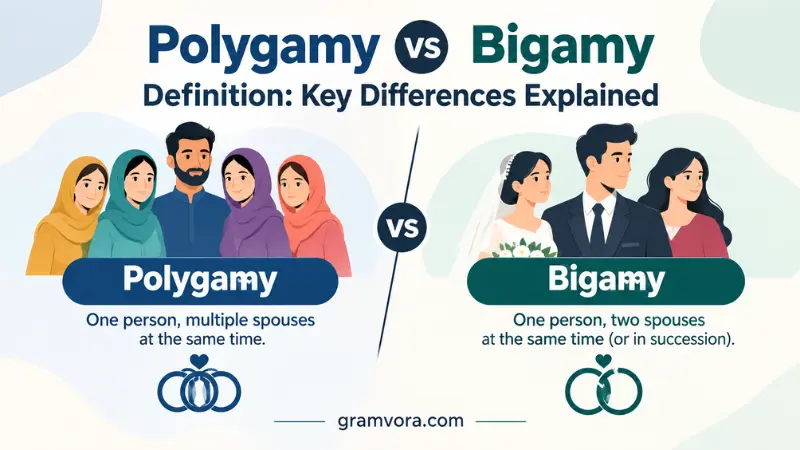
Polygamy and bigamy are closely related words, so they are easy to mix up. Both involve having more than one spouse at the same time, but they do not describe exactly the same thing.
The simplest distinction is this: polygamy describes the practice or condition of having more than one spouse, while bigamy refers specifically to marrying someone while already legally married to another person.
That difference matters because polygamy is mainly a descriptive term for a type of marriage arrangement. Bigamy is much more closely connected with legal marriage status and criminal law.
Quick Answer
If you are describing the practice of having multiple spouses, use polygamy.
If you are describing a person entering a second marriage while the first legal marriage is still active, use bigamy.
For example:
- “The community has a history of polygamy.”
- “He was accused of bigamy after marrying again before his first marriage ended legally.”
So, polygamy and bigamy are related, but they are not interchangeable in every sentence.
Why People Confuse Them
The confusion comes from their shared subject: multiple marriages or spouses.
Both words can involve someone being connected to more than one spouse at the same time. That overlap makes it tempting to use either word whenever multiple marriages are mentioned.
There is an important difference in focus, though.
Polygamy focuses on the marital practice or arrangement. Bigamy focuses on the act of entering a second marriage while another legal marriage remains in effect.
This is why a sentence about a social or marital system may naturally use polygamy, while a sentence about an allegedly unlawful second marriage may call for bigamy.
Key Differences At A Glance
| Feature | Polygamy | Bigamy |
|---|---|---|
| Basic meaning | Having more than one spouse at the same time | Marrying while already legally married |
| Main focus | Marriage practice or condition | Second marriage and existing legal marriage |
| Part of speech | Noun | Noun |
| Common adjective | Polygamous | Bigamous |
| Legal context | Can describe a prohibited multiple-marriage arrangement | Refers specifically to the second-marriage offense |
| Typical phrase | polygamous marriage | bigamous marriage |
The two words can overlap in a situation involving multiple marriages, but their meanings should not be treated as identical.
Meaning and Usage Difference
Polygamy is the broader term. Dictionaries define it as the practice or condition of having more than one spouse at the same time.
For example:
“The article discusses the history of polygamy in different societies.”
Here, the writer is discussing a type of marriage arrangement rather than one specific second marriage.
Bigamy, by contrast, centers on an existing legal marriage. It refers to marrying another person while still legally married to someone else.
For example:
“The second wedding created a possible bigamy issue because the first marriage had not been legally dissolved.”
The words can therefore point to the same general situation from different angles. Polygamy describes the multiple-spouse arrangement. Bigamy identifies the second marriage made while the earlier legal marriage continues.
In U.S. legal writing, this distinction becomes especially important. Bigamy is treated as a legal offense, while polygamy is the broader descriptive term for having multiple spouses.
The exact legal rules, definitions, exceptions, and penalties can vary by jurisdiction, so the vocabulary distinction should not be confused with a complete statement of any particular state’s law.
Tone, Context, and Formality
Both polygamy and bigamy are formal, standard English nouns. Neither is slang.
Their contexts are different, however.
Polygamy commonly appears in discussions of marriage systems, anthropology, religion, history, sociology, and family structures.
Examples include:
- “The study examines polygamy and family structure.”
- “The documentary explores communities that practice polygamy.”
- “Polygamy can refer to a marriage arrangement involving multiple spouses.”
Bigamy is more strongly associated with law and legal marriage status.
Examples include:
- “The court considered whether the marriage constituted bigamy.”
- “The first marriage was still legally active, creating a potential bigamy issue.”
When the focus is on the general arrangement, polygamy usually fits better. When the focus is on an additional marriage entered while an existing legal marriage remains active, bigamy is the more precise term.
Which One Should You Use?
Use polygamy when your sentence is about the practice, custom, or condition of having multiple spouses.
Example:
“The book examines polygamy as a form of marriage.”
Use bigamy when the sentence concerns a second marriage made while another legal marriage is still in effect.
Example:
“She discovered that the man had committed bigamy because he was still legally married.”
A useful way to remember the distinction is:
Polygamy = multiple spouses as a marriage practice.
Bigamy = a second marriage while another legal marriage is still active.
This is not a rule that makes every sentence perfectly predictable, but it provides a reliable starting point for ordinary U.S. English.
When One Choice Sounds Wrong
Some sentences become unclear when the wrong term is chosen.
Consider:
“The defendant was charged with polygamy after marrying someone else while still legally married.”
If the writer is referring specifically to the legal offense of entering a second marriage, bigamy is the more precise word.
A clearer version is:
“The defendant was charged with bigamy after marrying someone else while still legally married.”
Now consider:
“The documentary examines bigamy as a long-standing marriage system.”
That wording can be misleading because bigamy normally focuses on the act of entering a second marriage while an existing legal marriage continues. If the subject is a broader multiple-spouse marriage practice, polygamy is usually more appropriate.
A clearer version is:
“The documentary examines polygamy as a marriage system.”
The key is to identify what the sentence is emphasizing: the multiple-spouse practice or the second marriage while another legal marriage remains active.
Common Mistakes (and Quick Fixes)
Mistake 1: Treating the words as perfect synonyms
Incorrect approach: Using bigamy and polygamy as though they always mean exactly the same thing.
Quick fix: Use polygamy for the broader multiple-spouse practice and bigamy for the specific situation involving a second marriage during an existing legal marriage.
Mistake 2: Using bigamy for every multiple-partner relationship
Having multiple romantic partners does not automatically make a situation bigamy. The word specifically concerns marriage.
Quick fix: Reserve bigamy for a situation involving the relevant marriage status.
Mistake 3: Assuming every polygamous arrangement is described by the word bigamy
The words have overlapping subject matter, but polygamy is the broader term for a multiple-spouse marriage arrangement.
Quick fix: Ask whether the sentence describes the marriage structure or the second legal marriage.
Mistake 4: Assuming the words have the same legal meaning everywhere
Marriage laws are jurisdiction-specific.
Quick fix: For a legal question, check the law of the relevant state or jurisdiction rather than relying only on the dictionary meaning.
Everyday Examples
Here are natural examples showing how the words differ:
Polygamy
- “The class discussed polygamy in different societies.”
- “The documentary focuses on a polygamous family.”
- “The researcher compared monogamy and polygamy.”
- “The book uses polygamy to describe a multiple-spouse marriage system.”
Bigamy
- “The marriage raised questions about possible bigamy.”
- “He could not legally marry again because his first marriage was still active.”
- “The attorney explained the legal meaning of bigamy.”
- “The case involved an alleged bigamous marriage.”
The pattern is consistent: polygamy describes the broader marital practice, while bigamy points to the second marriage made during an existing legal marriage.
Dictionary-Style Word Details
Verb
- Polygamy: Not commonly used as a verb in standard U.S. English. The normal noun is polygamy. A related adjective is polygamous.
- Bigamy: Not commonly used as a verb in standard U.S. English. The normal noun is bigamy. A related adjective is bigamous.
Noun
- Polygamy: A noun meaning the practice or condition of having more than one spouse at the same time.
- Bigamy: A noun referring to the act or offense of marrying someone while already legally married to another person.
Both are generally used as uncountable nouns when referring to the concepts themselves.
Synonyms
Exact synonyms are limited because the two words carry different meanings.
- Polygamy: Closest plain alternatives include “multiple-spouse marriage” or “having multiple spouses,” depending on the sentence.
- Bigamy: Closest plain alternatives include “marrying while already married” or “a second marriage during an existing legal marriage.”
These alternatives explain the meaning but do not always function as direct replacements.
Example Sentences
- Polygamy: “The article explains how polygamy differs from monogamous marriage.”
- Polygamy: “The researcher studied polygamous marriage structures.”
- Bigamy: “The second wedding raised a question of bigamy.”
- Bigamy: “The first marriage had not ended legally, so the second marriage was described as bigamous.”
Word History
Polygamy entered English through French and Late Latin from Greek roots associated with having many marriages. Oxford dates the English word to the late 16th century.
Bigamy comes through Middle English and Old French from Latin and Greek elements associated with being married twice. Oxford identifies bi- as meaning “twice” and -gamos as relating to marriage.
The shared marriage-related element helps explain why the two words are often confused, but their modern meanings remain distinct.
Phrases Containing
Common expressions with polygamy include:
- practice of polygamy
- polygamy and marriage
- polygamous marriage
- polygamous family
- polygamous society
Common expressions with bigamy include:
- commit bigamy
- charged with bigamy
- accused of bigamy
- bigamy law
- bigamous marriage
- bigamous relationship
FAQs
Polygamy is the practice or condition of having more than one spouse at the same time. Bigamy specifically refers to marrying another person while already legally married to someone else. The terms overlap, but they are not exact synonyms.
The two concepts can overlap, but they emphasize different things. Polygamy describes a multiple-spouse marriage arrangement, while bigamy focuses on entering a second marriage while an existing legal marriage remains in effect.
Bigamy means marrying someone while you are still legally married to another person. The word is commonly associated with the legal consequences of entering a second marriage before the first marriage has been legally ended.
Polygamy means having more than one spouse at the same time. It is generally used to describe a type of marriage arrangement or practice rather than one specific marriage event.
No. Although both terms can involve multiple spouses, they have different focuses. Polygamy describes the broader marriage practice, while bigamy describes the act of entering another marriage while already legally married.
Yes. Bigamy is closely connected with legal marriage status. The exact definition, exceptions, and consequences depend on the applicable jurisdiction, so specific legal questions should be checked under the relevant state or local law.
Yes, when their meanings are being distinguished. For example: “The discussion compares polygamy as a marriage practice with bigamy as the act of entering another marriage while already legally married.”
A bigamous marriage is a marriage entered into by someone who is still legally married to another person. The precise legal treatment can vary depending on the jurisdiction and circumstances.
Conclusion
Polygamy and bigamy are related terms, but they serve different purposes.
Polygamy describes the practice or condition of having more than one spouse at the same time. Bigamy specifically refers to marrying someone while already legally married to another person.
When discussing a broader marriage structure, polygamy is generally the appropriate choice. When describing a second marriage entered while an existing legal marriage remains active, bigamy is the more precise term.
Remember the short distinction: polygamy describes the multiple-spouse practice; bigamy focuses on the second marriage while a legal marriage is still in effect.


