Both immediate family and extended family are correct phrases in American English. The difference is the size and closeness of the family group they describe.
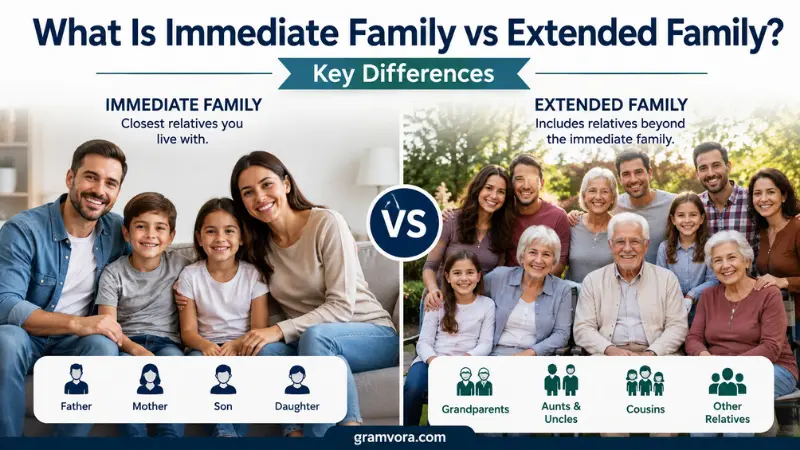
Immediate family usually refers to your closest family members, such as your parents, siblings, spouse, and children.
Extended family refers to relatives beyond that closer circle, such as grandparents, aunts, uncles, cousins, nieces, and nephews.
The boundary is not completely fixed. A workplace policy, law, benefit plan, or other formal rule may define family members differently. In ordinary conversation, however, the distinction is usually straightforward.
Quick Answer
Use immediate family when you mean your closest family group.
Use extended family when you mean the wider group of relatives beyond that core group.
For example:
- “My immediate family is coming to dinner.”
- “My extended family is coming for Thanksgiving.”
In the first sentence, the speaker is focusing on the closest family circle. In the second, the speaker means a larger group that can include relatives such as grandparents, aunts, uncles, and cousins.
So, if you are asking “Which is correct?”, the answer is: both are correct, but they are not normally interchangeable.
Why People Confuse Them
The two phrases overlap because there is no single everyday list that every speaker uses in exactly the same way.
For example, parents, children, spouses, and siblings are commonly treated as immediate family. Grandparents, aunts, uncles, and cousins are normally treated as extended family.
Some relationships are less clear. A person may consider a grandparent or in-law part of their closest family circle. A specific employer policy may also include that person in its definition of immediate family.
Living arrangements can also cause confusion. An aunt who lives with you is still normally described as an aunt and may still be considered part of your extended family. Sharing a home does not automatically change the usual meaning of the phrase.
The key is to distinguish ordinary usage from a special definition created for a particular situation.
Key Differences At A Glance
| Feature | Immediate family | Extended family |
|---|---|---|
| Basic idea | Closest family circle | Wider family circle |
| Common examples | Parents, siblings, spouse, children | Grandparents, aunts, uncles, cousins, nieces, nephews |
| Scope | Narrower | Broader |
| Household required? | No | No |
| Fixed in every context? | No | No |
| Common in US English? | Yes | Yes |
The easiest way to remember the difference is closest circle vs. wider circle.
Meaning and Usage Difference
Immediate family focuses on the relatives who are generally closest to you in ordinary family terminology. Merriam-Webster defines the phrase using parents, brothers and sisters, spouse, and children, while Cambridge also identifies these relationships as examples of close family. The exact boundary can vary by context.
Extended family goes beyond that close group. It commonly includes grandparents, aunts, uncles, cousins, and other relatives.
Consider these examples:
“Only immediate family attended the small ceremony.”
This suggests a limited group of close relatives.
“Our extended family meets every summer.”
This suggests a larger gathering involving relatives beyond the closest family circle.
Neither phrase necessarily tells you where the people live. Immediate family members may live in another state, while extended family members may live in the same house.
A useful distinction
Immediate family = closer family group
Extended family = family beyond that closer group
That distinction works well in everyday American English without requiring a strict family tree.
Tone, Context, and Formality
Both phrases are neutral and natural. Neither is unusually formal or informal.
Immediate family is especially common when the speaker needs to distinguish close relatives from other relatives. You may hear it when discussing weddings, funerals, family emergencies, travel, invitations, or workplace policies.
Extended family is common when talking about larger family gatherings, holidays, family relationships, or relatives who live outside the immediate household.
For example:
- “We’re keeping the wedding small and inviting immediate family.”
- “We’re spending Christmas with our extended family.”
- “She called her immediate family after the news.”
- “His extended family lives across several states.”
One important point is that formal policies can define these phrases differently. If a company handbook says exactly who qualifies as immediate family for a benefit, that written definition controls that situation.
Which One Should You Use?
Choose the phrase based on the family group you mean.
| Context | Best Choice | Why |
|---|---|---|
| Talking about your parents and children | Immediate family | They are normally part of the closest family group. |
| Talking about your spouse | Immediate family | A spouse is commonly included. |
| Talking about your brothers and sisters | Immediate family | Siblings are commonly included. |
| Talking about your cousins | Extended family | Cousins normally belong to the wider family circle. |
| Talking about your aunts and uncles | Extended family | They are normally outside the closest group. |
| Talking about a large family reunion | Extended family | The phrase naturally covers the wider family network. |
| Referring to a company benefit | Check the written definition | The policy may use its own definition. |
If you are simply describing your relatives in conversation, the ordinary distinction is usually enough.
When One Choice Sounds Wrong
Some choices can sound unnatural because the phrase does not match the relationship being described.
Less natural
“My cousins are my immediate family.”
More natural
“My cousins are part of my extended family.”
Cousins are normally understood as part of the wider family group.
Another example:
Less natural
“My aunt is my immediate family.”
More natural
“My aunt is part of my extended family.”
Again, this reflects ordinary usage, not a statement about how emotionally close you are to your aunt.
A person can be extremely close to a cousin or aunt and still describe that relative as extended family.
The reverse can also happen in formal settings. A particular policy may place a grandparent, in-law, or step-relative within its definition of immediate family. In that case, follow the definition being used.
Common Mistakes (and Quick Fixes)
Mistake 1: Treating immediate family as only people who live with you
Living together is not required. Your parents or children can live in another state and still be part of your immediate family.
Mistake 2: Assuming extended family means distant relatives only
Extended family can include relatively close relatives, such as grandparents, aunts, uncles, and cousins.
Mistake 3: Thinking the terms describe emotional closeness
They usually describe the type or scope of the family relationship, not how much affection people have for one another.
Mistake 4: Assuming every formal definition is identical
A company, organization, or government rule may define immediate family differently for a specific purpose.
Mistake 5: Using “extended family” for parents or children
In ordinary usage, parents and children are normally part of the immediate family.
Everyday Examples
Here are natural examples in American English:
- “My immediate family lives in Ohio.”
- “We’re inviting only immediate family to the dinner.”
- “My sister is part of my immediate family.”
- “My grandparents are part of my extended family.”
- “Our extended family gets together every summer.”
- “I have cousins all over the country, so my extended family is pretty large.”
- “She stayed with her extended family during the holidays.”
- “His parents and children are his immediate family.”
- “Her aunts and uncles came to the family reunion.”
- “The form asks whether an immediate family member is attending.”
Notice that immediate and extended describe the scope of the family group. They do not necessarily describe where relatives live or how often you see them.
Dictionary-Style Word Details
Verb
- Immediate family: Not commonly used as a verb. It is a noun phrase.
- Extended family: Not commonly used as a verb. It is also a noun phrase.
The words immediate and extended can have other grammatical functions in English, but the full phrases immediate family and extended family function as noun phrases.
Noun
- Immediate family: A person’s closest family members, commonly including parents, siblings, spouse, and children.
- Extended family: A broader family group that goes beyond the closest family circle and commonly includes grandparents, aunts, uncles, cousins, and other relatives.
Both phrases can function as the subject or object of a sentence:
- “My immediate family lives nearby.”
- “We visited our extended family.”
Synonyms
The two phrases do not have exact one-word synonyms that work in every situation.
- Immediate family: Closest family, close family members, or close relatives can work as closest plain alternatives, depending on the sentence.
- Extended family: Wider family, wider family group, or other relatives can work as closest plain alternatives, depending on context.
These alternatives are not necessarily exact replacements in every sentence.
Example Sentences
Immediate family:
- “My immediate family supported me during the move.”
- “Only immediate family members attended the private gathering.”
- “She called her immediate family first.”
Extended family:
- “Our extended family meets every Thanksgiving.”
- “He stays in touch with his extended family.”
- “Several members of her extended family traveled for the wedding.”
Word History
The two phrases are built from ordinary English words.
Immediate has a long history as an adjective meaning something close, direct, or nearest in relationship. Merriam-Webster records the family sense under the idea of being next in relation.
Extended comes from the idea of something being made broader or longer. In extended family, the word describes a family group that extends beyond the closest family circle.
The important point for modern usage is the meaning of the complete phrases, not a supposed historical rule separating every type of relative.
Phrases Containing
Common phrases include:
- immediate family member
- immediate family members
- close immediate family
- extended family member
- extended family members
- immediate and extended family
- immediate family and extended family
- large extended family
These phrases are especially common when speakers need to distinguish a close family group from a broader group of relatives.
FAQs
What is the difference between immediate family and extended family?
Immediate family usually means your closest family members, such as your parents, siblings, spouse, and children. Extended family refers to relatives beyond that closer circle, such as grandparents, aunts, uncles, and cousins.
Who is considered immediate family?
In everyday American English, immediate family commonly includes your parents, siblings, spouse, and children. The exact definition can vary in legal, workplace, or organizational settings.
Who is considered extended family?
Extended family generally includes relatives outside your closest family circle. Common examples include grandparents, aunts, uncles, cousins, nieces, and nephews.
Are grandparents immediate or extended family?
Grandparents are generally considered extended family in everyday American English. However, a specific policy or organization may define immediate family differently.
Are cousins immediate or extended family?
Cousins are generally considered extended family. They are usually outside the closest family group described as immediate family.
Are siblings immediate family?
Yes. Siblings are commonly considered part of your immediate family in American English.
Are aunts and uncles immediate family?
Aunts and uncles are generally considered extended family. They are normally outside the closest family circle.
Does immediate family mean people who live in the same house?
No. Immediate family does not necessarily mean people who live together. A parent, spouse, child, or sibling can live somewhere else and still be considered immediate family.
Conclusion
Immediate family and extended family are both correct, but they describe different family circles.
Use immediate family for the closest group, commonly including parents, siblings, spouses, and children.
Use extended family for relatives beyond that group, commonly including grandparents, aunts, uncles, cousins, nieces, and nephews.
The boundary can change in a specific legal, workplace, or organizational context, so check the applicable definition when the distinction has formal consequences.
For everyday American English, the simplest rule is clear: immediate family means the closer family circle; extended family means the wider family circle.