
Cousin once removed and second cousin are both correct family-relationship terms, but they do not describe the same thing.
The key difference is that second cousin identifies a specific cousin degree, while once removed identifies a one-generation difference.
There is also an important detail: “cousin once removed” is a broader phrase. By itself, it does not tell you whether the person is a first cousin, second cousin, third cousin, or another cousin degree once removed.
Quick Answer
Use second cousin when two people are in the same generation and share great-grandparents.
Use cousin once removed when the two relatives are one generation apart. For a precise relationship, the cousin degree should normally be included, such as first cousin once removed or second cousin once removed.
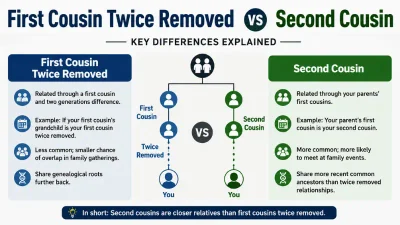
For example, your first cousin’s child is your first cousin once removed, not your second cousin.
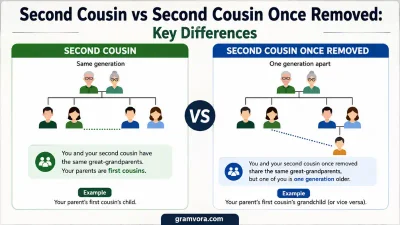
Your parent’s second cousin is your second cousin once removed, not simply your second cousin.
So, “once removed” measures the generation gap, while “second” identifies the cousin degree.
Why People Confuse Them
The confusion comes from the fact that both relationships describe relatives who are farther from you than a first cousin.
The word second can sound as if it simply means “one step farther away.” But cousin numbers and removals measure different things.
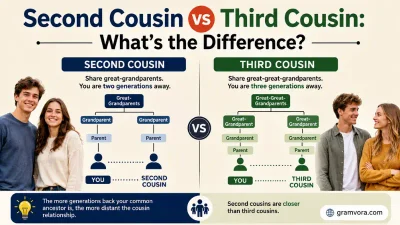
A second cousin is on the same generational level as you. You and that person share great-grandparents.
The phrase once removed means that you and the cousin are one generation apart. It can describe a first cousin, second cousin, third cousin, or another cousin degree.
That is why the phrase cousin once removed is incomplete when you need the most precise family relationship.
Key Differences At A Glance
| Context | Best Choice | Why |
|---|---|---|
| Same generation; shared great-grandparents | Second cousin | “Second” identifies the cousin degree |
| One generation apart from a first-cousin relationship | First cousin once removed | “Once removed” marks the one-generation gap |
| One generation apart from a second-cousin relationship | Second cousin once removed | The cousin degree remains second |
| General reference when the exact cousin degree is not stated | Cousin once removed | The phrase signals a one-generation gap but leaves the degree unspecified |
Quick comparison:
- Cousin once removed: one generation apart; the exact cousin degree may be unspecified.
- Second cousin: same generation; shared great-grandparents.
- Second cousin once removed: second-cousin relationship plus a one-generation gap.
Meaning and Usage Difference
A second cousin is a specific relationship.
Imagine two people whose parents are first cousins. Those two people are second cousins. They share the same great-grandparents but have different grandparents.
The term cousin once removed works differently. “Once removed” tells you that the two people are separated by one generation.
For instance, suppose Sarah and Mike are first cousins. Sarah has a son, David. David and Mike are first cousins once removed.
Now suppose Mike has a daughter, Emma. David and Emma are second cousins. They are in the same generation and share great-grandparents.
This shows why second cousin and once removed cannot simply be treated as two competing names.
The cousin number tells you the degree of the cousin relationship. The word removed tells you about the generation difference.
Tone, Context, and Formality
Neither term is inherently more formal or informal than the other.
Both are standard family-relationship expressions, especially when discussing genealogy, family trees, ancestry, or detailed family connections.
In everyday conversation, people often shorten complicated relationships and simply say cousin.
For example, someone might introduce a distant relative by saying, “She’s my cousin,” without explaining whether the relationship is a second cousin or a cousin once removed.
When precision matters, however, the full relationship is clearer.
A family-history record might need second cousin once removed, while a casual family gathering may only require cousin.
Which One Should You Use?
Choose second cousin if the relative is in your generation and your shared ancestors are great-grandparents.
Choose cousin once removed when the relative is one generation above or below you in the relevant cousin relationship.
For maximum accuracy, include the cousin degree before “once removed.”
So instead of saying only:
“She’s my cousin once removed.”
you can say:
“She’s my first cousin once removed.”
or:
“He’s my second cousin once removed.”
The correct degree depends on the family tree.
When One Choice Sounds Wrong
Calling a second cousin once removed can be misleading if the two people are actually in the same generation.
Likewise, calling a cousin’s child a second cousin is not automatically correct.
For example, your first cousin’s child is your first cousin once removed. That child is one generation below you.
The child of your second cousin is your second cousin once removed.
Your own child and your second cousin’s child, however, are third cousins because they are in the same generation and their shared ancestors are one generation farther back.
The safest approach is to identify the shared ancestor and then compare each person’s generation.
Common Mistakes (and Quick Fixes)
Mistake 1: Treating “once removed” as another cousin number
“Once removed” does not replace first, second, or third. It describes the generation difference.
Fix: Think of the two parts separately: cousin degree + generation gap.
Mistake 2: Calling your first cousin’s child your second cousin
Your first cousin’s child is your first cousin once removed.
Fix: A cousin’s child is not automatically the next cousin degree.
Mistake 3: Assuming “removed” means emotionally distant
It does not mean that you are less close to the relative.
Fix: In family terminology, “once removed” refers to a one-generation difference.
Mistake 4: Using “cousin once removed” when a precise label is available
The shorter phrase can be understood, but it does not identify the cousin degree.
Fix: Say first cousin once removed, second cousin once removed, or the appropriate degree.
Everyday Examples
Example 1: Your first cousin’s child
Your cousin Maria has a daughter named Ava. You and Maria are first cousins.
Ava is your first cousin once removed.
Example 2: Your parent’s second cousin
Your father has a second cousin named James.
James is your second cousin once removed because he is one generation above you.
Example 3: Your second cousin
You and Olivia share the same great-grandparents, and you are in the same generation.
Olivia is your second cousin.
Example 4: Two children of first cousins
Your mother and another person’s mother are first cousins. You and that person’s child are in the same generation.
You are second cousins.
Example 5: A second cousin’s child
You and Ben are second cousins. Ben has a son, Noah.
Noah is your second cousin once removed.
These examples show why the two labels should not be swapped simply because both describe extended family relationships.
Dictionary-Style Word Details
Verb
- Cousin once removed: Not used as a verb. It is a family-relationship noun phrase.
- Second cousin: Not used as a verb. It is also a family-relationship noun phrase.
The word removed has a separate grammatical life as an adjective in English, but in the family expression it helps identify a generational relationship.
Noun
- Cousin once removed: A noun phrase referring to a cousin who is one generation above or below the person being discussed. The exact cousin degree may be left unstated.
- Second cousin: A noun phrase identifying a specific cousin relationship involving shared great-grandparents in the standard genealogical system.
The plural forms are cousins once removed and second cousins.
Synonyms
There are no exact one-word synonyms for either relationship.
- Cousin once removed: Closest plain alternative: a cousin from a different generation, although this is an explanation rather than an exact replacement.
- Second cousin: Closest plain alternative: a relative who shares great-grandparents with you, although this is also a description rather than a true synonym.
Because these terms identify specific family relationships, replacing them with a general word such as relative loses important information.
Example Sentences
- Cousin once removed: “My aunt’s cousin is my cousin once removed.”
- Second cousin: “My second cousin and I share the same great-grandparents.”
- Cousin once removed: “Her first cousin once removed lives in another state.”
- Second cousin: “I met my second cousin at our family reunion.”
Word History
The terminology combines the ordinary noun cousin with words that describe the degree and generation of the relationship.
Cousin is an established English family term with roots going back to Middle English. Second cousin is also a long-established expression. In family terminology, removed developed the specific sense of indicating a difference in generation.
The important point for modern usage is the structure of the terms: the cousin number identifies the relationship degree, while once removed identifies a one-generation difference.
Phrases Containing
- Cousin once removed: Common precise forms include first cousin once removed, second cousin once removed, and third cousin once removed.
- Second cousin: Common related forms include second cousin once removed and second cousin twice removed.
The added number before cousin tells you the cousin degree. The word once or twice tells you how many generations separate the two people.
FAQs
1. Is a cousin once removed the same as a second cousin?
No. A second cousin is generally in the same generation as you and shares great-grandparents with you. “Once removed” means the two relatives are one generation apart.
2. What is the difference between a cousin once removed and a second cousin?
A second cousin describes the degree of the cousin relationship. Once removed describes a one-generation difference between two relatives.
3. Is my first cousin’s child my second cousin?
No. Your first cousin’s child is your first cousin once removed. The relationship is not automatically upgraded to second cousin.
4. Is my parent’s cousin my cousin once removed?
Yes. Your parent’s first cousin is your first cousin once removed because that person is one generation above you.
5. Who is considered a second cousin?
Your second cousin is someone who shares your great-grandparents with you but is generally in the same generation. Your parents and their parents determine the relationship.
6. What does “once removed” mean in a family relationship?
“Once removed” means there is a one-generation difference between two relatives. It can apply to first cousins, second cousins, third cousins, and so on.
7. Is my second cousin’s child my second cousin once removed?
Yes. Your second cousin’s child is your second cousin once removed because the child is one generation below your second cousin.
8. Are second cousins closer than cousins once removed?
Not necessarily. These terms measure different aspects of a family relationship. “Second” identifies cousin degree, while “once removed” identifies a generation difference.
9. Can someone be both a second cousin and a cousin once removed?
Yes, if the precise relationship is second cousin once removed. This means the person is your second cousin by degree and one generation apart from you.
10. How can I remember the difference between second cousin and once removed?
Remember this simple rule: the cousin number tells you the degree, while “removed” tells you the generation gap. A second cousin is usually in your generation; a cousin once removed is one generation above or below you.
Conclusion
Cousin once removed and second cousin are not interchangeable terms.
A second cousin is a specific cousin relationship in the same generation, normally involving shared great-grandparents.
Cousin once removed describes a cousin relationship in which the two people are one generation apart. Because the phrase does not state the cousin degree, a more precise form is usually better.
The easiest way to remember the difference is:
Cousin number = relationship degree.
Removed = generation difference.
So, when you know the exact family connection, use the full label that matches it.