
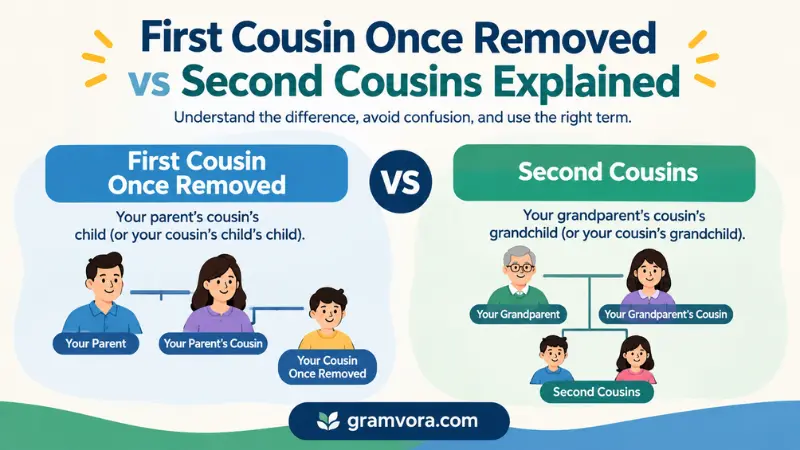
First cousin once removed and second cousins are not the same relationship.
The easiest way to tell them apart is to look at two things: the cousin level and the generation gap.
A first cousin once removed is a first-cousin relationship with a one-generation difference. A second cousin is a cousin relationship involving shared great-grandparents, normally between people in the same generation.
That difference explains why your cousin’s child can be your first cousin once removed, while another relative from your generation can be your second cousin.
Quick Answer
If you’re wondering which term is correct, both are correct, but they describe different family relationships.
- First cousin once removed: You and the other person are one generation apart from a first-cousin relationship.
- Second cousins: You and the other person are in the same generation and share great-grandparents.
For example, your first cousin’s child is your first cousin once removed. Your parent’s cousin’s child can be your second cousin.
So, “once removed” does not mean “second cousin.” It describes a generation difference.
Why People Confuse Them
The confusion comes from the word removed.
In ordinary English, “removed” can sound like something is farther away. In family terminology, however, it refers to a generation difference. “Once removed” means one generation apart.
The number before “cousin” tells you the cousin relationship. The word “removed” tells you that the people are not in the same generation.
That creates an important distinction:
- First cousin = same generation, shared grandparents.
- First cousin once removed = one generation apart from that first-cousin relationship.
- Second cousins = same generation, shared great-grandparents.
Once you separate those two ideas, the terminology becomes much easier.
Key Differences At A Glance
| Context | Best Choice | Why |
|---|---|---|
| Your cousin’s child | First cousin once removed | The child is one generation below your first cousin |
| Your parent’s first cousin | First cousin once removed | Your parent’s cousin is one generation above you |
| Child of your parent’s first cousin | Second cousin | You are in the same generation and share great-grandparents |
| Two relatives who share great-grandparents and are in the same generation | Second cousins | The cousin level is based on the shared ancestor |
| Two first cousins separated by one generation | First cousin once removed | “Once removed” marks the one-generation difference |
The key is not simply how closely related the people feel. It is how their family-tree positions line up.
A Simple Comparison
| Feature | First cousin once removed | Second cousins |
|---|---|---|
| Basic relationship | First-cousin relationship with a one-generation difference | Same-generation cousin relationship |
| Typical shared ancestor | Grandparents of the first-cousin pair | Great-grandparents |
| Generation difference | One generation | Usually none |
| Common example | Your first cousin’s child | Your parent’s first cousin’s child |
| “Removed” involved? | Yes | No |
Meaning and Usage Difference
The most important difference is generation.
A first cousin once removed can occur in either direction. If your first cousin has a child, that child is your first cousin once removed. If your parent has a first cousin, that person is also your first cousin once removed.
Second cousins work differently.
Second cousins normally occupy the same generation. They share great-grandparents, while their parents are first cousins. Merriam-Webster defines a second cousin as the child of one’s parent’s first cousin.
A useful way to remember the distinction is:
“First cousin once removed” = cousin level + generation difference.
“Second cousins” = a different cousin level, normally without a generation difference.
This is why calling your cousin’s child a “second cousin” is technically incorrect in standard genealogical terminology. The child is your first cousin once removed.
Tone, Context, and Formality
Both expressions are standard family-relationship terms. Neither is inherently casual or formal.
You might use first cousin once removed when discussing a family tree, genealogy, ancestry, or a complicated family connection.
For example:
“My grandmother’s cousin’s daughter is my first cousin once removed.”
In everyday conversation, people may simply say “my cousin” because the precise relationship can be difficult to explain. But when accuracy matters, the full term is useful.
Second cousins is also a normal noun phrase:
“I met some of my second cousins at the family reunion.”
The terminology is especially useful when several generations are being discussed and “cousin” by itself is too vague.
Which One Should You Use?
Use first cousin once removed when the person is one generation above or below you in a first-cousin relationship.
Use second cousins when you and the other people are in the same generation and your closest shared ancestors for the cousin relationship are great-grandparents.
A quick family-tree test helps:
- Find the common ancestor.
- Check each person’s generation relative to that ancestor.
- Determine the cousin level.
- Check whether the two people are in different generations.
If the relationship is first-cousin level but the people are one generation apart, first cousin once removed is the appropriate term.
If they are second cousins in the same generation, use second cousins.
When One Choice Sounds Wrong
Some common statements sound reasonable but use the wrong relationship label.
Incorrect: “My cousin’s daughter is my second cousin.”
Better: “My cousin’s daughter is my first cousin once removed.”
The problem is that the daughter has moved down one generation from your first cousin.
Another common mistake is calling your parent’s cousin a second cousin.
Incorrect: “My mom’s cousin is my second cousin.”
Better: “My mom’s cousin is my first cousin once removed.”
The generational difference is what makes the relationship “once removed.”
By contrast, the child of your parent’s first cousin is in your generation. That person is your second cousin.
Common Mistakes (and Quick Fixes)
Mistake 1: Thinking “once removed” means “more distant”
It does not simply mean a more distant cousin. It identifies a one-generation difference.
Fix: Read “once removed” as “one generation apart.”
Mistake 2: Calling your cousin’s child your second cousin
That skips the generational relationship.
Fix: Your first cousin’s child is your first cousin once removed.
Mistake 3: Calling your parent’s cousin your second cousin
Your parent’s cousin belongs to your parent’s generation.
Fix: Your parent’s first cousin is your first cousin once removed.
Mistake 4: Assuming all cousins in the same branch have the same label
Family relationships depend on both the shared ancestor and the generations of the people involved.
Fix: Identify the common ancestor first, then compare generations.
Everyday Examples
Here are some realistic examples using familiar family situations.
Example 1: Your cousin has a baby
Your cousin Jenna is your first cousin. Jenna has a daughter named Maya.
Maya is your first cousin once removed.
You and Jenna are in the same generation. Maya is one generation below you.
Example 2: Your mother has a cousin
Your mom’s cousin, Robert, is from your mom’s generation.
Robert is your first cousin once removed.
The “once removed” part identifies the one-generation difference between you and Robert.
Example 3: Your parent’s cousin has a child
Your dad’s first cousin has a son named Daniel.
You and Daniel are in the same generation. Your shared family line goes back to your great-grandparents.
Daniel is your second cousin.
Example 4: Two relatives meet at a reunion
You meet someone who turns out to be your second cousin. You discover that your great-grandparents were siblings.
Because you and that person are in the same generation, second cousin is the appropriate label.
Example 5: A family-tree discussion
Someone says, “She is my cousin, but she’s one generation above me.”
If the underlying relationship is first-cousin level, the precise term is first cousin once removed.
Dictionary-Style Word Details
Verb
- First cousin once removed: Not a verb. It is a noun phrase naming a family relationship.
- Second cousins: Not a verb. It is the plural noun form of second cousin.
Neither term functions as a verb in standard US English.
Noun
- First cousin once removed: A noun phrase describing a person who is one generation above or below you in a first-cousin relationship.
- Second cousins: The plural noun phrase for people who are second cousins. A second cousin is generally the child of a parent’s first cousin and shares great-grandparents with you.
Singular: second cousin
Plural: second cousins
The phrase first cousin once removed can refer to either person in the two-way relationship. Your first cousin’s child is your first cousin once removed, and you are that person’s first cousin once removed as well.
Synonyms
There are no exact everyday synonyms for either relationship.
- First cousin once removed: The closest plain alternative is “my cousin’s child” or “my parent’s first cousin,” depending on the direction of the relationship.
- Second cousins: The closest plain alternative is “children of our parents’ first cousins,” when that description accurately fits the family tree.
These alternatives explain the relationship but do not replace the standard relationship terms in precise family-tree language.
Example Sentences
First cousin once removed
- “My cousin’s son is my first cousin once removed.”
- “My dad’s first cousin is my first cousin once removed.”
- “I met my first cousin once removed at our family reunion.”
Second cousins
- “We discovered that we are second cousins.”
- “My second cousins live in another state.”
- “She invited several second cousins to the wedding.”
Word History
The individual words cousin, once, and removed have long histories in English, but the useful point for this comparison is the modern relationship system.
Merriam-Webster records second cousin as dating to the 17th century. The dictionary also specifically uses removed for relationships involving a younger or older generation.
There is no need to treat “once removed” as a separate type of cousin. It is a relationship label that adds generation information to the cousin relationship.
Phrases Containing
Common phrases include:
- first cousin once removed
- first cousin twice removed
- second cousin
- second cousins
- second cousin once removed
- second cousin twice removed
The pattern is consistent: the cousin number identifies the cousin level, while once removed or twice removed identifies the generation difference.
FAQs
Is a first cousin once removed the same as a second cousin?
No. A first cousin once removed is one generation above or below you in a first-cousin relationship. A second cousin is generally in your generation and shares great-grandparents with you.
Is my cousin’s child my first cousin once removed?
Yes. Your first cousin’s child is your first cousin once removed because the child is one generation below your first cousin.
Is my mom’s cousin my first cousin once removed?
Yes. Your mother’s first cousin is your first cousin once removed because that person is one generation above you.
Are second cousins in the same generation?
Usually, yes. Second cousins normally belong to the same generation and share great-grandparents.
Do first cousins once removed share grandparents?
They can. For example, you and your first cousin share grandparents, while your first cousin’s child is one generation below you.
Do second cousins share great-grandparents?
Yes. Second cousins generally have the same great-grandparents.
Which is closer, a first cousin once removed or a second cousin?
A first cousin once removed is generally the closer relationship. The exact genetic relationship can vary in real families, but the relationship labels are based on family-tree positions.
What does “once removed” mean?
“Once removed” means that two relatives are one generation apart. It does not simply mean that they are more distant cousins.
Is my dad’s first cousin my second cousin?
No. Your dad’s first cousin is your first cousin once removed because that person is one generation above you.
Is my parent’s cousin’s child my second cousin?
Yes, assuming the parent and their cousin are first cousins. You and that cousin’s child are generally second cousins because you are in the same generation.
Can first cousins once removed be older or younger?
Yes. A first cousin once removed can be older or younger than you. The term refers to the generation difference, not simply the person’s age.
What is the easiest way to remember the difference?
Remember: the cousin number identifies the relationship level, while “removed” identifies the generation gap. A first cousin once removed has a one-generation difference; second cousins are normally in the same generation.
Conclusion
First cousin once removed and second cousins describe different relationships.
A first cousin once removed is one generation above or below you in a first-cousin relationship. Your first cousin’s child and your parent’s first cousin are common examples.
Second cousins are normally in your generation and share great-grandparents.
The simplest rule is:
“Cousin” number tells you the relationship level; “removed” tells you the generation gap.
So if you’re choosing between first cousin once removed vs second cousins, identify the shared ancestor and then check whether the two people are in the same generation.


