

First cousin twice removed and second cousin are not the same relationship.
The confusion comes from the word cousin. Both terms describe relatives connected through a shared family line, but they measure different things.
The key is to separate cousin degree from generation difference. A first cousin twice removed is on the first-cousin line but two generations away. A second cousin is on the second-cousin line and is normally in your same generation.
Quick Answer
First cousin twice removed is correct when someone is two generations above or below you on your first-cousin line.
For example, your grandparent’s first cousin is your first cousin twice removed. So is your first cousin’s grandchild.
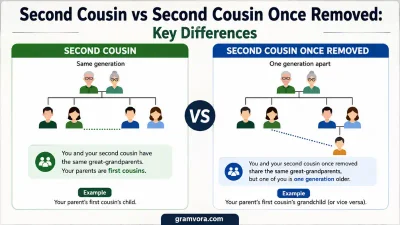
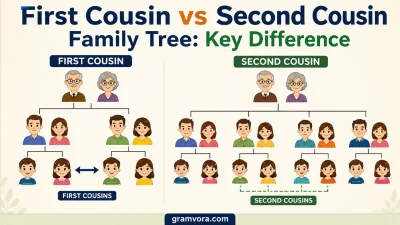
A second cousin is someone who shares your great-grandparents and is in the same generation as you.
So, if you’re asking which term is correct, neither is a substitute for the other. The correct term depends on how the two people connect in the family tree.
Why People Confuse Them
The word first or second describes the cousin relationship. The word removed describes a generation gap.
That creates two separate questions:
- How closely do the two people connect through their shared ancestors?
- Are they in the same generation?
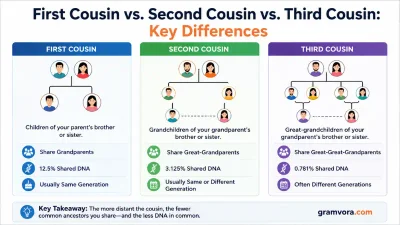
A second cousin has the same generation position as you when using the standard relationship. You share great-grandparents.
A first cousin twice removed has a two-generation difference. The relationship can run upward or downward.
For example, your grandfather’s first cousin is two generations above you. That makes this person your first cousin twice removed.
Your first cousin’s grandchild is two generations below you. That person is also your first cousin twice removed.
Key Differences At A Glance
| Feature | First Cousin Twice Removed | Second Cousin |
|---|---|---|
| Cousin degree | First cousin | Second cousin |
| Generation difference | Two generations | Normally none |
| Typical shared ancestors | Great-great-grandparents | Great-grandparents |
| Example | Grandparent’s first cousin | Child of your parent’s first cousin |
| Direction | Two generations older or younger | Same generation |
| “Removed” needed? | Yes | No |
The easiest way to remember the difference is:
First cousin twice removed = first-cousin line + two-generation gap.
Second cousin = second-cousin line + same generation.
Meaning and Usage Difference
First cousin twice removed combines two pieces of information.
“First cousin” identifies the cousin degree. “Twice removed” tells you that the two relatives are separated by two generations.
Imagine your grandmother has a first cousin. That person is your grandmother’s cousin, so the relationship to you moves two generations away from the first-cousin relationship.
The same principle works in the other direction. Your first cousin’s grandchild is two generations below your first cousin, making that child your first cousin twice removed.
A second cousin, by contrast, is normally someone from your own generation who shares your great-grandparents.
Your parents and your second cousin’s parents are first cousins. You and that person’s child are therefore second cousins.
The terms are therefore not interchangeable.
Tone, Context, and Formality
Both expressions are standard family-relationship terms, but they are much more common in genealogy and family-history discussions than in everyday conversation.
In casual conversation, someone might simply say:
“She’s a cousin from my grandmother’s side.”
When the exact relationship matters, first cousin twice removed gives much more information.
Second cousin is shorter and easier to use when describing someone from the same generation who shares your great-grandparents.
Neither expression is especially formal in tone. The difference is mainly precision, not politeness.
Which One Should You Use?
Use first cousin twice removed when:
- The person is your first cousin’s grandchild.
- The person is your grandparent’s first cousin.
- You and the relative are two generations apart on the first-cousin line.
Use second cousin when:
- You and the person share great-grandparents.
- You are in the same generation.
- Your parents and the other person’s parents are first cousins.
A quick family-tree check can prevent most mistakes: identify the closest shared ancestors first, then compare each person’s generation.
When One Choice Sounds Wrong
Calling your first cousin’s grandchild your second cousin is a common mistake.
That person is two generations below your first cousin. The cousin degree does not automatically increase just because another generation has been added on one branch.
Likewise, calling your grandparent’s first cousin your second cousin misses the generation difference.
The word removed is important because it tells you that the two people are not in the same generation.
A second cousin is also not simply a “more distant first cousin.” It represents a different cousin degree based on the shared ancestors.
Common Mistakes (and Quick Fixes)
Mistake: “My first cousin’s grandchild is my second cousin.”
Fix: That person is your first cousin twice removed.
Mistake: “My grandmother’s cousin is my second cousin.”
Fix: If your grandmother and that person are first cousins, that person is your first cousin twice removed.
Mistake: “Twice removed means we are twice as distant.”
Fix: “Twice removed” refers to the two-generation difference, not a general measure of closeness.
Mistake: “Second cousins are always one generation apart.”
Fix: A standard second-cousin relationship is between people in the same generation who share great-grandparents.
Everyday Examples
Example 1: Your Grandparent’s Cousin
Your grandfather, James, has a first cousin named Linda.
Linda is your grandfather’s first cousin. You are two generations below your grandfather.
Linda is your first cousin twice removed.
Example 2: Your First Cousin’s Grandchild
Your first cousin, Sarah, has a grandchild named Noah.
Noah is two generations below Sarah.
Noah is your first cousin twice removed.
Example 3: Your Second Cousin
Your mother has a first cousin named Daniel. Daniel has a child named Emma.
You and Emma share great-grandparents.
Emma is your second cousin.
Example 4: Why the Terms Are Different
Suppose two relatives both appear on your family tree.
One is your grandmother’s first cousin.
The other is the child of your parent’s first cousin.
The first is your first cousin twice removed.
The second is your second cousin.
The family tree position, not the casual feeling of being “close” or “distant,” determines the label.
Dictionary-Style Word Details
Verb
- First cousin twice removed: Not commonly used as a verb in standard US English. It is a noun phrase naming a family relationship.
- Second cousin: Not commonly used as a verb in standard US English. It is also a noun phrase naming a family relationship.
Noun
- First cousin twice removed: A person who is two generations removed from you on the first-cousin line, such as your grandparent’s first cousin or your first cousin’s grandchild.
- Second cousin: A person in the same generation who shares your great-grandparents.
Both expressions function as noun phrases when identifying a relative.
Synonyms
There are no exact everyday synonyms that preserve all the information in either term.
- First cousin twice removed: The closest plain alternative is a cousin two generations apart, but it is less precise.
- Second cousin: The closest plain alternative is a relative who shares your great-grandparents, although this is a description rather than an exact replacement.
The word cousin by itself is broader and does not give the same level of detail.
Example Sentences
- First cousin twice removed: “My grandfather’s cousin is my first cousin twice removed.”
- First cousin twice removed: “My first cousin’s granddaughter is my first cousin twice removed.”
- Second cousin: “Maria is my second cousin because we share great-grandparents.”
- Second cousin: “I met several of my second cousins at the family reunion.”
Word History
The individual relationship labels are built from the long-established English terms cousin and removed. The important point for modern usage is how the terms work together: the cousin number identifies the family degree, while “removed” identifies the generation difference.
No special historical distinction is needed to use either expression correctly today.
Phrases Containing
- First cousin twice removed
- my first cousin twice removed
- a first cousin twice removed
- second cousin
- my second cousin
- a second cousin
- first cousin once removed
- second cousin once removed
These expressions follow the same basic relationship system: the cousin number identifies the degree, while “removed” indicates a difference in generation.
FAQs
Is a first cousin twice removed the same as a second cousin?
No. A first cousin twice removed and a second cousin are different relationships. A first cousin twice removed is two generations above or below you on the first-cousin line, while a second cousin normally shares your great-grandparents and is in your same generation.
What does “twice removed” mean in a family relationship?
“Twice removed” means there is a two-generation difference between two relatives. It does not mean the relatives are twice as distant.
Is my grandmother’s first cousin my first cousin twice removed?
Yes. If your grandmother and that person are first cousins, that person is your first cousin twice removed because you are two generations below your grandmother.
Is my first cousin’s grandchild my first cousin twice removed?
Yes. Your first cousin’s grandchild is your first cousin twice removed because the grandchild is two generations below your first cousin.
Do second cousins share the same great-grandparents?
Yes. In the standard family-relationship system, second cousins share great-grandparents.
Which is closer, a second cousin or a first cousin twice removed?
Neither label should be treated as a simple measure of closeness. They describe different positions in a family tree. A second cousin is a different cousin degree, while “twice removed” describes a generation difference.
Is a second cousin in the same generation?
Normally, yes. Second cousins are generally people in the same generation who share great-grandparents.
Can a first cousin twice removed be older than me?
Yes. A first cousin twice removed can be two generations above you, such as your grandparent’s first cousin, or two generations below you, such as your first cousin’s grandchild.
What is the difference between a first cousin and a first cousin twice removed?
A first cousin is normally in your same generation and shares grandparents with you. A first cousin twice removed is two generations above or below you on that first-cousin relationship line.
How can I tell whether someone is my second cousin or first cousin twice removed?
Start by finding your closest shared ancestors. If you share great-grandparents and are in the same generation, the person is your second cousin. If the relationship follows the first-cousin line but you are two generations apart, the person is your first cousin twice removed.
Is my parent’s first cousin my first cousin once removed?
Yes. Your parent’s first cousin is your first cousin once removed because that person is one generation above you. A two-generation difference would be described as twice removed.
Is “first cousin twice removed” grammatically correct?
Yes. First cousin twice removed is a standard noun phrase used to describe a specific family relationship.
Can second cousins be different ages?
Yes. Being second cousins describes the family relationship, not the exact ages of the people involved. Second cousins can have a significant age difference while still being in the same genealogical generation.
Conclusion
First cousin twice removed vs second cousin is not a choice between two interchangeable labels.
A first cousin twice removed is on the first-cousin line but is two generations above or below you. A second cousin is normally in your generation and shares your great-grandparents.
The simplest memory trick is:
Cousin number = family degree.
Removed number = generation gap.
Once you separate those two ideas, the difference becomes much easier to see.
[…] second cousin twice removed […]