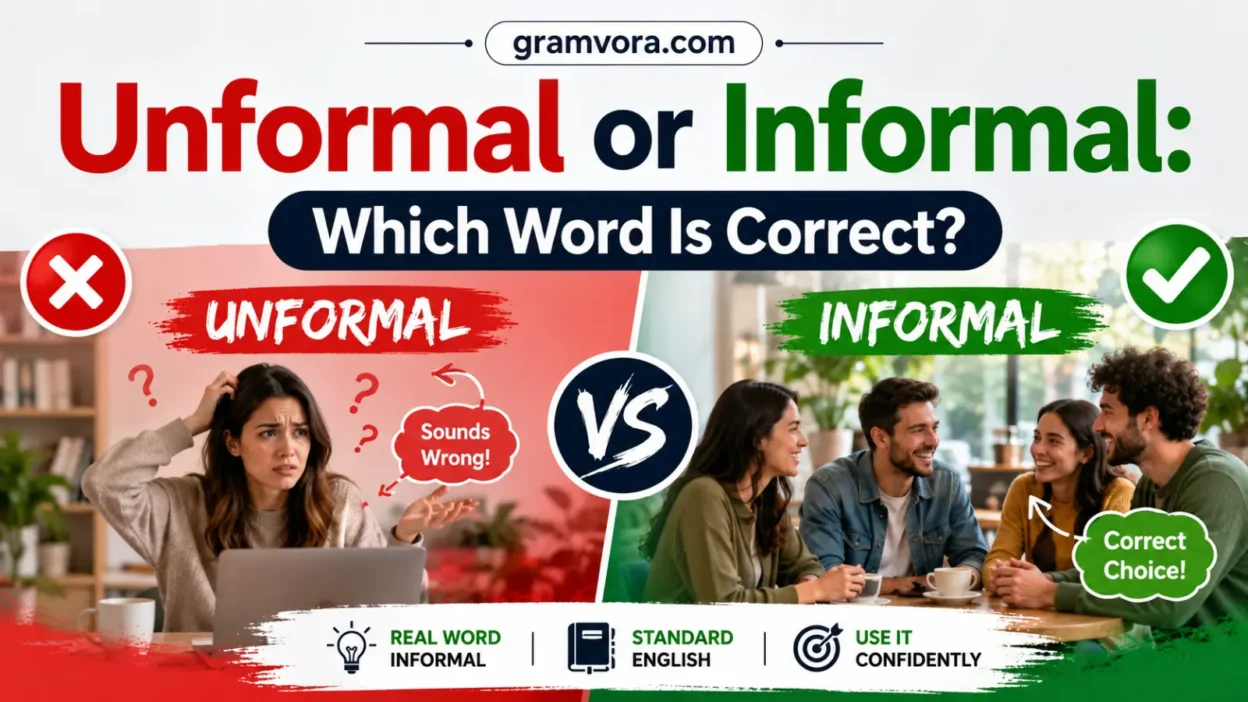
When you need a word that means “not formal,” informal is the normal choice in modern US English. It works for meetings, language, clothing, behavior, agreements, and social situations.
Unformal has appeared in English, but it is rare today. Most readers will see it as unusual or mistaken, so the practical choice is almost always informal.
Quick Answer
Use informal in modern speech and writing.
Write an informal meeting, informal clothes, informal language, and an informal agreement. Avoid unformal in schoolwork, business communication, articles, and everyday messages.
Although unformal has a historical record, it is not the established current alternative to formal for most readers. Choose informal unless you are quoting an older source or deliberately discussing the rare word itself.
Why People Confuse Them
The confusion comes from the prefix un-. English uses it in familiar opposites such as unhappy, unclear, and unofficial, so unformal may look logical.
However, English does not build every opposite with the same prefix. Established forms also use in-, im-, il-, or ir-, as in informal, impossible, illegal, and irregular. In this case, informal became the standard everyday form.
Key Differences At A Glance
| Feature | unformal | informal |
|---|---|---|
| Current status | Rare and usually avoided | Standard modern adjective |
| Likely reader reaction | May look mistaken or deliberately unusual | Sounds natural and familiar |
| Best setting | Historical discussion, quotation, or wordplay | Everyday, academic, and professional writing |
| Basic meaning | Intended to mean “not formal” | Not formal, casual, relaxed, or unofficial |
The two forms can point toward a similar basic idea. However, they do not have equal standing in modern US usage. Informal is the dependable choice.
Meaning and Usage Difference
Informal is an adjective. It describes something that lacks ceremony, strict formality, or official structure. It can also describe language, clothing, or behavior suited to relaxed and familiar situations.
Common examples include an informal conversation, informal clothing, informal writing, and an informal understanding.
Unformal is also recorded as an adjective meaning “not formal,” yet it is uncommon in present-day American English. Use informal when clarity matters. Reserve unformal for a quotation from an older text or a discussion of the rare form itself.
Tone, Context, and Formality
The word informal is standard vocabulary, even in polished writing. A professional report can refer to an informal interview, and a legal discussion can mention an informal arrangement. The adjective describes the subject; it does not make the sentence careless.
By contrast, unformal draws attention to itself and may suggest weak word choice. The real difference is that informal is established and widely accepted, while unformal is rare.
Which One Should You Use?
| Context | Best Choice | Why |
| School essay | informal | It is the standard accepted adjective |
| Work email | informal | It sounds clear and professional |
| Casual text | informal | It is still the natural everyday word |
| Clothing description | informal | “Informal attire” is an established phrase |
| Meeting description | informal | It clearly means relaxed or unofficial |
| Quoting an older passage containing the rare form | unformal | Preserve the original wording in the quotation |
| Discussing the word itself | unformal | The rare form is the subject of the discussion |
For nearly every normal sentence, choose informal.
When One Choice Sounds Wrong
Unformal usually sounds wrong when it directly modifies common nouns.
Incorrect or unnatural:
- We had an unformal meeting after lunch.
- She wore an unformal dress to the party.
- His email sounded too unformal.
- The manager conducted an unformal interview.
Natural revisions:
- We had an informal meeting after lunch.
- She wore an informal dress to the party.
- His email sounded too informal.
- The manager conducted an informal interview.
Meanwhile, informal can be the wrong description when the situation is actually official, ceremonial, or highly structured. The word may be grammatically correct but factually inaccurate. For instance, a black-tie awards ceremony is not usually an informal event.
Common Mistakes (and Quick Fixes)
A common mistake is assuming that any adjective can take un- to form its opposite. The quick fix is to learn the established pair: formal–informal.
Do not treat unformal and informal as equal choices with different degrees of casualness. Unformal does not mean “more casual” than informal.
Also, do not replace every use of informal with casual. The words overlap, but informal can also mean unofficial or not governed by strict procedure.
Everyday Examples
- We had an informal chat before the scheduled interview.
- The invitation says informal attire, so a suit is not required.
- Our neighbors reached an informal agreement about the shared fence.
- The teacher used an informal tone to help the class relax.
- “Hey” is an informal greeting in many situations.
- They discussed the proposal in an informal setting before the official vote.
In each sentence, replacing informal with unformal would make the wording less natural for a modern US audience.
Dictionary-Style Word Details
Verb
- unformal: Not commonly used as a verb in standard US English.
- informal: Not commonly used as a verb. Use a verb phrase such as make less formal, relax, or handle informally.
Noun
- unformal: Not commonly used as a noun.
- informal: Mainly used as an adjective, not as a general noun. For clarity, write informal event, informal meeting, or informal gathering rather than using the adjective alone.
Synonyms
- unformal: The closest plain alternative for its intended meaning is informal. Because the rare form has limited current use, a separate modern synonym set is not helpful.
- informal: Depending on context, close alternatives include casual, relaxed, unofficial, conversational, familiar, and unceremonious. These are not interchangeable in every sentence.
The clearest antonym of informal is formal. In some contexts, official, ceremonial, or structured may express the opposite idea more precisely.
Example Sentences
- unformal: The editor preserved unformal because it appeared exactly that way in the historical quotation.
- informal: We scheduled an informal coffee meeting before the final interview.
- unformal: The article discussed why unformal sounds unusual to many modern readers.
- informal: Her message was friendly and informal, but still respectful.
Word History
- unformal: The form has historical evidence, so it should not be described as completely invented. It did not become the normal modern choice.
- informal: This became the widely accepted opposite of formal in current English.
Both formations have appeared, but informal became the standard everyday word.
Phrases Containing
- unformal: No common fixed phrases are widely established in current standard US English. In most cases, revise the phrase with informal.
- informal: Common phrases include informal meeting, informal language, informal agreement, informal attire, informal discussion, informal poll, and informal chat.
FAQs
Is unformal a correct word?
Unformal has appeared in older English, so it is not completely invented. However, it is extremely rare in modern US English. In everyday, academic, and professional writing, informal is the correct and natural choice.
Which is correct: unformal or informal?
Informal is the standard word. Use it to describe language, clothing, meetings, behavior, agreements, or situations that are relaxed, casual, or unofficial.
Why do we say informal instead of unformal?
English does not always use un- to create an opposite. Some words use prefixes such as in-, im-, il-, or ir-. The established opposite of formal is informal.
Can I use unformal in a sentence?
You may use unformal when discussing the word itself or quoting an older source that contains it. In normal communication, replace it with informal because most readers will consider unformal unusual or incorrect.
What does informal mean?
Informal means relaxed, casual, conversational, or not officially structured. For example, an informal meeting may involve a relaxed discussion rather than a strict agenda or official procedure.
Is informal the same as casual?
The meanings often overlap, but they are not always identical. Casual commonly describes a relaxed style, appearance, or attitude. Informal can also mean unofficial, such as an informal agreement or informal discussion.
Is informal suitable for professional writing?
Yes. Informal is a standard adjective and can appear in professional writing. For example, a report may mention an informal interview, an informal arrangement, or an informal meeting.
What is the opposite of informal?
The main opposite of informal is formal. Depending on the context, other contrasting words may include official, ceremonial, structured, or professional.
Conclusion
Choose informal when you mean casual, relaxed, conversational, unofficial, or not highly formal. It is the standard word for modern US speech and writing.
Unformal has rare historical use, but it is not an equal everyday alternative. Most readers will expect informal, so using it will make your sentence clearer, more natural, and easier to trust.