In everyday American life, small word choices can make a big difference in how clearly we communicate. “Either” and “neither” are two short words that frequently appear in conversations, emails, text messages, and professional documents. Yet many people — even native US English speakers — pause when deciding which one fits best.
These words both deal with two options, which is exactly why they create confusion. One offers possibilities while the other closes them down. Understanding the real distinction helps you sound more natural whether you’re ordering food in a busy Dallas restaurant, discussing plans with colleagues in Chicago, or chatting with friends in Los Angeles.
This guide breaks down the practical differences in clear, straightforward American English. You will see exactly when to reach for “either” and when “neither” is the better choice, supported by realistic situations that reflect how people actually speak and write in the United States today.
Quick Answer
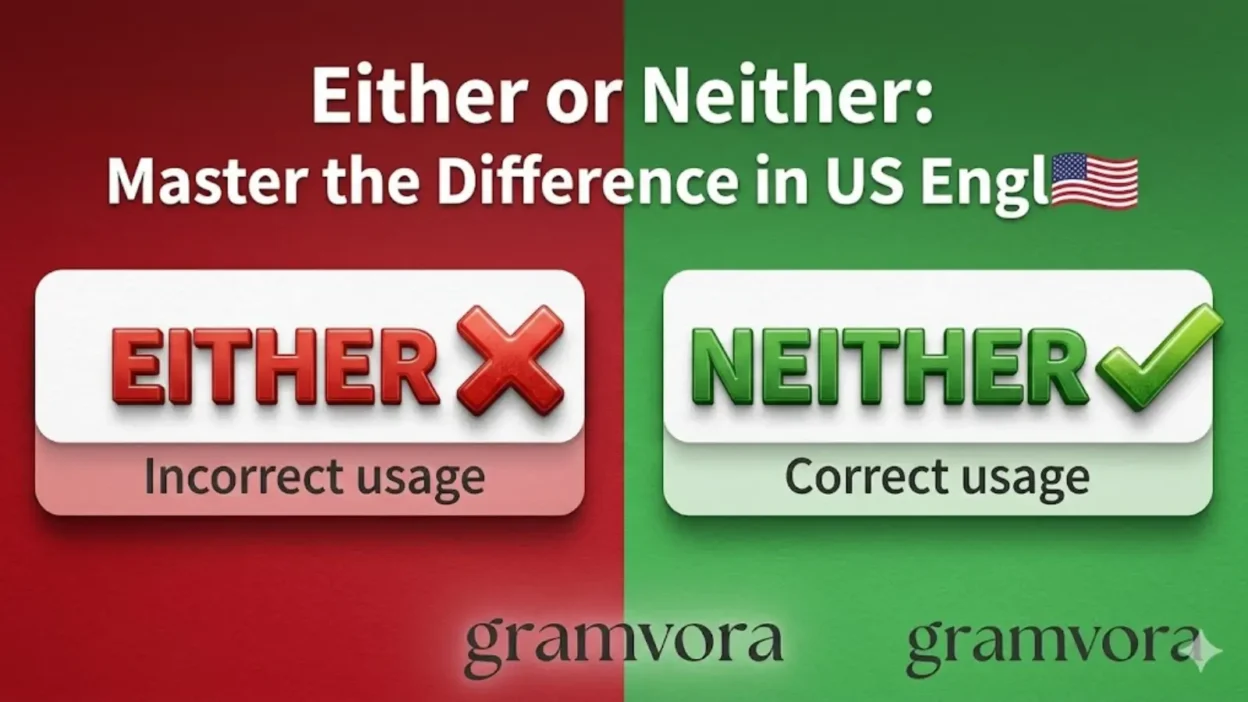
Use either when you are presenting or selecting one of two options. Use neither when you are saying that none of the two options work or apply.
“Either” generally carries a positive or open feeling. “Neither” is negative and definitive. They are not interchangeable. Using the wrong one can change the entire meaning of what you are trying to say.
Why People Confuse Them
The confusion starts with their similar spelling and pronunciation. Both words handle exactly two items and often appear in paired structures: “either…or” and “neither…nor.” In fast-paced spoken English, the distinction gets blurry.
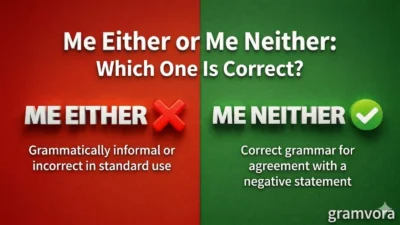
Many Americans grew up hearing both words used loosely in casual settings. Social media, TV shows, and quick text replies have made the lines even softer. A common example is responding to “I don’t like this movie” with “Me either” instead of the more traditional “Me neither.”
Additionally, English learners and even long-time speakers sometimes wonder about subject-verb agreement, formality levels, and whether these words can stretch beyond exactly two items. The overlap in how they function as pronouns, determiners, and adverbs adds another layer of complexity in real-life usage.
Key Differences At A Glance
| Context | Best Choice | Why |
|---|---|---|
| Presenting two options | either | Opens up a choice between them |
| Rejecting both options | neither | Clearly states none work |
| Agreeing with a negative | neither / not…either | Matches the negative tone correctly |
| Making a neutral decision | either | Keeps the tone open and flexible |
| Strong negative statement | neither | Delivers clear rejection |
Feature Comparison
- Either: Focuses on alternatives or addition in negative contexts. Can feel inclusive.
- Neither: Focuses on exclusion. Always signals that both choices are out.
Meaning and Usage Difference
Either refers to one or the other of two possibilities. It can express a choice, an alternative, or agreement in a negative sentence. For example, it works when you want to say that any one of the two is acceptable.
Neither means not the first and not the second. It is used to indicate that both options are unacceptable or do not apply. This word always carries a sense of negation.
In grammar terms, both can serve multiple roles, but their core meanings stay distinct:
Either as a determiner: “Either color looks good on you.” Either as a pronoun: “Either is fine with me.” Either as an adverb: “I can’t go either.” (meaning in addition to someone else) Either in a pair: “You can either take the bus or drive your car.”
Neither as a determiner: “Neither road leads to the destination we want.” Neither as a pronoun: “Neither of the candidates impressed the voters.” Neither as an adverb: “Neither have I.” Neither in a pair: “Neither the manager nor the team members agreed with the new policy.”
Pronunciation can vary slightly across the US. “Either” is commonly pronounced as EE-ther or EYE-ther. “Neither” follows as NEE-ther or NYE-ther. These variations rarely cause misunderstanding, but being aware of them helps when speaking with people from different regions.
The key is that “either” keeps possibilities alive while “neither” shuts them down. This fundamental contrast affects every sentence where they appear.
Tone, Context, and Formality
“Either” tends to sound more open, flexible, and neutral. It works beautifully in casual conversations, friendly decision-making, and situations where you want to offer options without pressure. In a relaxed California coffee shop discussion, you might hear: “We can either hike in the morning or go surfing in the afternoon.”
“Neither” carries a firmer, more negative tone. It is excellent for expressing clear disagreement or rejection. In professional or academic settings, it often sounds more polished and precise. A manager in New York might say: “Neither proposal meets our current budget requirements.”
In very formal writing, such as business reports or legal documents, “neither…nor” pairings are preferred for their clarity. In everyday texting and social media among friends, both words get shortened and blended into more casual forms. However, “neither” still maintains its negative force even in informal contexts.
Regional differences in the US are minor. Both words are understood nationwide, though urban areas with diverse populations may see more creative mixing in spoken English.
Which One Should You Use?
Ask yourself these simple questions:
- Am I offering a choice or alternative? → Use either.
- Am I saying no to both possibilities? → Use neither.
In positive or neutral situations, default to “either.” When the message involves rejection or disappointment, reach for “neither.” Always consider your audience. With close friends, casual forms work well. In job interviews, client meetings, or academic papers, stick to the standard pairings for the most professional impression.
Remember that context decides the winner. The same two restaurant options could use either word depending on whether you are excited about choosing or unhappy with both.
When One Choice Sounds Wrong
Certain combinations immediately signal a mistake to native listeners. Saying “neither restaurant is good, so pick whichever you want” creates a logical contradiction because “neither” already rejected both.
Another awkward construction: “Either of the plans won’t work.” This mixes positive and negative incorrectly. The right version would be “Neither of the plans will work.”
In questions, “Do you want either?” can sound off if the expected answer is negative. Better: “Do you want one or the other?” or rephrase entirely with “neither” when expecting a no.
These mismatches happen most often in rapid speech or when someone is tired. Catching them improves both your credibility and the flow of conversation.
Common Mistakes (and Quick Fixes)
Here are the most frequent errors Americans make with these words:
- “Me either” after a negative statement Mistake: “I didn’t enjoy the game.” “Me either.” Fix: “Me neither.” or “I didn’t either.”
- Mixing the pairs Mistake: “Neither coffee or tea.” Fix: “Neither coffee nor tea.”
- Wrong verb agreement Mistake: “Neither of the options are acceptable.” Fix: “Neither of the options is acceptable.” (singular verb is standard)
- Stretching beyond two items Mistake: Using “neither” for three or more choices in formal writing. Fix: Use “none” for more than two.
- Using “either” in strong negative contexts Mistake: “I don’t like either choice” when you mean total rejection. Fix: “I like neither choice.”
Quick memory trick: The “n” at the beginning of neither stands for negative. This helps many people choose correctly under pressure.
Everyday Examples
Let’s look at how these words appear in real American situations:
At home: “Honey, we can either watch a movie or go for a walk after dinner.” (Either offers choices.) Response: “Neither sounds fun tonight. I’m really tired.” (Neither rejects both.)
In the office: “The meeting is scheduled for either Tuesday or Wednesday next week.” Later: “Neither date works for the client team. We need to find another solution.”
With friends: “I haven’t been to that new restaurant yet.” “Me neither.” (Correct negative agreement.)
During shopping: “Either of these two jackets would look great for the interview.” “Actually, neither one fits my style perfectly.”
In 2026 daily life: A parent in Texas might text, “The kids can either join soccer or baseball this season.” A reply could be, “Neither sport interests them right now. They’re really into robotics.”
Another modern example: While planning a road trip across the Southwest, someone says, “We can either stop in Santa Fe or Albuquerque for the night.” The response might be, “Neither city appeals to me for an overnight stay. Let’s push through to Flagstaff.”
These examples show how the choice between either and neither shapes the direction of conversations in practical ways.
Dictionary-Style Word Details
Verb
- Either: Not commonly used as a verb in standard US English.
- Neither: Not commonly used as a verb in standard US English.
Noun
- Either: Occasionally used as a noun to mean one of two options (“You can choose either.”).
- Neither: Used as a noun to mean none of the two (“Neither is suitable for the job.”).
Synonyms
- Either: Closest plain alternatives include “one or the other” or “any of the two.”
- Neither: Closest plain alternatives include “none of the two” or “not one nor the other.” Antonyms depend heavily on context. For either, “neither” can sometimes serve as contrast. For neither, “both” or “either” can act as opposites.
Example Sentences
- Either: “Either path you take will lead to personal growth if you stay committed.”
- Neither: “Neither explanation fully addressed the customer’s concerns during the call.”
- Combined: “You can either study now or later, but neither choice excuses poor preparation.”
Word History Both “either” and “neither” trace back to Old English forms related to concepts of “one” and “two.” Their usage for choices and negation has remained relatively stable in American English over time, though spoken forms continue to evolve naturally.
Phrases Containing
- Either: either way, either or both, on either hand, either…or.
- Neither: neither here nor there, neither one thing nor the other, neither fish nor fowl, neither…nor.
FAQs
What is the main difference between “either” and “neither”?
“Either” presents a choice between two options or adds agreement in negative sentences. “Neither” rejects both options completely and always carries a negative meaning. They are not interchangeable.
Is it “me either” or “me neither”?
“Me neither” is the more traditional and grammatically preferred response after a negative statement. “I don’t either” is also correct and very common in modern US English. “Me either” is widely used in casual speech but considered less precise by many style guides.
Can “either” and “neither” be used for more than two items?
Strictly speaking, no. Both words refer to two options. For three or more items, use “any,” “none,” or “all” instead. In very casual conversation, people sometimes stretch “neither,” but it is not recommended in formal writing.
Do “either” and “neither” take singular or plural verbs?
In standard American English, both usually take singular verbs:
- “Either option is acceptable.”
- “Neither plan works well.” When followed by “of the + plural noun,” singular is still preferred in most cases.
When should I use “either…or” versus “neither…nor”?
Use either…or when offering alternatives (positive or neutral). Use neither…nor when making a negative statement about both options.
Are “either” and “neither” formal or informal words?
Both words work across all levels of American English. “Neither…nor” sounds more formal and polished in business emails or academic writing. Short forms like “me neither” feel natural in everyday texting and conversation.
How do you pronounce “either” and “neither”?
- Either: EE-ther (most common) or EYE-ther
- Neither: NEE-ther or NYE-ther Both pronunciations are accepted across the US. Regional preferences exist, but they rarely cause confusion.
Can “either” ever mean “both”?
In some older or specific constructions, “either” can imply “both” (e.g., “There are trees on either side of the road”). However, this is different from its main use as a choice word.
What are common mistakes with “either” and “neither”?
- Mixing pairs (“neither…or” instead of “neither…nor”)
- Using “me either” after negatives
- Wrong subject-verb agreement
- Using them for more than two items in formal contexts
Is there any situation where “either” and “neither” can replace each other?
Almost never. Replacing one with the other usually reverses the meaning of the sentence. Always check whether you are offering choices or rejecting them.
How can I practice using “either” and “neither” correctly?
Try rewriting sentences from your daily life. For example, turn “I don’t want pizza and I don’t want pasta” into “I want neither pizza nor pasta.” Or “We can go to the park or the mall” into “We can either go to the park or the mall.”
Which one is more common in American English — “either” or “neither”?
“Either” appears more frequently because people discuss choices often. “Neither” is used when strong rejection or agreement with negatives is needed.
Conclusion
Mastering the difference between “either” and “neither” is one of those small improvements that noticeably raises your English confidence. “Either” opens doors by presenting options. “Neither” closes them with clear rejection.
Pay attention to the tone you want to create, match the words to the situation, and practice in real conversations. Over time, choosing correctly between them will become automatic. Whether you are making weekend plans in Miami, discussing strategy in a Seattle boardroom, or simply agreeing with a friend over coffee, these two words help you express yourself with precision and natural American flow.
Keep practicing with the examples in this guide. The more you notice how native speakers use them in daily life, the more comfortable you will feel making the right choice every time.