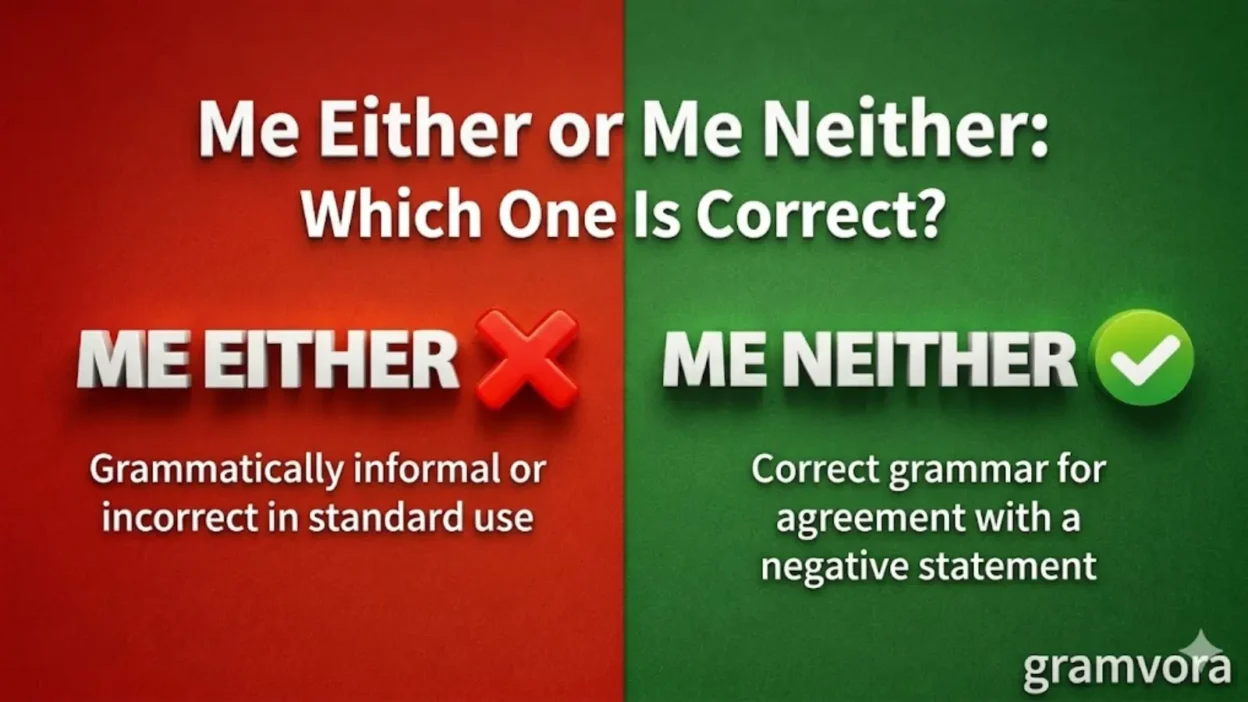
Many English learners and native speakers wonder whether they should say me either or me neither when agreeing with a negative statement. Both expressions appear regularly in conversation, which makes the choice confusing.
The short answer is that both are used in American English, but they are not viewed exactly the same way. Understanding when and why people use each expression can help you sound more natural and confident in everyday conversations.
Quick Answer
Both me either and me neither are commonly used in American English when responding to a negative statement.
Example:
Person A: “I don’t like waking up early.”
Person B: “Me neither.”
Person B could also say:
“Me either.”
However, me neither is traditionally considered the more grammatically standard response, while me either is widely accepted in casual speech and appears frequently in everyday American conversation.
If you want the safest choice in all situations, use me neither.
Why People Confuse Them
The confusion exists because both expressions often communicate the exact same idea.
When someone makes a negative statement, another person may want to express agreement.
For example:
- I don’t enjoy horror movies.
- I can’t swim.
- I haven’t seen that show.
In each case, another speaker may respond with either:
- Me neither.
- Me either.
Since both responses are common in conversation, many people assume they are completely interchangeable. While they often function the same way, there are slight differences in formality and traditional grammar expectations.
Key Differences At A Glance
| Context | Best Choice | Why |
|---|---|---|
| Formal writing | Me neither | Traditionally preferred |
| Academic writing | Me neither | More standard |
| Professional communication | Me neither | Safest option |
| Casual conversation | Me neither | Always acceptable |
| Informal speech | Me either or Me neither | Both commonly used |
| Everyday American conversation | Either one | Both widely understood |
Meaning and Usage Difference
The meaning of both expressions is nearly identical.
They are used to agree with a negative statement.
Example:
“I don’t drink coffee.”
Possible responses:
- Me neither.
- Me either.
Both responses mean:
“I don’t drink coffee either.”
Me Neither
Me neither has long been regarded as the traditional and grammatically preferred response to a negative statement.
Examples:
- I don’t watch baseball. — Me neither.
- I can’t drive a motorcycle. — Me neither.
- I wasn’t invited. — Me neither.
The word neither naturally carries a negative meaning, which is why many grammar references prefer this construction.
Me Either
Me either is extremely common in spoken American English.
Examples:
- I don’t eat spicy food. — Me either.
- I haven’t finished the book. — Me either.
- I can’t stay late. — Me either.
Although some teachers and editors historically preferred me neither, modern American speech uses me either so frequently that most listeners do not notice any difference.
Parts of Speech and Structure
Neither expression forms a complete sentence.
Instead, both act as shortened conversational responses.
The complete versions would be:
- I don’t either.
- Neither do I.
Over time, speakers shortened these responses into the familiar expressions used today.
Small Comparison
| Feature | Me Either | Me Neither |
| Common in conversation | Yes | Yes |
| Traditional grammar preference | No | Yes |
| Casual American speech | Very common | Very common |
| Formal writing | Less preferred | Preferred |
| Easily understood | Yes | Yes |
Tone, Context, and Formality
Tone is where the biggest difference appears.
Me Neither
This expression sounds slightly more traditional and slightly more formal.
Examples:
- I haven’t visited New York. — Me neither.
- I don’t know the answer. — Me neither.
Because it aligns more closely with traditional grammar expectations, it works well in nearly every setting.
Me Either
This expression sounds highly conversational.
Examples:
- I don’t want pizza tonight. — Me either.
- I haven’t watched that movie. — Me either.
Many Americans use it naturally in everyday speech with friends, family members, classmates, and coworkers.
In most casual situations, it does not sound unusual at all.
Which One Should You Use?
If you are unsure, choose me neither.
It works everywhere:
- School writing
- Professional communication
- Formal situations
- Casual conversations
If you are speaking casually with friends or family, me either is also widely accepted and natural in American English.
A simple rule is:
- Formal or uncertain situation → Me neither
- Casual conversation → Either one works
When One Choice Sounds Wrong
Sometimes the issue is not choosing between me either and me neither.
Instead, people use them after positive statements.
Example:
“I love tacos.”
Incorrect responses:
- Me neither.
- Me either.
These responses express agreement with negative statements, not positive ones.
Better responses:
- Me too.
- So do I.
Likewise:
“I went to the concert.”
Correct agreement:
- Me too.
- So did I.
Not:
- Me neither.
- Me either.
The key is remembering that both expressions are primarily used after negative statements.
Common Mistakes (and Quick Fixes)
Mistake: Using them after a positive statement
Incorrect:
“I love basketball.” — “Me neither.”
Correct:
“I love basketball.” — “Me too.”
Mistake: Treating them as complete formal sentences
Informal:
“Me neither.”
More formal:
“Neither do I.”
Mistake: Assuming one is always wrong
Some people believe me either is completely incorrect.
In reality, it is extremely common in American speech and widely understood.
Mistake: Mixing positive and negative agreement
Incorrect:
“I don’t eat seafood.” — “Me too.”
Correct:
“I don’t eat seafood.” — “Me neither.”
or
“I don’t eat seafood.” — “Me either.”
Everyday Examples
Here are examples that reflect natural American English.
- I don’t like crowded malls. — Me neither.
- I don’t like crowded malls. — Me either.
- I haven’t seen that movie. — Me neither.
- I haven’t seen that movie. — Me either.
- I can’t stay for the meeting. — Me neither.
- I can’t stay for the meeting. — Me either.
- I don’t own a truck. — Me neither.
- I don’t own a truck. — Me either.
- I wasn’t expecting that. — Me neither.
- I wasn’t expecting that. — Me either.
Notice that the meaning stays almost identical in each pair.
Dictionary-Style Word Details
Verb
Me Either
Not commonly used as a verb. Functions as a conversational expression used to agree with a negative statement.
Me Neither
Not commonly used as a verb. Functions as a conversational expression used to agree with a negative statement.
Noun
Me Either
Not commonly used as a noun in standard American English.
Me Neither
Not commonly used as a noun in standard American English.
Synonyms
Me Either
Closest plain alternatives:
- I don’t either
- Neither do I
- Same here
- Not me either
Me Neither
Closest plain alternatives:
- Neither do I
- I don’t either
- Same here
- Not me
Because both expressions communicate agreement with a negative statement, many of their alternatives overlap.
Example Sentences
Me Either
- I don’t enjoy camping. — Me either.
- I haven’t met her before. — Me either.
- I can’t attend tomorrow. — Me either.
- I wasn’t informed about the change. — Me either.
Me Neither
- I don’t enjoy camping. — Me neither.
- I haven’t met her before. — Me neither.
- I can’t attend tomorrow. — Me neither.
- I wasn’t informed about the change. — Me neither.
Word History
Me Either
Developed as a conversational response in English and became especially common in informal American speech. It is widely used today in everyday conversation.
Me Neither
Has long been recognized as the traditional response for agreeing with a negative statement. Many grammar guides continue to treat it as the more standard choice.
Phrases Containing
Me Either
- me either
- not me either
Me Neither
- me neither
- neither do I
- me neither, actually
FAQs About Me Either or Me Neither
Is it correct to say “me either”?
Yes. Me either is very common in everyday American English, especially in casual conversation. While some grammar guides prefer me neither, most native speakers understand and use me either regularly.
Is “me neither” more grammatically correct than “me either”?
Traditionally, yes. Me neither has long been considered the more standard response to a negative statement. However, me either is widely accepted in informal American speech.
When should I use “me neither”?
Use me neither when agreeing with a negative statement, especially in formal, academic, or professional situations.
Example:
- I don’t like cold weather.
- Me neither.
When should I use “me either”?
Use me either when agreeing with a negative statement in casual conversations.
Example:
- I haven’t seen that movie.
- Me either.
Are “me either” and “me neither” interchangeable?
In many everyday conversations, yes. Both expressions often mean the same thing and are used to agree with a negative statement. However, me neither is generally viewed as the more formal and traditional choice.
Can I use “me either” after a positive statement?
No. Me either is typically used after negative statements.
Incorrect:
- I love pizza.
- Me either.
Correct:
- I love pizza.
- Me too.
Can I use “me neither” after a positive statement?
No. Me neither is also intended for agreement with negative statements.
Correct:
- I don’t eat seafood.
- Me neither.
What is a more formal alternative to “me neither”?
A more formal response is “Neither do I.”
Example:
- I don’t enjoy long meetings.
- Neither do I.
Do Americans use “me either” often?
Yes. Many Americans use me either naturally in everyday speech. It is especially common in casual conversations with friends, family, and coworkers.
Which should I use if I am unsure?
If you are uncertain, choose me neither. It is accepted in both formal and informal situations and is generally considered the safest option.
Conclusion
When comparing me either or me neither, both expressions are commonly used to agree with a negative statement.
Me neither remains the more traditionally accepted and grammatically preferred choice. It fits comfortably in both formal and informal situations.
Me either is extremely common in everyday American speech and sounds natural in casual conversations. Most native speakers understand it immediately and use it regularly.
If you want the safest choice, use me neither. If you are speaking casually with friends or family, either expression will usually sound natural and communicate the same meaning.