Both sheath and sheathe are correct, but they usually perform different jobs.
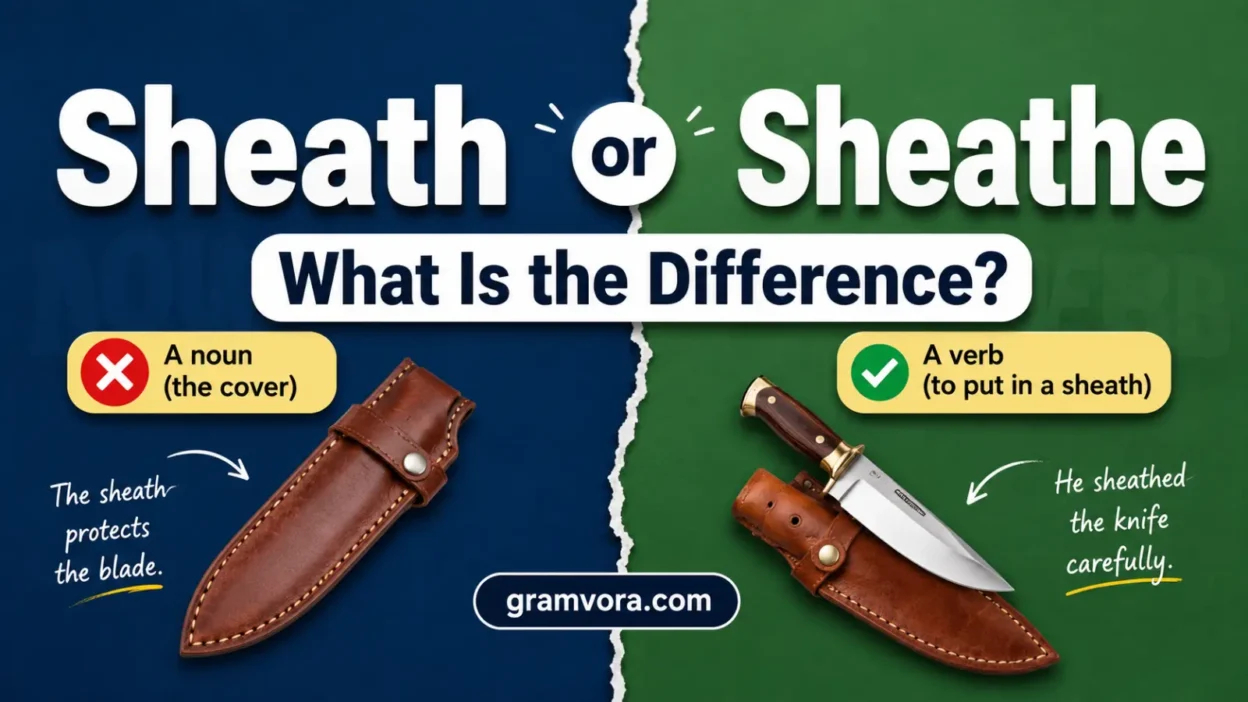
A sheath is a covering, case, or protective layer. To sheathe something is to place it inside such a covering or surround it with protective material.
The spelling difference is only one final e, yet that letter normally changes the word from a noun to a verb. The words also have slightly different final sounds.
Quick Answer
Use sheath as a noun:
- The knife has a leather sheath.
- The cable’s outer sheath was damaged.
Use sheathe as a verb:
- Please sheathe the knife.
- Workers will sheathe the walls in plywood.
Some dictionaries also recognize sheath as a less-common verb variant. However, sheathe is the clearest and most widely expected verb form in edited American writing.
Why People Confuse Them
The words come from the same basic idea: a close covering around something.
They also differ by only one letter. When readers see forms such as sheathed and sheathing, the relationship becomes even harder to track.
Pronunciation adds another difficulty. Sheath ends with the unvoiced th sound heard at the end of teeth. Sheathe ends with the voiced th sound heard in breathe.
That sound difference is small, but it helps separate the noun from the verb.
Key Differences At A Glance
| Context | Best Choice | Why |
|---|---|---|
| A case that holds a knife or blade | sheath | It names the physical covering. |
| The action of putting a blade away | sheathe | It describes an action. |
| A protective layer around a cable | sheath | It names the layer itself. |
| Covering walls with plywood | sheathe | It describes adding a covering. |
| A close-fitting style of dress | sheath | It forms the noun phrase sheath dress. |
| Retracting a cat’s claws | sheathe | It describes drawing the claws into their coverings. |
| A less-common verb spelling in quoted material | sheath | Some dictionaries record it, although sheathe is clearer. |
Meaning and Usage Difference
Sheath most often names a close-fitting cover. The cover may protect a knife blade, cable, plant stem, nerve, tendon, or another object or body structure.
Sheathe describes placing something inside a sheath or covering something with a protective layer.
A compact way to compare them is:
- Sheath: the case, layer, sleeve, or covering
- Sheathe: to put inside, cover, encase, or surround
- Preferred pattern: a thing has a sheath, while a person or process may sheathe something
Consider this sentence:
Maya removed the knife from its sheath and later sheathed it.
The first word names the case. The second describes the action of returning the knife to it.
The verb is transitive, so it normally takes an object. You sheathe a knife, a wall, a cable, or a ship’s hull.
Tone, Context, and Formality
Sheath is neutral. It appears naturally in everyday, medical, electrical, biological, and clothing contexts.
Examples include knife sheath, myelin sheath, cable sheath, and sheath dress.
Sheathe can sound literary when used with swords, mist, snow, or ice:
The field was sheathed in frost.
However, the verb is not limited to storytelling. In building and manufacturing contexts, it is a practical term for covering a surface with protective material:
The crew sheathed the exterior walls before installing the siding.
There is no important American-versus-British spelling division here. Both words are standard in American English when used in their usual grammatical roles.
Which One Should You Use?
Choose sheath when you need the name of a covering.
A simple test is to place a, an, or the before the word:
- a leather sheath
- the cable sheath
- a protective sheath
Choose sheathe when the sentence describes an action:
- sheathe the blade
- sheathe the building
- sheathe the wire in plastic
Inflected verb forms also keep the final e in the base word, although spelling changes occur when endings are added:
- sheathe
- sheathes
- sheathed
- sheathing
For clear modern prose, follow the noun–verb distinction even though a less-common verb variant of sheath appears in some dictionaries.
When One Choice Sounds Wrong
Using sheathe as a noun is not standard:
Incorrect: The dagger was stored in its sheathe.
Correct: The dagger was stored in its sheath.
The same problem appears in technical contexts:
Incorrect: The cable has a rubber sheathe.
Correct: The cable has a rubber sheath.
Using sheath as a verb is more nuanced. Some dictionaries recognize it, so it is not an invented form. Still, many readers expect sheathe when an action is intended:
Less clear: Sheath the knife before placing it in the drawer.
Preferred: Sheathe the knife before placing it in the drawer.
A missing verb ending also creates an obvious error:
Incorrect: The walls were sheath in plywood.
Correct: The walls were sheathed in plywood.
Common Mistakes (and Quick Fixes)
Mistake: Using sheathe for the physical case
The knife came with a nylon sheathe.
Fix:
The knife came with a nylon sheath.
Mistake: Dropping the final e from the preferred verb
He began to sheath his sword.
Fix:
He began to sheathe his sword.
The first version may match a recorded variant, but the second is clearer for most readers.
Mistake: Writing the past tense as sheathed but treating the base word as a noun
Remember that sheathed normally comes from the verb sheathe.
Mistake: Treating scabbard as an exact replacement in every context
A scabbard is a type of holder for a sword or similar blade. It does not replace sheath in phrases such as myelin sheath, cable sheath, or sheath dress.
Everyday Examples
- The camping knife came with a durable leather sheath.
- Jordan carefully sheathed the blade after cleaning it.
- The damaged cable sheath exposed the inner wiring.
- The installer sheathed the wire in a protective layer.
- A fatty sheath helps insulate each nerve fiber.
- The cabin was sheathed in plywood before the siding arrived.
- Her navy sheath dress had a simple, straight shape.
- The cat extended its claws, then quickly sheathed them.
- Frost sheathed the branches during the cold night.
- The sword remained in its sheath throughout the ceremony.
Dictionary-Style Word Details
Verb
- Sheath: Some dictionaries record this as a less-common transitive verb meaning to place in a sheath or provide with a protective covering. Because many readers identify sheath mainly as a noun, sheathe is usually the clearer verb choice.
- Sheathe: A standard transitive verb meaning to put something into a sheath, retract it into a covering, or encase it in protective material. Its forms are sheathes, sheathed, and sheathing.
Noun
- Sheath: A countable noun for a close-fitting case, sleeve, or protective covering. It may refer to a blade holder, cable covering, biological structure, plant structure, or close-fitting dress. The plural is sheaths.
- Sheathe: Not commonly used as a noun in standard American English.
Synonyms
- Sheath: Closest plain alternatives include case, casing, cover, covering, sleeve, and jacket. Scabbard fits sword and blade contexts but not every meaning. No single exact antonym applies to all noun senses.
- Sheathe: Meaning-matched alternatives include encase, enclose, cover, wrap, and clad. Unsheathe is a direct antonym when a blade or claw is drawn from its covering. In broader covering contexts, uncover or expose may fit.
Example Sentences
- Sheath: The chef replaced the knife in its protective sheath.
- Sheath: Doctors examined the tissue surrounding the tendon sheath.
- Sheathe: She paused to sheathe the blade before entering the house.
- Sheathe: Contractors will sheathe the roof with panels before adding shingles.
Word History
- Sheath: The noun comes through Middle English from an Old English word for a case or covering, especially one made for a blade. Its meaning later expanded to other close coverings and protective structures.
- Sheathe: The verb developed from the related noun. Its earliest meanings involved furnishing something with a sheath or putting a blade into one. It later gained the broader meaning of covering or encasing something.
Phrases Containing
- Sheath: knife sheath, sword sheath, sheath knife, sheath dress, myelin sheath, tendon sheath, cable sheath, leaf sheath
- Sheathe: sheathe a sword, sheathe a knife, sheathe the claws, sheathe the walls, sheathe with copper, sheathed in ice, sheathed in mist
FAQs
Is sheath or sheathe correct?
Both words are correct, but they usually have different grammatical roles. Sheath is mainly a noun that names a protective covering. Sheathe is a verb that describes placing something inside a covering or surrounding it with protective material.
Should I write sheath or sheathe a sword?
Use sheathe when describing the action:
The knight began to sheathe his sword.
Use sheath when referring to the sword’s holder:
The sword rested in its sheath.
Can sheath be used as a verb?
Some major dictionaries recognize sheath as a less-common verb meaning to cover or place inside a sheath. However, sheathe is the clearer and more widely expected verb form in modern American writing.
Is sheathe ever used as a noun?
No. Sheathe is not commonly used as a noun in standard English. When you need the name of a protective case, sleeve, or covering, use sheath.
Correct: The knife came with a leather sheath.
Incorrect: The knife came with a leather sheathe.
How are sheath and sheathe pronounced?
Sheath ends with the unvoiced th sound heard in teeth. Sheathe ends with the voiced th sound heard in breathe. The final e changes both the grammatical role and the usual pronunciation.
What is the plural of sheath?
The plural of sheath is sheaths.
The store sells leather sheaths for hunting knives.
The plural ending may look unusual, but sheaths is the standard form.
What is the past tense of sheathe?
The past tense and past participle of sheathe are both sheathed.
She sheathed the knife after using it.
The cables were sheathed in protective plastic.
The present participle is sheathing.
Can sheathe mean more than putting away a sword?
Yes. Sheathe can also mean covering or encasing something with a protective layer.
Workers sheathed the walls in plywood.
Ice sheathed the tree branches.
The wire was sheathed in rubber.
Therefore, the verb appears in construction, manufacturing, electrical work, and descriptive writing—not only in sword-related contexts.
Conclusion
Both words are correct, but they are not normally interchangeable.
Use sheath for the covering itself:
The knife is in its sheath.
Use sheathe for the action of putting something into a covering or surrounding it with protective material:
Sheathe the knife before storing it.
Although some dictionaries recognize sheath as a less-common verb, sheathe remains the clearest choice for an action in most modern American writing.