
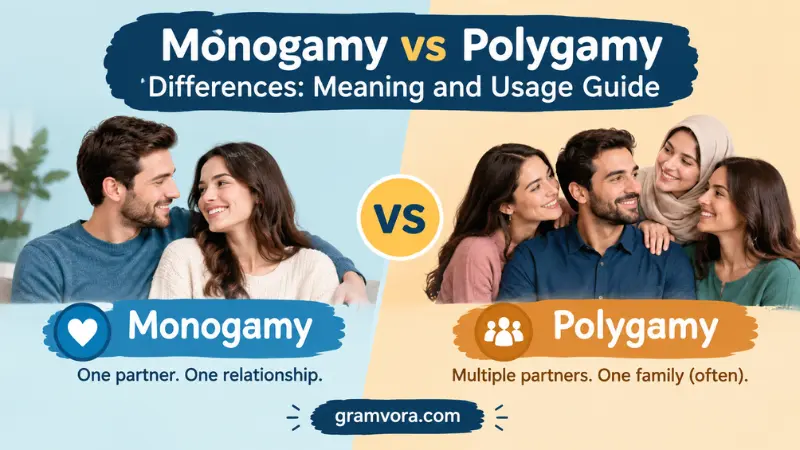
If you are wondering about the monogamy vs polygamy differences, both words are correct English terms. The important question is what relationship or marriage structure you are describing.
Monogamy generally refers to having one spouse or one romantic or sexual partner at a time. Polygamy generally refers to marriage involving more than one spouse at the same time.
That means the choice is not about which word is grammatically correct. Both are standard nouns. The difference is mainly one of meaning and usage.
A person can also have several relationships during a lifetime and still have a monogamous relationship pattern if those relationships occur one at a time. Having several partners over many years does not automatically make someone polygamous.
Quick Answer
Use monogamy when you mean a relationship or marriage with one partner or spouse at a time.
Use polygamy when you mean marriage involving more than one spouse at the same time.
| Context | Best Choice | Why |
|---|---|---|
| One spouse at a time | Monogamy | It describes a one-spouse marriage structure. |
| One romantic or sexual partner at a time | Monogamy | The term is also used beyond marriage. |
| Multiple spouses at the same time | Polygamy | This is the central human-marriage meaning. |
| Several relationships over different periods | Monogamy may fit | Several relationships do not necessarily mean simultaneous spouses. |
| Multiple-spouse marriage system | Polygamy | It directly identifies the marriage structure. |
The easiest way to remember the distinction is:
Monogamy = one partner or spouse at a time.
Polygamy = more than one spouse at the same time.
Why People Confuse Them
The two words look closely related because they share the ending -gamy, and both are connected with relationships and marriage.
Their beginnings also create an obvious contrast. Mono- carries the idea of one, while poly- carries the idea of many. The similarity makes the words easy to recognize as related, but they are not interchangeable.
Another reason for confusion is that monogamy has a broader everyday relationship use. Someone can describe an unmarried romantic relationship as monogamous. Dictionaries also define monogamy in terms of having one sexual partner at a time.
Polygamy is different in ordinary human relationship language because its central meaning is multiple-spouse marriage.
This creates an important distinction:
Several relationships over time do not automatically equal polygamy.
For example, someone may date one person for several years, end that relationship, and later date someone else. That person has had multiple relationships, but those relationships were not necessarily simultaneous.
Polygamy describes a different situation: multiple spouses at the same time.
Key Differences At A Glance
| Feature | Monogamy | Polygamy |
|---|---|---|
| Main grammatical role | Noun | Noun |
| Basic idea | One partner or spouse at a time | More than one spouse at the same time |
| Marriage use | One spouse at a time | Multiple spouses at the same time |
| Broader relationship use | Common | Less typical |
| Can describe a relationship without marriage? | Yes | Usually not in ordinary human usage |
| Related adjective | Monogamous | Polygamous |
| Main contrast | One at a time | Multiple at the same time |
The most useful distinction is not simply one person versus many people.
It is more precise to think about one partner or spouse at a time versus multiple spouses at the same time.
That distinction prevents several common mistakes.
For example, a person who has been married three times, with each marriage ending before the next begins, should not automatically be described as polygamous. The number of marriages across a lifetime is not enough to establish polygamy.
Meaning and Usage Difference
Monogamy is the practice or condition of having one spouse or one sexual partner at a time. Cambridge, Oxford, and Merriam-Webster all support meanings centered on one partner or spouse at a time.
In everyday US English, the term can therefore appear in discussions about dating, romantic relationships, sexual exclusivity, and marriage.
For example:
“They agreed that monogamy was important to their relationship.”
Here, the word describes the relationship structure rather than simply the legal status of the couple.
Polygamy, by contrast, means the practice or condition of having more than one spouse at the same time. Dictionary definitions specifically connect the term with plural marriage.
For example:
“The documentary examines polygamy as a marriage system.”
The word is therefore not simply a synonym for dating several people.
There is also an important point about terminology. Polygamy is a broad term for multiple-spouse marriage. More specific terms can identify the particular arrangement when that detail matters. For example, a discussion may distinguish between a marriage involving one man and multiple wives and one involving one woman and multiple husbands.
For ordinary word choice, however, the central distinction remains simple: monogamy describes one partner or spouse at a time, while polygamy describes multiple spouses at the same time.
Tone, Context, and Formality
Neither monogamy nor polygamy is an inherently informal word. Both are established nouns used in everyday writing as well as academic, legal, cultural, and relationship discussions.
Monogamy is especially common when people talk about relationship expectations.
Examples include:
“They prefer monogamy.”
“The couple chose a monogamous relationship.”
“The book examines changing attitudes toward monogamy.”
Polygamy appears more often when the subject is plural marriage, culture, religion, law, history, or social organization.
Examples include:
“The documentary discusses polygamy.”
“The class examined different marriage systems, including polygamy.”
“The legal discussion focused on polygamy.”
The surrounding context determines the tone. Neither term needs a special informal or formal replacement.
One important US-English point is legal usage. Cornell’s Legal Information Institute defines polygamy as having more than one spouse at the same time and states that polygamy is outlawed in every US state.
That legal fact does not change the dictionary meaning of the word. It simply explains why polygamy often appears in US legal discussions.
Which One Should You Use?
Choose monogamy when your sentence focuses on one partner or spouse at a time.
Choose polygamy when your sentence focuses on multiple spouses at the same time.
Consider these examples:
Use monogamy:
“They want a relationship based on monogamy.”
The sentence describes a one-partner relationship structure.
Use polygamy:
“The article discusses polygamy in different societies.”
The sentence is about marriage involving multiple spouses.
A useful test is to ask:
How many partners or spouses are involved at the same time?
If the answer is one, monogamy may be the appropriate term.
If the answer is more than one spouse and marriage is the subject, polygamy is the more precise choice.
Do not choose based only on the total number of people someone has dated or married throughout life.
A person can have several relationships over decades and still have had one partner at a time.
When One Choice Sounds Wrong
Polygamy can sound inaccurate when a sentence only describes multiple romantic partners without multiple marriages.
For example:
“She practices polygamy because she has dated several people.”
This is misleading if the people were separate relationships rather than simultaneous spouses.
A clearer sentence would be:
“She has had several relationships over the years.”
Or, when the relationship structure is specifically exclusive:
“She has practiced monogamy in each relationship.”
Likewise, monogamy sounds wrong when a sentence clearly describes several spouses existing simultaneously.
For example:
“The marriage system allows one person to have several spouses at the same time, so it is based on monogamy.”
The terms conflict in that sentence. Polygamy is the appropriate term for the multiple-spouse structure.
Another common error is treating polygamy as a direct synonym for every form of non-monogamous relationship. That is too broad. Current relationship references distinguish polygamy from other forms of non-monogamy, including relationships involving multiple romantic partners without plural marriage.
Common Mistakes (and Quick Fixes)
Mistake 1: “Both words mean having several partners.”
Fix: Monogamy focuses on one partner or spouse at a time. Polygamy focuses on multiple spouses at the same time.
Mistake 2: Calling someone polygamous because they have had several relationships.
Fix: Look at whether the relationships happened simultaneously. Several separate relationships do not automatically mean polygamy.
Mistake 3: Assuming polygamy means simply dating multiple people.
Fix: In ordinary human usage, polygamy is centered on multiple-spouse marriage.
Mistake 4: Thinking one word is grammatically correct and the other is incorrect.
Fix: Both monogamy and polygamy are standard nouns. The correct choice depends on the meaning you intend.
Mistake 5: Treating monogamy as meaning one partner for an entire lifetime.
Fix: Monogamy can describe having one partner at a time. A person may have several successive relationships while maintaining a monogamous pattern in each relationship. The APA Dictionary specifically recognizes serial monogamy.
Mistake 6: Assuming polygamy automatically identifies one gender arrangement.
Fix: Polygamy is the broader term for plural marriage. When the gender arrangement matters, more specific terminology may be appropriate.
Everyday Examples
Here are natural examples showing the difference:
- “They decided that monogamy was important before getting married.”The sentence describes a one-partner relationship preference.
- “Their marriage is based on monogamy.”One spouse is involved at a time.
- “She prefers a monogamous relationship.”The adjective monogamous describes the relationship.
- “The documentary examines polygamy in several societies.”The subject is plural marriage.
- “The book compares monogamy with polygamy.”Both terms are correct because the sentence compares two different marriage or relationship structures.
- “He has been married several times, but the marriages were consecutive.”This does not by itself describe polygamy.
- “The study discusses attitudes toward monogamy.”The word fits a general discussion of one-partner relationship structures.
- “The class covered the history and legal treatment of polygamy.”The word fits a discussion of multiple-spouse marriage.
- “They chose monogamy because they wanted an exclusive relationship.”Here, the focus is one partner at a time.
- “The article distinguishes polygamy from other forms of non-monogamy.”The sentence correctly keeps plural marriage separate from broader relationship categories.
The main lesson is consistent: do not count every partner someone has had throughout life. Focus on the relationship structure being described at the relevant time.
Dictionary-Style Word Details
Verb
- Monogamy: Not commonly used as a verb in standard US English. The noun is normally used with verbs such as practice, choose, prefer, or value: “They practice monogamy.”
- Polygamy: Not commonly used as a verb in standard US English. The noun normally appears with verbs such as practice, permit, prohibit, or discuss: “The article discusses polygamy.”
The related adjectives monogamous and polygamous are commonly used to describe people, relationships, marriages, or systems.
Noun
- Monogamy: An uncountable noun referring to the practice or condition of having one spouse or one sexual partner at a time.
- Polygamy: A noun referring to the practice or condition of having more than one spouse at the same time.
Both words name a relationship or marriage structure rather than directly naming a person.
For a person or relationship, the adjective forms are monogamous and polygamous.
Synonyms
- Monogamy: There is no perfect one-word synonym in ordinary US English. A closest plain alternative is one-partner relationship structure, although that phrase is explanatory rather than a strict dictionary synonym.
- Polygamy: Plural marriage is a close plain alternative when the subject is human marriage involving multiple spouses.
These alternatives should not be treated as completely interchangeable in every specialized context.
For example, monogamy has recognized uses in biological and relationship discussions that a simple phrase such as “one-partner relationship” may not fully capture.
Example Sentences
Monogamy
- “They chose monogamy because they wanted an exclusive relationship.”
- “The couple discussed monogamy before getting married.”
- “Her previous relationships were monogamous.”
Polygamy
- “The documentary explores polygamy as a marriage system.”
- “The course examined the history of polygamy.”
- “The article explains how polygamy differs from other relationship structures.”
These examples show why the words cannot simply replace one another.
Word History
Both terms are built from Greek-derived elements associated with marriage.
Monogamy comes through French and Late Latin from Greek monogamia, built from elements meaning roughly “single” and “marriage.” Merriam-Webster and Oxford both provide this historical background.
Polygamy comes through French from Greek polygamia, formed from elements meaning roughly “many” and “marriage.”
The shared -gamy element helps explain why the words are related. Their prefixes create the basic contrast between one and many.
Phrases Containing
Common phrases with monogamy include:
- practice monogamy
- choose monogamy
- prefer monogamy
- serial monogamy
- monogamy in marriage
- monogamy in relationships
Common phrases with polygamy include:
- practice polygamy
- polygamous marriage
- polygamy laws
- polygamy debate
- history of polygamy
- polygamy as a marriage system
The adjective forms are especially useful when describing a person or relationship:
- monogamous relationship
- monogamous marriage
- polygamous relationship
- polygamous marriage
FAQs
What is the main difference between monogamy and polygamy?
Monogamy generally means having one spouse or romantic or sexual partner at a time. Polygamy generally refers to marriage involving more than one spouse at the same time.
Is monogamy the opposite of polygamy?
Yes, in the basic sense of marriage structure, they describe contrasting arrangements. Monogamy involves one spouse at a time, while polygamy involves multiple spouses at the same time.
Is polygamy the same as having multiple partners?
Not necessarily. In ordinary human relationship usage, polygamy specifically refers to having multiple spouses, rather than simply dating or having several romantic partners.
Can someone have multiple relationships and still be monogamous?
Yes. Having several relationships throughout life does not automatically mean someone is polygamous. A person can have one partner at a time across different relationships.
Is monogamy only about marriage?
No. Monogamy can describe romantic or sexual relationships as well as marriage. The term commonly refers to having one partner at a time.
Does polygamy always mean one man with several wives?
No. Polygamy is a broader term for marriage involving multiple spouses. More specific terminology can describe the particular arrangement when the gender of the spouses is relevant.
Are monogamy and polygamy nouns?
Yes. Monogamy and polygamy are nouns. Their related adjectives are monogamous and polygamous.
Which word should I use for a one-partner relationship?
Use monogamy when you mean a relationship structure involving one partner at a time. For example: “They prefer monogamy.”
Which word should I use for multiple-spouse marriage?
Use polygamy when you mean a marriage structure involving more than one spouse at the same time. For example: “The article discusses polygamy.”
Is having several marriages the same as polygamy?
Not necessarily. If each marriage ended before the next one began, the person had several marriages but was not necessarily practicing polygamy. Polygamy involves multiple spouses at the same time.
Conclusion
The monogamy vs polygamy differences become clear when you focus on what each word actually describes.
Monogamy generally means having one spouse or one romantic or sexual partner at a time. Polygamy generally means marriage involving more than one spouse at the same time.
Both terms are correct English nouns. Neither is the “correct” word in every situation.
Use monogamy for a one-partner or one-spouse structure. Use polygamy when multiple spouses at the same time are the subject.
Most importantly, do not confuse several relationships across a lifetime with simultaneous multiple-spouse marriage. Once that distinction is understood, choosing between monogamy and polygamy becomes much easier.


