
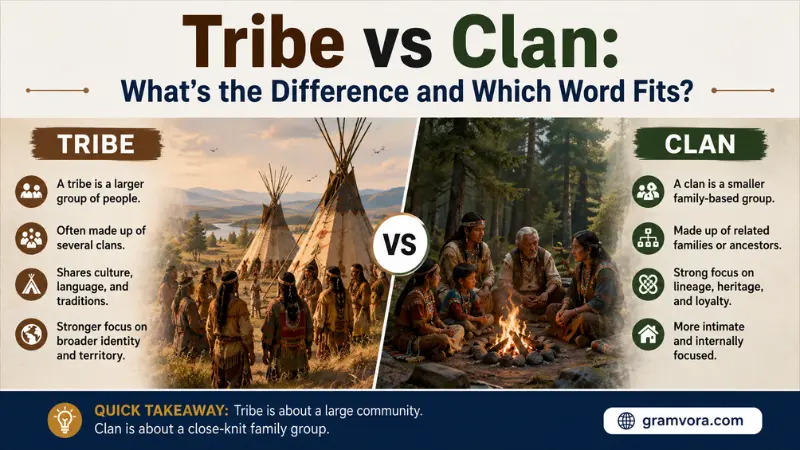
Tribe and clan can both describe groups of people connected by identity, ancestry, or tradition, so it is easy to assume that they mean the same thing. They do not always.
A clan is most strongly associated with kinship or shared descent, whether that ancestry is historically documented, traditionally claimed, or understood within a particular culture. A tribe can refer more broadly to a community connected through ancestry, culture, language, social organization, political identity, or several of these factors together.
In some societies, a tribe contains several clans. That structure is useful for understanding the words, but it is not a universal rule for every culture.
Context matters most. The correct word depends on how the group identifies itself and what kind of relationship you are describing.
Quick Answer
Use clan when the main idea is family connection, kinship, or descent from a shared ancestor.
Use tribe when referring to a broader cultural, social, political, or recognized community for which tribe is the established term.
A clan may be part of a larger tribe in some cultural systems, but you should not assume that every tribe contains clans or that every clan belongs to a tribe.
For Native peoples in the United States, use the community’s official or preferred name whenever you know it. Tribe may be correct when it is part of that name or when the governmental context calls for it.
Why People Confuse Them
The confusion comes from the amount of meaning the two words share.
Both can involve ancestry, identity, tradition, loyalty, and community. Older historical accounts may also describe societies in which families form clans and several clans participate in a larger tribal community.
That makes the words look like two levels of the same system.
Sometimes they are. In other situations, they are not.
A clan keeps a much stronger connection to the idea of kinship. A tribe has a wider range and may describe cultural or political membership that cannot be reduced to one family line.
Modern informal English adds another layer of confusion. People sometimes use clan for a large family or close group of associates and tribe for people who share interests or lifestyles. Those casual meanings should not be mistaken for formal cultural definitions.
Key Differences At A Glance
| Context | Best Choice | Why |
|---|---|---|
| Group organized around shared descent | Clan | Kinship is the central idea |
| Scottish Highland family grouping | Clan | This is a long-established use |
| Large extended family, informally | Clan | The word can refer playfully to relatives |
| Broader cultural community historically called a tribe | Tribe | Identity extends beyond one descent group |
| Official group whose name contains “Tribe” | Tribe | It is part of the established name |
| Community containing several recognized clans | Tribe for the larger community; clan for each kin group | The two words describe different levels |
| Group of friends or people with the same interests | Usually group, community, or circle | These are often clearer neutral choices |
Compact comparison:
- Tribe: broader community identity; may involve culture, ancestry, language, political organization, or recognized membership.
- Clan: primarily kinship-centered; often based on actual, claimed, or traditionally understood common descent.
- Key caution: size alone does not determine which word is correct.
Meaning and Usage Difference
The clearest difference is the type of connection being emphasized.
Tribe
As a noun, tribe can describe a community connected by combinations of shared ancestry, culture, language, history, social organization, or political identity.
The exact structure varies widely. A tribe may contain smaller kinship groups in one culture, while another community may organize itself differently.
In the United States, the word also has an important governmental use. Some federally recognized Native communities have Tribe in their official names, while others use terms such as Nation, Band, Community, or another specific designation.
For that reason, tribe should not be treated as a casual substitute for the name of every Indigenous community.
Clan
Clan focuses more clearly on descent and kinship.
The word is especially familiar from Scottish history, where clans traditionally brought together families associated through ancestry and social ties.
It also appears in descriptions of kinship systems in other cultures. Members of a clan may understand themselves as descendants of a shared ancestor even when every genealogical connection cannot be traced generation by generation.
Informally, Americans may also say things such as “the whole clan is coming for Thanksgiving,” meaning a large extended family.
Grammatically, both tribe and clan are primarily countable nouns: a tribe, several tribes; a clan, several clans.
Their pronunciations are straightforward and rarely cause confusion, so pronunciation does not affect the word choice.
Tone, Context, and Formality
Neither word is automatically formal or informal. Context changes the tone.
Clan sounds natural in historical Scottish discussion, descriptions of recognized kinship systems, and informal references to extended families.
For example:
“The MacLeod clan has a long history in Scotland.”
“The entire clan came over for dinner.”
The first is historical. The second is casual and family-centered.
Tribe requires more contextual care. It may be entirely appropriate when it is the historical, legal, governmental, or self-used designation for a particular community.
However, casually calling any cultural or ethnic group a tribe can be inaccurate. When discussing Native peoples, the safest choice is normally the specific name the community uses for itself.
The casual expression “my tribe” can mean a close group of friends or like-minded people. Although dictionaries record informal group meanings, writers may prefer community, circle, group, or friends when no literal tribal identity is involved. These choices are usually clearer and avoid mixing a casual metaphor with a term that has real cultural and governmental significance.
Which One Should You Use?
Choose clan when family descent is the main point.
Examples include:
- a Scottish clan
- a traditional kinship clan
- a group whose identity is tied to a shared ancestor
- an informal reference to a large extended family
Choose tribe when the group is a broader recognized community and that word accurately reflects its established identity, historical description, or governmental status.
Do not choose between the words based only on the number of people.
A clan may be smaller than a tribe in many systems, but “small group = clan” and “large group = tribe” is not a dependable rule.
When writing about a real cultural community, check the terminology used by that community. A specific official name is more precise than guessing between tribe and clan.
When One Choice Sounds Wrong
Using clan sounds wrong when no family or descent relationship is involved.
For example:
“Several clans with unrelated cultural backgrounds formed the city.”
If these are simply unrelated communities, clans wrongly suggests kinship.
Likewise, tribe can sound inaccurate when you are clearly talking about one extended family:
“Everyone in our tribe is coming to Grandma’s house for Thanksgiving.”
Informal speakers sometimes use tribe this way, but family or clan expresses the intended relationship more directly.
Another problem appears when a writer automatically replaces a Native nation’s actual name with tribe. If the community calls itself a Nation, Band, Community, or another name, replacing that wording can make the sentence less accurate rather than more accurate.
The best word is the one that matches the group’s real social relationship and established identity.
Common Mistakes (and Quick Fixes)
Mistake: Assuming every clan is a tribe.
Fix: Treat clan as a kinship-centered term. It may exist within a broader community, but that larger structure depends on the culture.
Mistake: Assuming every tribe is made of clans.
Fix: Say that some tribal systems contain clans rather than presenting the structure as universal.
Mistake: Choosing by size alone.
Fix: Look at the basis of membership. Kinship points toward clan; broader cultural or political community may point toward tribe.
Mistake: Treating clan as another word for immediate family.
Fix: A clan normally suggests a broader descent or kin group, not simply parents and children.
Mistake: Using tribe for any friend group.
Fix: In ordinary writing, community, circle, or group of friends often communicates the meaning more clearly.
Mistake: Calling every Native community a tribe.
Fix: Use the community’s specific name or preferred designation when possible.
Everyday Examples
Here are natural examples showing how the distinction works.
Clan:
“The whole clan is meeting at my aunt’s house for Thanksgiving.”
The sentence uses clan informally for a large extended family.
Clan:
“The museum exhibit explains the history of several Scottish clans.”
Kinship and historical family identity make clans the natural choice.
Tribe:
“She works with members of a federally recognized Tribe.”
Here, the word refers to a specific governmental and community context.
Tribe:
“The historian described how the tribe maintained relationships among several local groups.”
The word refers to the broader community rather than one family line.
Both:
“Members of different clans participated in the tribe’s council.”
This sentence works when the culture being described actually recognizes clans within the larger tribal community.
Better alternative:
“We finally found a community of people who share our interests.”
In casual modern English, community is often clearer than using tribe metaphorically.
Better alternative:
“The Cherokee Nation announced the program.”
When a group’s established name uses Nation, keeping that name is more precise than replacing it with another label.
Dictionary-Style Word Details
Verb
Tribe: Not commonly used as a verb in standard modern US English. In normal writing, tribe functions primarily as a noun.
Clan: Not commonly used as a verb in standard modern US English. Its ordinary role is also a noun.
Avoid creating verb forms simply because related adjectives or nouns exist.
Noun
Tribe: A countable noun referring, depending on context, to a cultural, social, historical, political, or recognized community.
Example:
“The tribe elected new representatives.”
Clan: A countable noun referring primarily to a kinship or descent group and, informally, to a large family or close group.
Example:
“The clan gathered for the annual reunion.”
Plural forms are regular:
- tribe → tribes
- clan → clans
Synonyms
Neither word has one perfect synonym because both can carry culture-specific meanings.
Tribe — closest plain alternatives:
people, community, group or, in certain specific contexts, nation.
These are not automatic replacements. The correct alternative depends on how the actual community identifies itself.
Clan — closest plain alternatives:
kin group, extended family, family group.
For its casual social meaning, circle or group may sometimes fit.
Exact antonyms are not especially useful for either word because the terms describe types of social groups rather than simple qualities with direct opposites.
Example Sentences
Tribe:
- “The tribe maintains its own cultural traditions.”
- “Representatives from the Tribe attended the meeting.”
- “The book describes several communities historically identified as tribes.”
- “Researchers should use the name preferred by the community itself.”
Clan:
- “Her family belongs to a well-known Scottish clan.”
- “Several related households were identified as one clan.”
- “Our entire clan shows up for the Fourth of July cookout.”
- “The clan traced its identity to a shared ancestral tradition.”
Word History
Tribe: English tribe ultimately comes from Latin tribus, a word connected with divisions of the Roman people. Its English meanings later expanded far beyond that Roman setting.
The deeper origin of the Latin word is not certain enough to support a simple story such as “tribe literally means three families.” Avoid repeating that claim as established fact.
Clan: English clan came through Scottish Gaelic clann, associated with offspring or descendants. Its strong connection with Scottish kinship history remains visible in modern English.
Over time, clan also developed broader informal uses for extended families and closely connected groups.
Phrases Containing
Tribe:
- tribal member
- tribal government
- tribal community
- tribal council
These phrases belong to particular cultural or governmental contexts and should be used accurately rather than applied to unrelated groups.
Clan:
- Scottish clan
- clan chief
- clan member
- family clan
In casual conversation, people may also say “the whole clan” to mean many relatives gathered together.
FAQs
What is the main difference between a tribe and a clan?
A clan is mainly connected through kinship, family ties, or shared descent. A tribe usually refers to a broader cultural, social, political, or recognized community. In some societies, several clans may exist within one tribe.
Is a clan smaller than a tribe?
Often, yes, but size is not the main rule. A clan is defined more by kinship or descent, while a tribe may include a wider community. The exact structure depends on the culture being described.
Can a tribe have more than one clan?
Yes. In some cultural systems, a tribe may contain several clans, with each clan representing a kinship or descent group. However, this structure is not universal, so it should not be assumed for every tribe.
Are tribe and clan interchangeable?
No. Although the words can overlap in some contexts, they are not generally interchangeable. Use clan when family or ancestry is central, and use tribe when describing a broader recognized cultural or political community.
Can clan mean a large family?
Yes. In informal American English, clan can refer to a large extended family. For example, someone might say, “The whole clan is coming over for Thanksgiving.”
Is tribe the correct word for every Native American group?
No. Native communities may use terms such as Tribe, Nation, Band, Community, or another official name. The most accurate choice is usually the specific name or designation that the community uses for itself.
Conclusion
The difference between tribe vs clan is not simply “large group versus small group.”
A clan is most clearly a kinship or descent group, often connected through actual, claimed, or traditionally understood common ancestry. A tribe can describe a broader cultural, social, political, historical, or recognized community, depending on the context.
Some societies organize clans within tribes, so the size distinction can sometimes help. It should never be treated as a universal formula.
When writing about a real cultural group, accuracy matters more than a dictionary shortcut. Use clan when kinship is central. Use tribe when it is the established and appropriate name for the broader community. For Native communities in the United States, use the group’s specific official or preferred name whenever possible.


