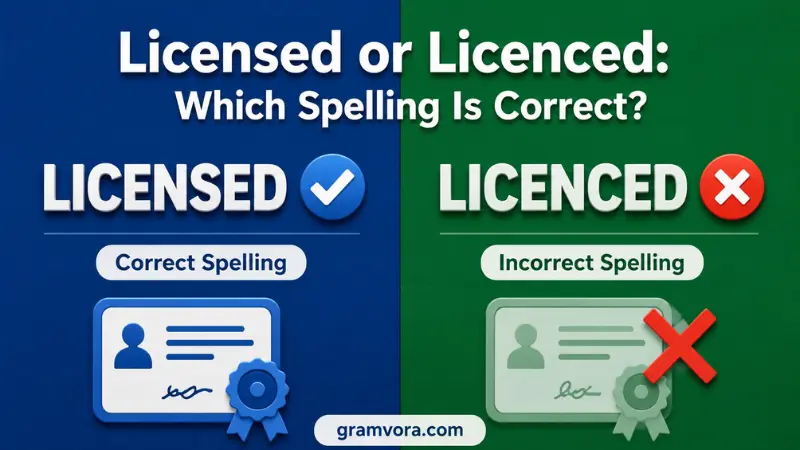
Licensed is the standard spelling in American English. It describes someone or something that has received official permission, approval, or authorization.
The spelling licenced has the same basic meaning and can be found in some British or Commonwealth writing. However, it is much less common in carefully edited modern English. Even major British dictionaries normally use licensed.
For a US audience, the practical choice is simple: use licensed.
Quick Answer
Use licensed in American English:
- a licensed contractor
- a licensed driver
- a company licensed to operate
Licenced is a less common regional variant with the same meaning. Although some dictionaries recognize it as chiefly British, leading British references generally prefer licensed for the verb form and the related adjective.
Why People Confuse Them
The confusion begins with the base word.
American English uses license as both a noun and a verb:
- She renewed her driver’s license.
- The state will license the new facility.
British English commonly separates the forms:
- licence for the noun
- license for the verb
Because British writers see the noun licence, some naturally form licenced by adding -d. Nevertheless, the standard British verb is usually license, which produces licensed.
The two spellings also sound exactly the same. Nothing in their pronunciation tells a writer whether to use s or c.
Key Differences At A Glance
| Context | Best Choice | Why |
| General US writing | licensed | This is the standard American spelling |
| US professional or legal writing | licensed | It matches American dictionaries and official usage |
| Edited British writing | licensed | The British verb is generally spelled license |
| A source that deliberately uses licenced | Preserve the source’s form | It may reflect regional or house style |
| International communication | licensed | It is the clearest and most widely recognized choice |
Compact comparison:
- Licensed: Standard in the United States and widely preferred in modern edited English.
- Licenced: Same meaning, but less common and mainly associated with limited British or Commonwealth usage.
- Pronunciation: Both are pronounced the same.
- Meaning: Neither spelling creates a separate definition.
Are They the Same Word?
Yes. Licensed and licenced represent the same underlying word. Both can describe a person, organization, product, activity, or property that has received permission from an authority or rights holder.
For example, a licensed electrician has official permission or qualifications to perform regulated electrical work. A licensed product may be manufactured or sold with the permission of the person or company that owns the relevant rights.
The spelling does not change that meaning. The real difference is acceptance and preference.
Licensed is the firmly established form in US English. It also appears as the normal form in major British dictionaries and edited publications. Licenced survives as a regional variant, but many readers and editors may treat it as a spelling error.
US vs UK Preference
In the United States, always use licensed. This applies whether the word is a past-tense verb, a past participle, or an adjective.
- The state licensed the clinic.
- The clinic is fully licensed.
- We hired a licensed inspector.
British English requires a more careful explanation. The noun is usually spelled licence, but the verb is normally license. As a result, the expected past form and adjective are licensed.
- British noun: She obtained a driving licence.
- British verb: The agency licensed the operator.
- British adjective: They visited a licensed restaurant.
Some dictionaries and regional publications accept or use licenced. Still, it should not be presented as the universal British equivalent of American licensed.
Which Spelling Should You Use?
Choose licensed for nearly all modern writing.
It is the correct choice for a US audience, including applications, business websites, professional profiles, advertisements, contracts, reports, and educational content.
The same recommendation works well for international readers. Licensed is immediately recognizable and is unlikely to be questioned by American or British editors.
Use licenced only when you have a clear reason, such as:
- following an established house style
- preserving the wording of an official title
- quoting a source exactly
- matching terminology required by a regional organization
Do not switch to licenced merely because your audience is British. Standard British references commonly use licensed.
When One Spelling Looks Wrong
In American writing, licenced usually looks like a misspelling. A reader may assume that the writer confused the British noun licence with the verb license.
Incorrect or unsuitable for US English:
- She is a licenced real estate agent.
- We hired a licenced plumber.
- The facility is licenced by the state.
Preferred:
- She is a licensed real estate agent.
- We hired a licensed plumber.
- The facility is licensed by the state.
The less common spelling may be acceptable when it appears in a quoted name, historic document, regional regulation, or organization’s established wording. In that situation, changing it could misrepresent the original source.
Common Mistakes (and Quick Fixes)
Mistake: Assuming every British form uses a c
British English normally uses licence for the noun but license for the verb. Therefore, the common participle is licensed.
Quick fix: Identify the grammatical role before changing the spelling.
Mistake: Using licenced for a US profession
- Wrong for standard US writing: a licenced nurse
- Correct: a licensed nurse
Quick fix: For American readers, keep the s in licensed.
Mistake: Treating the spellings as different meanings
The two forms do not describe different types of permission.
Quick fix: Base your decision on regional preference and editorial consistency, not meaning.
Mistake: Mixing forms in one document
A page may refer to a “licensed dealer” in one paragraph and a “licenced dealer” in another.
Quick fix: Select one convention and apply it consistently. For US content, select licensed.
Everyday Examples
The following sentences use the recommended American spelling:
- Maya is a licensed physical therapist in California.
- Only licensed contractors may submit bids for the project.
- The restaurant is licensed to serve beer and wine.
- Our company sells officially licensed team merchandise.
- Before signing the agreement, confirm that the broker is licensed.
- The software was licensed for use on twenty office computers.
- A licensed guide led the group through the protected area.
- The daycare center must remain licensed by the state.
The spelling licenced could appear in a source following a particular regional convention:
- The notice described the property as a licenced venue.
- Applicants had to work under a licenced supervisor.
The meaning remains unchanged, but licensed would be the safer form for a general US or international readership.
Dictionary-Style Word Details
Verb
- Licensed: The standard past tense and past participle of the verb license in American English. It means gave official permission or received official authorization.
- Licenced: A less common regional spelling of the same verb form. It is recorded by some dictionaries but is not the preferred form in standard US writing.
Examples:
- The state licensed the new pharmacy.
- The company was licensed to distribute the product.
Noun
Neither licensed nor licenced normally functions as a noun.
The related noun is license in American English. British English commonly spells the noun licence.
- US: She renewed her professional license.
- UK: She renewed her professional licence.
Synonyms
Meaning-matched alternatives depend on context.
Closest plain alternatives include:
- authorized
- permitted
- approved
- certified
- accredited
- officially allowed
These words are not interchangeable in every situation. For example, a person may be certified by a professional organization without holding the government license required by law.
Useful opposites include:
- unlicensed
- unauthorized
- prohibited
- uncertified
Example Sentences
Licensed:
- The electrician is licensed and insured.
- Our store sells licensed movie merchandise.
- The pilot is licensed to operate several types of aircraft.
- City officials licensed the business last month.
Licenced:
- The original notice referred to a licenced operator.
- The regional document used the phrase “licenced premises.”
The second spelling does not create a different meaning.
Word History
The base forms license and licence have existed in English for centuries. British English developed a noun-and-verb distinction similar to the difference between practice and practise: licence became the usual noun, while license remained the verb.
Because licensed develops from the verb license, the s spelling is standard in American English and strongly established in British edited usage. The spelling licenced reflects a less common extension of the noun’s c spelling or a regional convention.
Phrases Containing
Common phrases normally use licensed:
- licensed professional
- licensed contractor
- licensed dealer
- licensed physician
- fully licensed
- duly licensed
- licensed to practice
- licensed to operate
- licensed premises
- officially licensed merchandise
The same phrases may occasionally appear with licenced in regional writing. Their meanings remain the same, but the s form is recommended for US readers.
FAQs
Is it licensed or licenced in American English?
Licensed is the correct and standard spelling in American English. Use it for people, businesses, products, and activities that have received official permission or approval.
For example:
- a licensed physician
- a licensed contractor
- officially licensed merchandise
Is licenced a correct spelling?
Licenced is recorded by some dictionaries as a chiefly British or regional variant. However, it is uncommon in modern edited English and may look like a spelling mistake to many readers.
For general, professional, and international writing, licensed is the safer choice.
Is licensed used in British English?
Yes. Although British English commonly uses licence as the noun, it usually uses license as the verb. Therefore, the normal past-tense and adjective form is licensed.
For example:
- She received a driving licence.
- The agency licensed the business.
- It is a licensed venue.
Do licensed and licenced have different meanings?
No. Both spellings refer to receiving official permission, approval, or authorization. The difference is spelling preference, not meaning.
However, licensed is much more widely accepted and is the standard form in US English.
Should I write licensed professional or licenced professional?
Write licensed professional, especially for a US audience.
Examples include:
- licensed medical professional
- licensed financial professional
- licensed mental health professional
Using licenced professional may appear incorrect unless a specific regional organization or house style requires it.
Is it licensed premises or licenced premises?
Licensed premises is the safest and most widely accepted form. The phrase usually refers to a place that has official permission to carry out a regulated activity, such as serving alcohol.
Licenced premises may occasionally appear in regional writing, but it is less common.
How can I remember the correct spelling?
Remember that the verb is normally license, with an s. When you add -d, it becomes licensed.
- license → licensed
- license → licensing
For American English, keep the s in every form.
Conclusion
Use licensed for American English and as the safest choice in most modern writing. It is also the normal form in leading British dictionaries and edited publications.
Licenced has the same meaning and survives as a limited regional variant, but it may look incorrect to many readers. Unless a specific source or house style requires otherwise, write licensed.