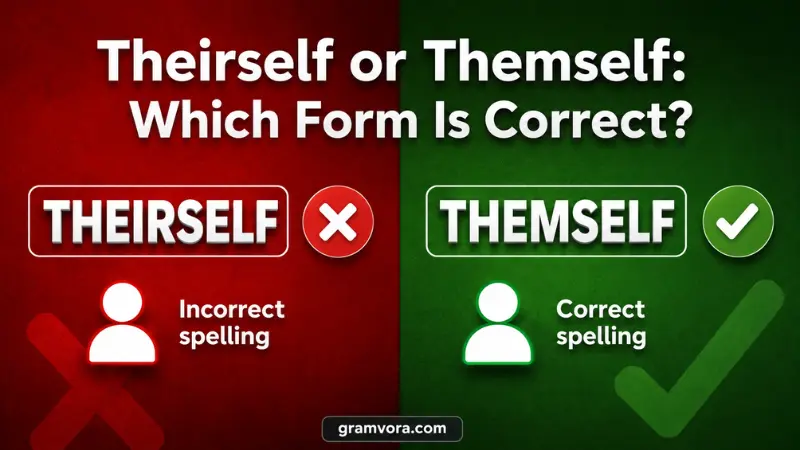
When choosing between theirself or themself, use themself in standard American English.
Themself is a singular reflexive or intensive pronoun used with singular they. Theirself communicates a similar idea, but it is chiefly a dialectal form. It may occur naturally in regional speech, quoted language, or dialogue, but it is normally avoided in edited school, workplace, and professional writing.
One important detail is often missed: themselves can also refer to one person. Major style authorities accept both themself and themselves with singular they. However, between the two forms in the main question, themself is the safer standard choice.
Quick Answer
Use themself when singular they refers to one person who performs an action affecting that same person.
“Alex taught themself how to repair the bike.”
Use theirself only when preserving a person’s dialect, exact wording, character voice, or stated pronoun preference. It is not the usual form in standard edited English.
Remember these four points:
- One person with singular they: usually themself or themselves
- More than one person: themselves
- Standard comparison choice: themself
- Regional or dialectal form: theirself
What Is Correct?
Themself is correct in modern American usage when it refers to one person represented by singular they.
For example:
“Every applicant should introduce themself at the front desk.”
“Jordan reminded themself to submit the form.”
“The instructor themself approved the schedule.”
The first two sentences use themself reflexively. The subject and the object refer to the same person. The third uses it intensively to emphasize the instructor.
Theirself is understandable, and it has a long history in English. Still, it is not the default form for standard edited writing. A teacher, editor, or employer may mark it as nonstandard.
When writing about a known person, follow that person’s pronoun preference. Some people who use they prefer themself, while others prefer themselves. A person may also use a less common form as part of an individual pronoun set.
The Core Grammar Rule
A reflexive pronoun points back to the subject of its clause. Use one when the person performing the action is also receiving or experiencing that action.
“Taylor prepared themself for the interview.”
Taylor performed the preparation, and Taylor was the person being prepared.
Do not use a reflexive pronoun merely because it sounds formal. When the subject and object refer to different people, use the ordinary object pronoun them.
“Please contact Taylor or them.”
In that sentence, the person making contact is not Taylor. Therefore, themself would not fit.
The same form can also work as an intensive pronoun. An intensive pronoun adds emphasis and can usually be removed without changing the basic meaning.
“Taylor themself answered the complaint.”
“Taylor answered the complaint.”
Both sentences report the same action, but the first emphasizes that Taylor personally answered.
When Each Form Is Correct
| Form or Pattern | Best Use | Why |
|---|---|---|
| themself | Referring to one person represented by singular they | It is a recognized singular reflexive or intensive form |
| theirself | Preserving regional speech, exact wording, dialogue, or an individual preference | It is meaningful but chiefly dialectal rather than standard |
| themselves | Referring to several people or, when preferred, one person represented by singular they | It is the established plural form and an accepted singular alternative |
Use themself when you want to make the singular meaning clear:
“Someone left themself a reminder.”
“Riley taught themself to play the guitar.”
“The winner can choose the prize themself.”
In normal edited prose, revise theirself:
Less standard: “Riley taught theirself to play.”
Standard: “Riley taught themself to play.”
However, retaining theirself can be appropriate when reproducing someone’s exact speech or creating dialogue that reflects a particular regional variety.
When It Is Incorrect or Less Natural
Theirself is less natural in standard American writing because it is associated mainly with dialectal speech. The sentence may be understandable, but it may distract readers or be corrected by an editor.
Less natural in edited prose:
“Each employee should check theirself in at reception.”
More standard:
“Each employee should check themself in at reception.”
A separate error occurs when themself is used where ordinary them is needed.
Incorrect:
“Please send the receipt to Morgan or themself.”
Correct:
“Please send the receipt to Morgan or them.”
The person sending the receipt is not Morgan, so the reflexive form cannot point back to the subject.
Using a reflexive as the entire subject is also generally nonstandard.
Incorrect:
“Themself will present the report.”
Correct:
“They will present the report themself.”
Correct:
“They themself will present the report.”
The second corrected version is grammatical but may sound formal or emphatic.
Meaning, Structure, or Emphasis Differences
Theirself and themself normally express the same basic meaning: one person refers back to that same person, or one person receives special emphasis.
The main difference is not meaning. It is usage status.
Themself is increasingly accepted as part of the singular set they, them, their, theirs, and themself. It clearly signals that only one person is involved.
Theirself is formed in a way that may feel logical to some speakers because several reflexive pronouns begin with a possessive-looking form, as in myself and yourself. However, English reflexive pronouns do not follow one completely regular formation rule. Standard usage is established by convention, not by one simple formula.
Compare the two functions:
“Jamie blamed themself.”
Here, themself is reflexive. Jamie performed and received the action.
“Jamie themself approved the design.”
Here, themself is intensive. It emphasizes Jamie’s direct involvement.
Real-World Examples
“Each customer can complete the return themself.”
The word refers back to the singular subject each customer.
“Cameron introduced themself to the new team.”
Cameron is both the person introducing and the person being introduced.
“The doctor themself called with the results.”
The pronoun adds emphasis. It tells us that the doctor personally called.
“Someone may surprise themself by finishing early.”
The identity or gender of the person is unknown or unimportant.
“Lee said they would handle the problem themself.”
The final word makes clear that Lee will act without another person doing it for them.
Nonstandard:
“The student congratulated theirself.”
Standard:
“The student congratulated themself.”
Wrong reflexive placement:
“The director asked Casey and themself to attend.”
Correct:
“The director asked Casey and them to attend.”
In the corrected sentence, them is the object of asked. It does not refer back to the director.
Common Mistakes (and Quick Fixes)
A common mistake is assuming that theirself must be correct because English has yourself. That comparison seems logical, but reflexive pronouns developed through mixed patterns. Modern standard usage favors themself, not theirself, for singular they.
Another mistake is claiming that themself is always the only acceptable singular choice. In reality, many writers and style guides also accept themselves for one person.
Some writers use themself as a formal substitute for them. This creates the same type of error seen in phrases such as “contact myself.” A reflexive pronoun needs a matching subject unless it is being used only for emphasis.
Writers may also confuse dialect with meaningless language. Theirself is a genuine form used by some English speakers. Calling it standard formal English would be inaccurate, but claiming that it has no meaning would also be inaccurate.
Grammar Rule Details
Rule
Use themself when singular they refers back to one person who is also the subject of the clause.
“Robin allowed themself a short break.”
Use it intensively when you want to emphasize the person represented by singular they.
“Robin themself approved the final version.”
Correct Usage
A correct reflexive sentence contains a clear relationship between the subject and the reflexive pronoun.
“Dana taught themself Spanish.”
“Every participant should ask themself whether the plan is realistic.”
“The owner themself opened the store.”
The first two examples are reflexive. The final example is intensive.
Incorrect or Less Natural Usage
In standard edited English, theirself is normally replaced with themself or themselves.
Less natural:
“Pat made the reservation theirself.”
More standard:
“Pat made the reservation themself.”
Do not use themself when the pronoun does not point back to the subject.
Incorrect:
“You should invite Pat and themself.”
Correct:
“You should invite Pat and them.”
Examples
“Anyone can teach themself the basic steps.”
“Quinn reminded themself about the appointment.”
“The applicant themself requested another interview.”
“Whoever finishes first can congratulate themself.”
“Sky said they needed time by themself.”
In the final example, by themself means alone or without help.
Common Mistakes
Do not treat theirself as the default formal form.
Do not assume themself is automatically correct anywhere them could appear.
Do not use themself for several people. Use themselves when the referent is clearly plural.
Do not change a known person’s pronoun set merely to follow your own preference.
Exceptions
Theirself may be appropriate in an exact quotation, dialogue representing regional speech, linguistic discussion, or writing about a person who specifically uses that form.
This does not make it the general standard. It means the writer has a reason to preserve the original or preferred language.
Another accepted option is singular themselves. Some publications prefer it because it is more established and familiar.
Quick Test
Ask two questions:
Does the pronoun refer to one person represented by they?
Does it point back to that same person or emphasize that person?
When both answers are yes, use themself unless the person or publication prefers themselves. In ordinary edited writing, do not replace it with theirself.
Usage Notes
Acceptance of themself is still developing. Some dictionaries retain cautionary labels, while major American academic styles accept it.
For writing that must follow a particular publication, school, or workplace standard, check the required house style. For a specific person, use the reflexive form that person prefers.
FAQs
Is theirself a real word?
Yes. Theirself is a recorded English word, but it is chiefly dialectal. That means it belongs naturally to certain regional or social varieties of English rather than to general standard edited English. It may be appropriate in dialogue, quotations, or linguistic discussion. In most formal writing, use themself instead.
Is themself grammatically correct?
Yes. Themself can function as the singular reflexive or intensive form associated with singular they. It is especially useful when referring to a specific person who uses they pronouns or to one person whose gender is unknown or irrelevant. Some readers and publications still prefer themselves.
Should one person use themself or themselves?
Both forms can be acceptable with singular they. Themself clearly marks the referent as one person, while themselves is the older and more familiar form in current usage. Follow the person’s preference when known. Otherwise, follow the style required for the document.
Can theirself be used in dialogue?
Yes. Theirself can be retained when it accurately reflects how a character or real speaker talks. Dialogue does not always follow the conventions of formal edited prose. However, avoid using the form carelessly to stereotype a speaker or community.
Is themself a reflexive or intensive pronoun?
It can perform either role. It is reflexive when it points back to the subject, as in “Avery prepared themself.” It is intensive when it adds emphasis, as in “Avery themself made the decision.” Removing an intensive pronoun usually leaves the sentence’s basic meaning intact.
Conclusion
Between theirself or themself, choose themself for standard American English.
Use it when singular they refers back to one person or when you want to emphasize that person. Theirself is a meaningful dialectal form, but it is not the usual choice for school, business, academic, or other edited writing.
Remember that themselves is also accepted with singular they. A person’s stated preference or a publication’s house style may determine the final choice. Without another requirement, themself is the clearest standard answer to the comparison.