
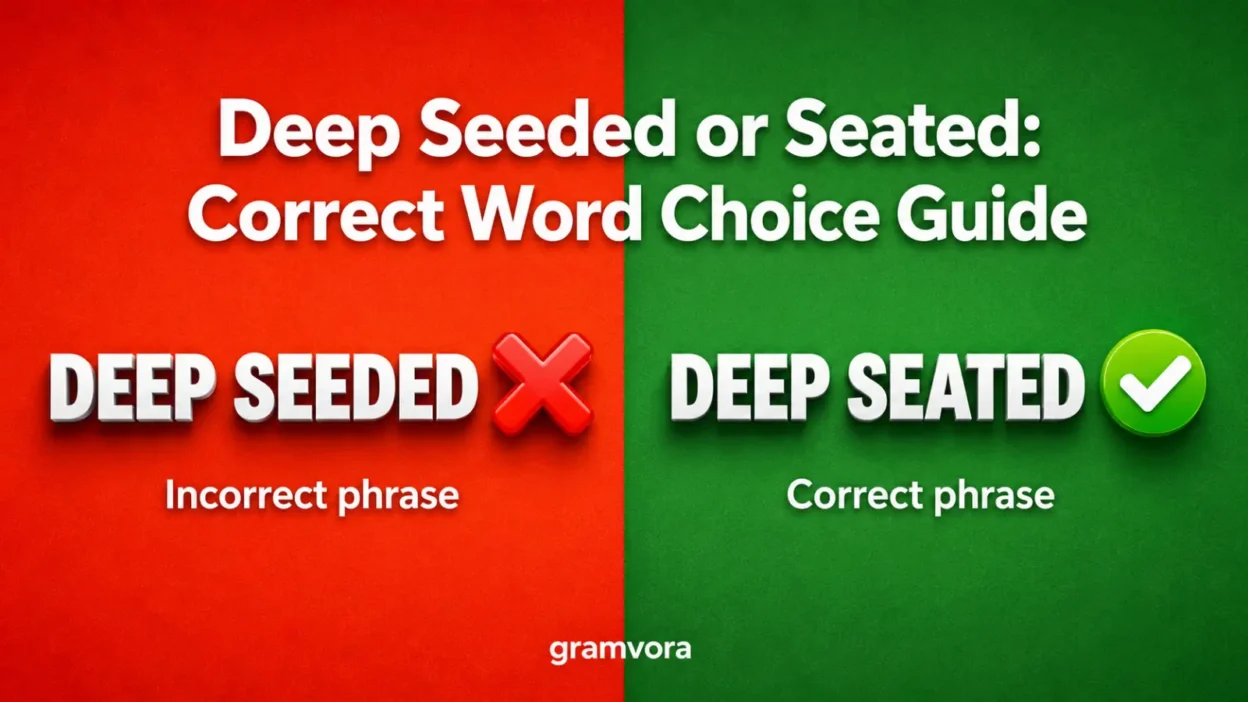
If you are choosing between deep seeded or seated, the standard expression you probably need is deep-seated. It means something is firmly established, strongly held, or set far below the surface.
The phrase often describes fears, beliefs, problems, anger, habits, or social issues that are hard to change. The confusion happens because deep seeded sounds logical. A seed can be planted deep, so the image feels natural. In standard writing, though, that is not the usual phrase for an ingrained feeling or problem.
The word seated matters because it carries the idea of something being fixed in place. In this expression, the full form is normally written with a hyphen: deep-seated.
Quick Answer
Use deep-seated when you mean firmly established, deeply felt, or hard to remove.
Use seated by itself only when you mean sitting, placed, or installed in a position.
Avoid deep seeded when you mean an entrenched belief, fear, problem, or feeling. It is usually treated as a mistake in edited US English.
Correct: She has a deep-seated fear of failure.
Incorrect: She has a deep seeded fear of failure.
Why People Confuse Them
People confuse these forms because seeded creates a strong mental image. A seed planted deep in the ground can grow roots, so “deep seeded” feels like it should mean “deeply rooted.”
That logic is understandable, but it is not the standard expression.
The correct phrase is based on seated, not seeded. Here, seated does not mean someone is sitting in a chair. It points to something fixed, placed, or settled deep within a person, system, body, or situation.
That is why deep-seated resentment, deep-seated pain, and deep-seated problems sound natural in careful writing.
Key Differences At A Glance
| Context | Best Choice | Why |
|---|---|---|
| A strong fear | deep-seated | It means firmly established or deeply felt. |
| A long-term problem | deep-seated | It suggests something hard to change. |
| A physical pain below the surface | deep-seated | It can describe something located deep inside. |
| Someone sitting down | seated | It means sitting or placed in a seat. |
| A planted crop | seeded | It can describe seeds being planted. |
| A belief that is hard to remove | deep-seated | “Deep seeded” is not the standard phrase. |
Meaning and Usage Difference
Deep seeded is usually a mistaken form when the intended meaning is “firmly established.” It may look meaningful, but it is not the form careful writers use for beliefs, fears, prejudice, habits, or problems.
Seated is a real word. It can mean sitting, placed, or fixed in position. But in this comparison, readers are usually not choosing between deep seeded and seated alone. They are trying to write the full expression deep-seated.
Compact comparison:
- deep seeded: usually wrong for “firmly established”
- seated: correct as a normal word meaning sitting or placed
- deep-seated: the correct full expression for something ingrained, fixed, or hard to change
Pronunciation is simple: deep-seated sounds like “deep SEE-tid.”
Tone, Context, and Formality
Deep-seated works in both serious everyday writing and formal writing. It is common in business, psychology, health, politics, education, and social commentary.
You might write about a deep-seated concern, a deep-seated bias, or a deep-seated issue in the company culture.
The phrase often sounds serious because it points to something that is not easy to fix. It is stronger than simply saying “big,” “old,” or “strong.”
Deep seeded can look careless in polished writing. Even if readers understand your meaning, some may notice the error. For professional writing, school papers, reports, and published content, use deep-seated.
Which One Should You Use?
Use deep-seated when the idea is internal, old, strong, or hard to change.
Write:
A deep-seated fear
A deep-seated belief
A deep-seated problem
A deep-seated resentment
A deep-seated cultural habit
A deep-seated pain
Use seated alone when you are talking about someone or something being placed in a seat or position.
Write:
The guests were seated by 7 p.m.
She remained seated during the announcement.
The board seated two new members.
Do not use deep seeded for fear, anger, bias, beliefs, or problems unless you are making a literal statement about seeds.
When One Choice Sounds Wrong
Deep seeded sounds wrong in standard writing when there are no actual seeds involved.
Wrong: The team has deep seeded trust issues.
Better: The team has deep-seated trust issues.
Wrong: His anger was deep seeded.
Better: His anger was deep-seated.
Wrong: The policy caused deep seeded confusion.
Better: The policy caused deep-seated confusion.
Seated sounds wrong if you use it alone where the full adjective is needed.
Awkward: She has a seated fear of dogs.
Better: She has a deep-seated fear of dogs.
The word seated needs the full phrase deep-seated to carry this meaning.
Common Mistakes (and Quick Fixes)
Mistake: Writing deep seeded because it sounds more natural.
Fix: Use deep-seated for something firmly established.
Mistake: Dropping the hyphen before a noun.
Fix: Write a deep-seated problem, not a deep seated problem, in polished writing.
Mistake: Using seated alone for an emotion.
Fix: Use deep-seated when describing a strong inner feeling.
Mistake: Using the phrase for small, temporary issues.
Fix: Save deep-seated for serious or long-lasting things.
Weak: I have a deep-seated craving for pizza.
Better: I have a strong craving for pizza.
Everyday Examples
Correct: Her fear of public speaking is deep-seated.
Correct: The city faces deep-seated housing problems.
Correct: The novel explores deep-seated family resentment.
Correct: He has a deep-seated need to prove himself.
Correct: The doctor asked about any deep-seated pain.
Correct: The company is trying to address deep-seated mistrust.
Correct: The guests were seated near the front.
Correct: Please stay seated until the meeting ends.
Incorrect: Her fear of public speaking is deep seeded.
Incorrect: The city faces deep seeded housing problems.
Incorrect: He has a seated fear of failure.
Dictionary-Style Word Details
Verb
deep seeded: Not commonly used as a verb phrase in standard US English for this meaning. The word seeded can be a verb form in literal uses, as in “The farmer seeded the field,” but that is not the same as deep-seated fear.
seated: Can be a verb form of seat. Example: “The host seated the guests near the window.” In deep-seated, it helps form an adjective.
Noun
deep seeded: Not commonly used as a noun in standard US English.
seated: Not commonly used as a noun in this comparison. It is usually an adjective or a verb form.
Synonyms
deep seeded: No exact standard synonym applies because the phrase is usually a mistaken form for deep-seated in this context.
seated: Closest plain alternatives depend on meaning: sitting, placed, positioned, installed.
deep-seated: Closest plain alternatives include ingrained, entrenched, firmly established, deep-rooted, long-standing, and hard to change.
Example Sentences
deep seeded: Avoid it for this meaning.
Incorrect: The issue is deep seeded in the organization.
seated: The audience was seated before the show began.
deep-seated: The issue is deep-seated in the organization.
deep seeded: Avoid it for this meaning.
Incorrect: She carried a deep seeded fear of rejection.
deep-seated: She carried a deep-seated fear of rejection.
Word History
deep seeded: This form likely spread because it sounds sensible. The image of a seed planted deep in the ground makes the mistake easy to understand. Still, it is not the standard expression for an ingrained feeling, belief, or problem.
seated: The relevant idea behind seated is placement or fixed position. In deep-seated, the meaning points to something set deeply in place. The phrase has a long history in English, but everyday writers do not need a date to use it correctly.
Phrases Containing
deep seeded: Avoid in standard phrases such as deep seeded fear, deep seeded resentment, and deep seeded problem. Use deep-seated instead.
seated: Common phrases include be seated, remain seated, seated at the table, and seated in office.
deep-seated: Common phrases include deep-seated fear, deep-seated belief, deep-seated resentment, deep-seated problem, deep-seated pain, and deep-seated bias.
FAQs
Is it deep seeded or deep-seated?
The correct expression is deep-seated. It means something is firmly established, strongly felt, or difficult to change. Deep seeded is usually a mistake when people mean deep-seated.
What does deep-seated mean?
Deep-seated means deeply fixed, strongly rooted, or hard to remove. It is often used for fears, beliefs, problems, anger, pain, or attitudes that have existed for a long time.
Is deep seeded ever correct?
Deep seeded can make sense only in a literal seed-related context, such as seeds planted deep in soil. But for emotions, beliefs, fears, or problems, the correct phrase is deep-seated.
Why do people write deep seeded instead of deep-seated?
People write deep seeded because it sounds logical. A seed planted deep can grow roots, so the phrase feels natural. However, the standard expression is deep-seated, not deep seeded.
Should deep-seated have a hyphen?
Yes, use a hyphen when it comes before a noun: a deep-seated fear, a deep-seated problem, a deep-seated belief. After the noun, the hyphen is still commonly used because it is a fixed compound adjective.
Can I say seated instead of deep-seated?
No. Seated alone usually means sitting or placed in a position. To mean “firmly established” or “deeply felt,” use the full expression deep-seated.
What is an example of deep-seated in a sentence?
Example: She has a deep-seated fear of failure.
This means her fear is strong, long-lasting, and not easy to change.
What is the opposite of deep-seated?
There is no perfect opposite, but possible plain opposites include temporary, surface-level, minor, short-term, or easy to change, depending on the sentence.
Is deep-rooted the same as deep-seated?
They are very close in meaning. Deep-rooted often suggests something has grown over time, while deep-seated suggests something is firmly fixed or established. In many everyday sentences, both can work.
Which phrase should I use in formal writing?
Use deep-seated in formal, academic, business, and professional writing. Avoid deep seeded unless you are literally talking about seeds.
Conclusion
For the choice deep seeded or seated, the answer is clear: use deep-seated when you mean something is firmly established, deeply felt, or hard to change.
Deep seeded may sound logical, but it is usually a mistake for this meaning. Seated is a correct word by itself, but it does not replace the full expression unless it appears as part of deep-seated.
Best rule: if there are no actual seeds, and you mean “ingrained” or “hard to change,” write deep-seated.
[…] are correct words, but they describe different relationship […]