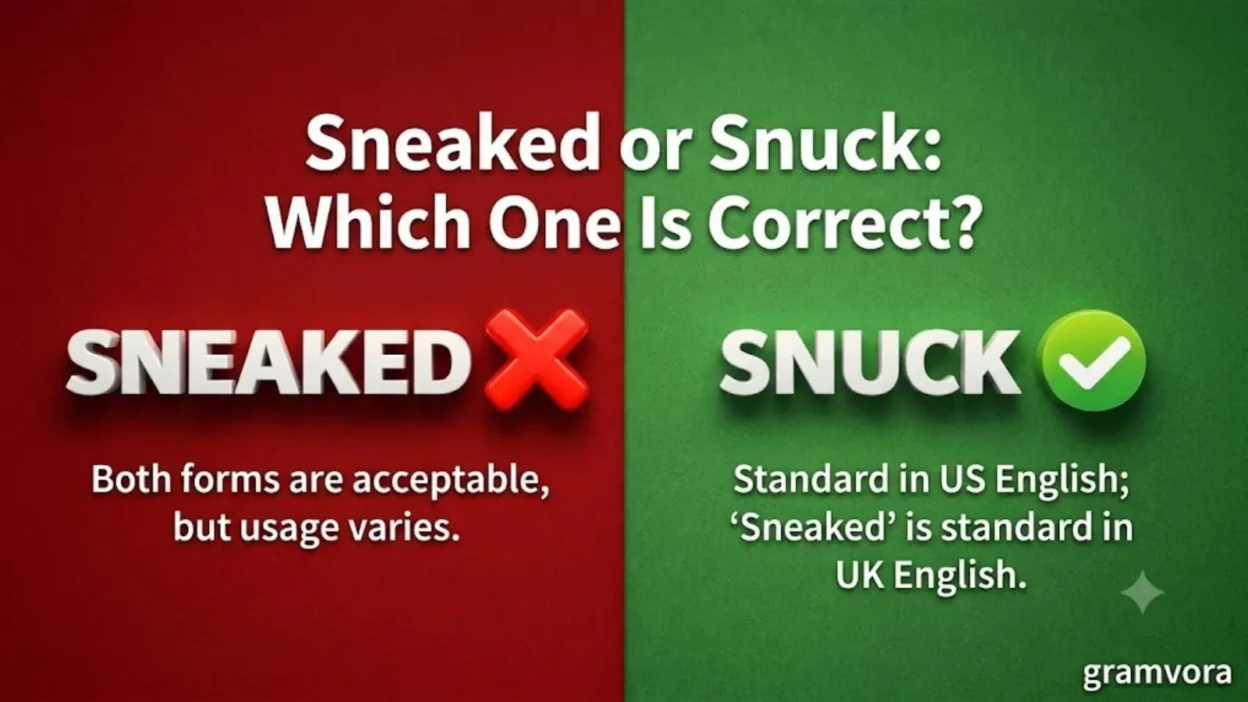
“Sneaked” and “snuck” are both used as the past tense and past participle of the verb “sneak.” The difference is not meaning. The difference is tone, setting, and reader expectation.
In modern US English, both forms are accepted. Still, they do not feel exactly the same. “Sneaked” sounds more traditional, polished, and safe in formal writing. “Snuck” sounds more casual, conversational, and strongly natural to many American speakers.
So the best choice depends on where the sentence will appear.
Quick Answer
Use “sneaked” when you want the safest choice, especially in school papers, workplace writing, formal articles, reports, and edited prose.
Use “snuck” when you want a natural, casual American tone, especially in dialogue, personal stories, texts, and relaxed writing.
Both can mean the same thing:
She sneaked out of the meeting early.
She snuck out of the meeting early.
The action is the same. The tone changes. “Sneaked” feels more formal. “Snuck” feels more conversational.
Why People Confuse Them
People confuse “sneaked” and “snuck” because English has two kinds of past-tense patterns.
Many verbs are regular. They form the past tense with “-ed.” That is why “sneak” can become “sneaked.”
Other verbs are irregular. They change form instead of adding “-ed.” That is why “sneak” can also become “snuck.”
The confusing part is that “sneak” did not always work this way for everyone. “Sneaked” is the older regular form. “Snuck” came later and became common, especially in American English.
That is why some readers still prefer “sneaked,” while many speakers use “snuck” without thinking twice.
Key Differences At A Glance
| Context | Best Choice | Why |
|---|---|---|
| Formal writing | sneaked | It is the safer traditional form. |
| School assignments | sneaked | Teachers and editors are less likely to object. |
| Business writing | sneaked | It sounds more polished and neutral. |
| News-style writing | sneaked | It avoids distracting readers who dislike “snuck.” |
| Casual conversation | snuck | It sounds natural to many US speakers. |
| Dialogue in fiction | snuck | It can make speech sound relaxed and real. |
| Personal storytelling | snuck | It fits an informal voice. |
| When unsure | sneaked | It works almost everywhere. |
Meaning and Usage Difference
“Sneaked” and “snuck” usually have the same meaning. Both mean that someone moved, acted, or placed something secretly, quietly, or without being noticed.
You can use either one for a person moving secretly:
The kids sneaked into the kitchen.
The kids snuck into the kitchen.
You can also use either one when someone secretly brings, takes, or adds something:
He sneaked candy into the theater.
He snuck candy into the theater.
The real difference is not the action. The real difference is how the sentence sounds.
“Sneaked” is the regular past form. It follows the normal “-ed” pattern. “Snuck” is the irregular past form. It does not follow the regular pattern, but it is common in US English.
Pronunciation can also help. “Sneaked” sounds like “sneekt.” “Snuck” rhymes with “duck.” The sound difference is clear, but the meaning is usually the same.
Tone, Context, and Formality
“Sneaked” is the better choice when your writing needs to sound careful. It works well in formal emails, school essays, workplace reports, and edited articles.
For example:
The employee sneaked confidential files out of the office.
That sentence sounds serious and controlled. “Snuck” would still be understandable, but it may sound too casual for the context.
“Snuck” is more relaxed. It often sounds right in everyday American speech:
I snuck out early because the meeting ran too long.
That sentence sounds natural in conversation. It is direct and casual.
This does not mean “snuck” is only slang. It is widely used. Still, some careful readers may prefer “sneaked,” especially in formal writing. That is why “sneaked” remains the safer default.
Which One Should You Use?
Choose “sneaked” when you do not know your reader’s preference.
That one choice solves most problems. “Sneaked” is clear, correct, and unlikely to distract anyone. It works in formal and casual settings.
Choose “snuck” when you want a natural American speaking voice. It can sound smoother in dialogue or personal writing.
Compare these two sentences:
I sneaked into the room after the movie started.
I snuck into the room after the movie started.
The first sentence sounds a little more written. The second sounds more like something a person might say out loud.
Neither sentence changes the basic meaning. The choice is about voice.
When One Choice Sounds Wrong
“Snuck” can sound wrong in very formal writing because some readers still see it as too casual. In a legal memo, academic essay, or formal company report, “sneaked” is usually better.
Weak: The contractor snuck extra charges into the invoice.
Better: The contractor sneaked extra charges into the invoice.
The second version sounds more professional.
“Sneaked” can sound stiff in casual dialogue, especially if the speaker is meant to sound relaxed.
Stiff: I sneaked out before anyone saw me.
Natural: I snuck out before anyone saw me.
Both are correct, but the second line may sound more like everyday US speech.
Common Mistakes (and Quick Fixes)
One common mistake is saying “snuck” is always wrong. That is too strict for modern US English. “Snuck” is common and accepted in many contexts.
Better fix: Use “snuck” freely in casual writing, but switch to “sneaked” when the tone needs to be formal.
Another mistake is saying “sneaked” and “snuck” have different meanings. They usually do not.
Wrong idea: “Sneaked” means moving secretly, while “snuck” means stealing secretly.
Better idea: Both can describe secret movement or secret action.
A third mistake is mixing the base form with the past form.
Incorrect: She sneak out after dinner.
Correct: She sneaked out after dinner.
Correct: She snuck out after dinner.
Use “sneak” for present tense. Use “sneaked” or “snuck” for past tense.
Everyday Examples
Here are natural ways to use both words.
She sneaked into the garage to hide the birthday gift.
She snuck into the garage to hide the birthday gift.
The dog sneaked under the table during dinner.
The dog snuck under the table during dinner.
I sneaked a look at the final score during class.
I snuck a look at the final score during class.
They sneaked out before the speeches began.
They snuck out before the speeches began.
The writer sneaked a joke into the last paragraph.
The writer snuck a joke into the last paragraph.
The coach sneaked a new play into the second half.
The coach snuck a new play into the second half.
In each pair, the basic meaning stays the same. “Sneaked” sounds a bit more formal. “Snuck” sounds more relaxed.
Dictionary-Style Word Details
Verb
Sneaked: A past-tense and past-participle form of the verb “sneak.” It is the regular form and works in both formal and informal writing.
Example: She sneaked past the front desk.
Snuck: A past-tense and past-participle form of the verb “sneak.” It is the irregular form and is especially common in casual US English.
Example: She snuck past the front desk.
Both forms can be used after helping verbs:
He had sneaked out before sunrise.
He had snuck out before sunrise.
Noun
Sneaked: Not commonly used as a noun in standard US English.
Snuck: Not commonly used as a noun in standard US English.
The base word “sneak” can be a noun, as in “He is a sneak,” but “sneaked” and “snuck” are normally verb forms. Do not use them as nouns in ordinary writing.
Synonyms
Sneaked: Closest plain alternatives include slipped, crept, tiptoed, stole, skulked, and moved quietly.
Snuck: Closest plain alternatives include slipped, crept, tiptoed, stole, skulked, and moved quietly.
These are not perfect replacements in every sentence. “Slipped out” may sound less secretive than “sneaked out.” “Skulked” can sound darker or more suspicious. “Tiptoed” focuses more on quiet movement.
Clear opposites are hard to give because “sneaked” and “snuck” describe a manner of action, not a simple opposite idea. In some sentences, “entered openly,” “walked in,” or “announced” may work as opposite-style wording.
Example Sentences
Sneaked: The cat sneaked into the laundry room while the door was open.
Snuck: The cat snuck into the laundry room while the door was open.
Sneaked: I sneaked a quick look at my phone during the break.
Snuck: I snuck a quick look at my phone during the break.
Sneaked: The team sneaked a clever reference into the commercial.
Snuck: The team snuck a clever reference into the commercial.
Sneaked: He had sneaked out before anyone noticed.
Snuck: He had snuck out before anyone noticed.
Word History
Sneaked: This is the older regular past form of “sneak.” It follows the normal pattern used by many English verbs: sneak, sneaked, sneaked.
Snuck: This is the later irregular form. It became common in American English and is now widely used. Its exact path into common use is not fully clear, so it is safest to describe it as a later form rather than claim one certain origin.
The important point for writers is simple: “sneaked” has the longer formal history, while “snuck” has become normal in much modern American use.
Phrases Containing
Sneaked: sneaked out, sneaked in, sneaked up on, sneaked around, sneaked a look, sneaked a peek, sneaked past.
Snuck: snuck out, snuck in, snuck up on, snuck around, snuck a look, snuck a peek, snuck past.
Both forms fit the same phrase patterns. The choice still depends on tone.
| Feature | Sneaked | Snuck |
| Verb form | Regular past form | Irregular past form |
| Tone | More formal | More casual |
| Best use | Formal writing | Everyday speech |
| Risk level | Very safe | May bother some formal readers |
| Meaning | Secret movement or action | Secret movement or action |
Conclusion
“Sneaked” and “snuck” are both past forms of “sneak” in modern US English. They usually mean the same thing, so the choice is mainly about tone.
Use “sneaked” when you want the safest, most formal, least distracting option.
Use “snuck” when you want a casual, natural American sound.
When in doubt, choose “sneaked.” It works almost everywhere. But in everyday speech and relaxed writing, “snuck” is also a normal choice.