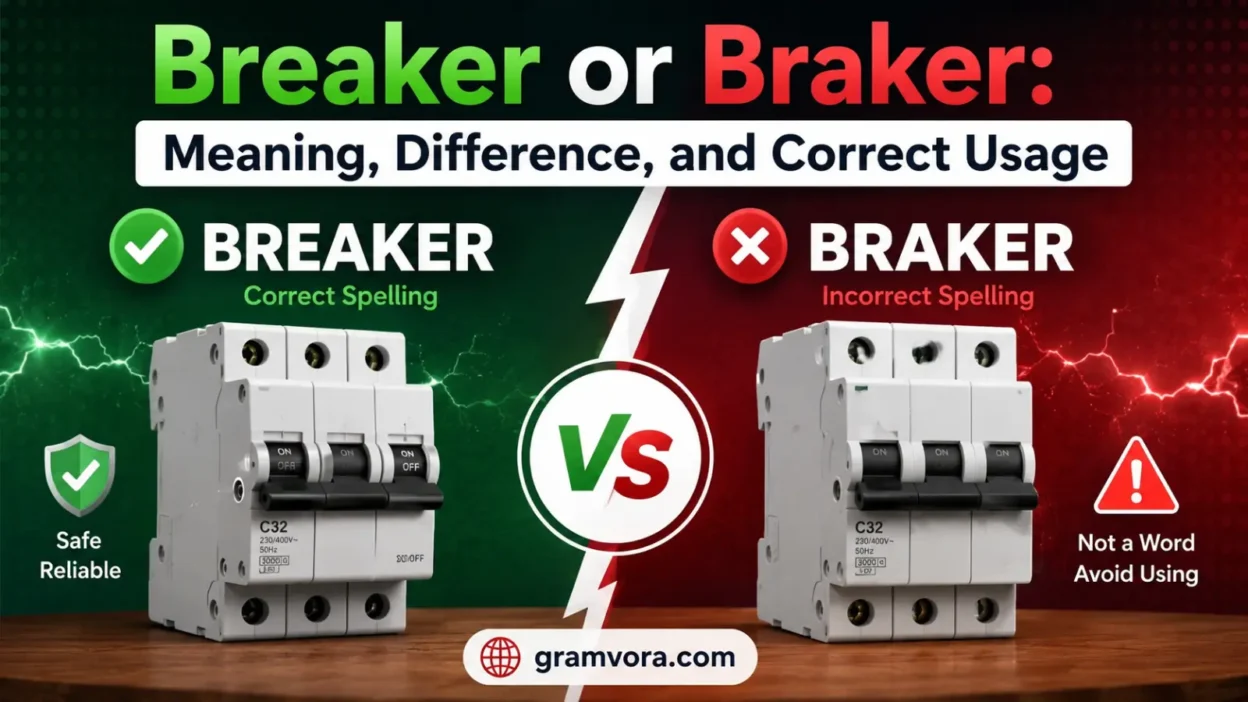
Breaker and braker sound the same, but they are not interchangeable. Breaker is the familiar word used for electrical devices, breaking waves, and compounds such as deal-breaker and tie-breaker. Braker is a real but uncommon noun limited to narrow occupational or technical uses.
For almost every everyday sentence, breaker is the choice readers expect.
Quick Answer
Use breaker when you mean a person or thing that breaks, interrupts, separates, or ends something. Common examples include circuit breaker, record breaker, rule-breaker, tie-breaker, and ocean breakers.
Use braker only when the context specifically refers to someone who applies brakes or to one of its rare specialized occupational meanings. In ordinary writing, readers may assume braker is a misspelling unless the context makes its narrow meaning clear.
Both words are nouns, and both are usually pronounced BRAY-ker.
Why People Confuse Them
The confusion begins with the verbs break and brake. Break can mean to damage, divide, interrupt, or stop continuity. Brake means to slow or stop movement with a braking system.
Adding -er creates two similar-looking nouns. Break becomes breaker, while brake can produce the much rarer braker. Because the resulting words sound alike, the missing or added e is easy to overlook.
Writers also connect electrical equipment with stopping power. However, a circuit breaker is named for breaking or interrupting a circuit, not for applying a vehicle brake.
Key Differences At A Glance
| Context | Best Choice | Why |
|---|---|---|
| Electrical safety device | breaker | It breaks or interrupts an electrical circuit. |
| Wave collapsing near shore | breaker | The wave breaks into foam. |
| Condition that ends an agreement | deal-breaker | The condition breaks or ends the deal. |
| Final event that decides a tie | tie-breaker | It breaks the tie. |
| Person or achievement that exceeds a record | record breaker | The person or result breaks the record. |
| Person described by braking technique | braker | This rare use can describe someone who applies brakes, as in left-foot braker. |
| Specialized dough-production worker | braker | A dictionary sense refers to a worker who rolls dough in a machine called a brake. |
Compact comparison:
- Breaker: Common noun formed from break; broad everyday, technical, sports, and figurative uses.
- Braker: Rare noun formed from brake; narrow occupational or braking-related uses.
- Both: Pronounced alike in standard American English, so context and spelling carry the distinction.
Meaning and Usage Difference
Breaker has several established meanings. It can name someone or something that breaks an object, rule, record, deadlock, or flow. It also refers to a wave that breaks into foam and commonly serves as a shortened form of circuit breaker.
Its meaning changes with the noun beside it. A rule-breaker violates a rule. A record breaker surpasses a record. A deal-breaker causes someone to reject an agreement, purchase, plan, or relationship. In each case, the idea of breaking, interrupting, or ending remains central.
Braker has much less range. It may describe a person according to how that person uses brakes, especially in a specialized phrase such as left-foot braker. Dictionaries also preserve rare occupational and technical senses, including a worker who rolls dough with a machine called a brake and a shipbuilding term.
Therefore, braker is not simply an alternative spelling of breaker. It belongs to a different word family and appears in far fewer situations.
Tone, Context, and Formality
The choice is not mainly about formal versus informal language. It is about common versus specialized meaning.
Breaker sounds natural in conversation, schoolwork, journalism, business writing, sports coverage, home-maintenance instructions, and electrical documents. Readers recognize its common meanings immediately.
Braker often needs context. In a driving discussion, a skilled left-foot braker may be clear. In an old factory record, the word may name a specific worker. Without that support, many readers will treat braker as an error.
In professional writing, use braker only when the narrow meaning is intentional. When clarity matters more than technical brevity, a phrase such as driver who brakes with the left foot or brake operator may be easier to understand.
Which One Should You Use?
Choose breaker when the sentence involves breaking, interrupting, separating, defeating, or ending something. This rule covers electrical circuits, waves, records, rules, ties, agreements, and many machines.
Choose braker only when the sentence truly concerns a person who brakes or a documented specialty meaning. Do not use it for electrical panels, ocean waves, records, rules, deals, or tied scores.
A useful check is to look at the base verb. If break fits the idea, use breaker. However, braker may be correct when brake fits and you need a noun for a person or specialized role.
When One Choice Sounds Wrong
“The electrician replaced the damaged braker” looks wrong because electrical equipment contains a breaker, which interrupts the circuit.
“The contract clause was a deal-braker” also looks wrong. The accepted compound is deal-breaker because the condition can break the deal.
“We watched the brakers roll toward shore” is incorrect in ordinary English. Waves that break into foam are breakers.
By contrast, “She is a smooth left-foot braker” can be correct in a focused driving discussion. Even there, the uncommon word may need explanation for general readers.
Common Mistakes (and Quick Fixes)
A frequent mistake is writing circuit braker because the device stops electricity. The correct form is circuit breaker because it breaks the electrical connection.
Another error appears in compounds. Write deal-breaker, tie-breaker, rule-breaker, and record breaker, not forms ending in braker.
Writers sometimes state that braker is never a word. That correction goes too far. Braker has recorded specialized meanings, although most people rarely need it.
Finally, do not replace every reference to a person using brakes with braker. In general writing, driver, operator, or a fuller description will often sound more natural.
Everyday Examples
The storm tripped a breaker in the garage.
Please check the circuit breaker before calling an electrician.
Remote work was not a deal-breaker for the hiring manager.
The final question served as the tie-breaker.
Her time made her a school record breaker.
Surfers waited beyond the breakers for a cleaner wave.
The driving coach described him as a careful right-foot braker.
The old production record listed a braker beside the dough-rolling machine.
Dictionary-Style Word Details
Verb
Breaker: Not commonly used as a verb in standard US English. The related verb is break.
Braker: Not commonly used as a verb in standard US English. The related verb is brake.
Noun
Breaker: A person, object, machine, wave, or condition that breaks, interrupts, separates, surpasses, or ends something. It is also a common shortened name for a circuit breaker.
Braker: A rare noun associated with braking or specialized work. Depending on context, it may describe someone who applies brakes, a dough-production worker using a brake, or a narrow shipbuilding sense.
Synonyms
Breaker: Exact alternatives depend on the meaning. Closest plain alternatives include interrupter for some devices, surf or breaking wave for the ocean sense, record holder for some record-related uses, and sticking point or deciding obstacle for deal-breaker.
Braker: Closest plain alternatives include brake operator, person applying the brakes, and rollerman for the specific dough-production occupation. No single everyday synonym covers every rare sense.
Clear antonyms do not apply consistently to either word because each noun has several context-dependent meanings.
Example Sentences
Breaker: The main breaker shut off power to the kitchen. Hidden service charges became a deal-breaker. Large breakers crashed against the seawall.
Braker: The instructor praised her control as a left-foot braker. The plant record identified one employee as a braker. A historical shipbuilding glossary included the word braker.
Word History
Breaker: Formed from break plus the noun-forming ending -er. Its recorded meanings share the idea of a person or thing that breaks, interrupts, crushes, or surpasses.
Braker: Formed from brake plus -er. Dictionaries record more than one rare specialized sense, so its exact meaning must come from context. It should not be treated as a general replacement for breaker.
Phrases Containing
Breaker: Common forms include circuit breaker, deal-breaker, tie-breaker, record breaker, rule-breaker, lawbreaker, icebreaker, and breakers near the shore.
Braker: Specialized combinations include left-foot braker and right-foot braker. The word has no similarly broad set of common modern compounds or idioms.
FAQs
Is breaker or braker correct?
Breaker is correct in most everyday situations. Use it for circuit breakers, ocean waves, deal-breakers, tie-breakers, rule-breakers, and record breakers. Braker is a rare word used only in narrow braking-related or occupational contexts.
Is braker a real word?
Yes, braker is a real but uncommon noun. It may describe someone who applies brakes, such as a left-foot braker. Some dictionaries also record specialized occupational meanings. However, it is not an alternative spelling of breaker.
Is it circuit breaker or circuit braker?
The correct phrase is circuit breaker. A circuit breaker interrupts or breaks an electrical circuit when a problem occurs. Writing circuit braker is incorrect.
Are breaker and braker pronounced the same way?
Yes. In standard American English, both words are usually pronounced BRAY-ker. Because they sound alike, writers may confuse their spellings. Their meanings, however, are different.
Is it deal-breaker or deal-braker?
The correct form is deal-breaker. It refers to a condition, problem, or requirement that causes someone to reject an agreement, purchase, plan, or relationship. Deal-braker is not the accepted spelling.
Can braker mean someone who uses brakes?
Yes, but the word is uncommon. In driving discussions, a person may be described as a left-foot braker or right-foot braker. In general writing, a clearer phrase such as “a driver who brakes with the left foot” may sound more natural.
Is it record breaker or record braker?
The correct phrase is record breaker. It describes a person, performance, or achievement that breaks or surpasses an existing record. Record braker is incorrect.
What is the easiest way to remember breaker or braker?
Think about the base verbs. Breaker comes from break, while braker comes from brake. When something breaks, interrupts, ends, or surpasses something, use breaker. Use braker only in a specific context involving brakes or a rare occupational meaning.
Conclusion
For modern American English, breaker is the correct choice in nearly every familiar situation. Use it for electrical devices, ocean waves, records, rules, ties, and conditions that end a deal.
Braker is real, but it is rare and meaning-specific. Reserve it for clear braking-related or specialized occupational contexts. When the sentence is about something that breaks or interrupts, choose breaker.