
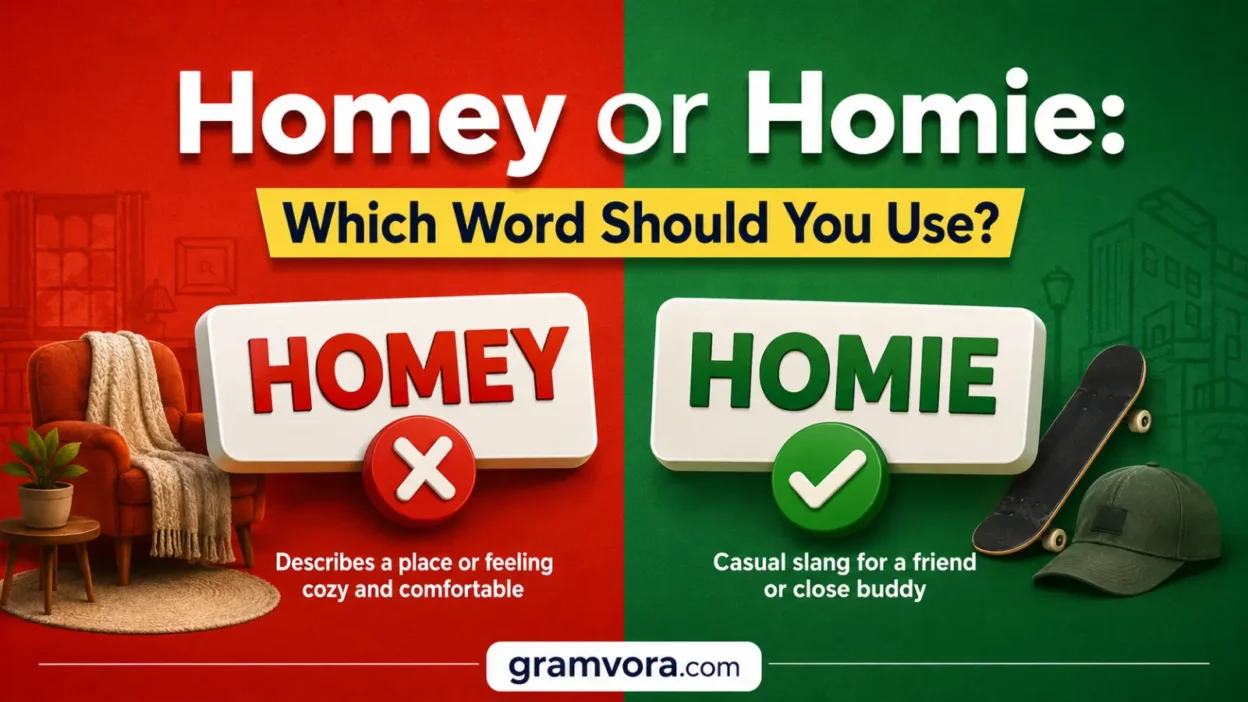
Homey and homie sound exactly alike in American English, but they usually do different jobs. Homey most often describes something that feels comfortable, welcoming, or like home. Homie is an informal noun for a close friend.
One important detail is that homey can also be a noun spelling of homie. That use is accepted, but homie is usually clearer when you mean “friend.”
Quick Answer
Use homey when describing a cozy place, atmosphere, meal, style, or feeling.
Use homie when referring informally to a close friend.
Both words are pronounced HOH-mee. For clear writing, keep homey for the descriptive meaning and homie for the friendship meaning.
Why People Confuse Them
The words differ by only one letter and have the same pronunciation. A listener cannot tell which spelling a speaker intends without context.
Homey also has two grammatical uses. Its common role is adjective: “a homey kitchen.” Its less common noun role means a friend. Because the adjective is widespread, “Jordan is my homey” may make readers pause.
Autocorrect may replace one spelling with the other, while the sentence still sounds normal aloud.
Key Differences At A Glance
| Feature | homey | homie |
|---|---|---|
| Usual role | Adjective | Noun |
| Main meaning | Cozy, comfortable, or suggestive of home | A close friend |
| Tone | Conversational but standard | Strongly informal |
| Common use | Rooms, cafés, meals, decor, atmosphere | Friendly address and casual references to friends |
| Extra note | Can also be a noun variant of homie | Clearest modern spelling for the friendship meaning |
Meaning and Usage Difference
Homey is usually an adjective describing comfort, warmth, simplicity, or familiarity associated with home.
“The guest room feels homey” means it feels relaxed and welcoming. “A homey dinner” suggests familiar food rather than a formal meal. Its comparison forms are homier and homiest.
Homie is a countable noun for a close friend or trusted companion. Its regular plural is homies.
“My homie helped me move” refers to a person. “We met up with our homies” refers to several friends.
As nouns, homey and homie can share the friendship meaning. Still, homie prevents the reader from first interpreting the word as the cozy adjective.
Tone, Context, and Formality
Homey has a friendly, approving tone. It fits everyday descriptions, travel writing, restaurant reviews, real estate copy, and conversations about interiors. As an adjective, it is conversational but not slang-only.
Homie belongs to relaxed speech, texts, dialogue, captions, and other casual settings. It can sound affectionate between people who share that style.
Calling a close friend “homie” may sound natural. Using it for a stranger, supervisor, or formal audience may sound forced. In formal prose, friend, colleague, or the exact relationship is clearer.
Which One Should You Use?
| Context | Best Choice | Why |
| Describing a cozy apartment | homey | It works as an adjective for comfort and warmth. |
| Describing a welcoming café | homey | The word modifies the setting or atmosphere. |
| Referring to a close friend in a text | homie | It is the clearest informal noun spelling. |
| Addressing a friend in casual dialogue | homie | The familiar tone fits relaxed speech. |
| Referring to a friend in formal writing | Neither; use friend | Homie is highly informal, and noun homey may look unclear. |
| Reproducing someone’s chosen spelling | Keep the original form | Homey may intentionally represent the noun variant. |
Check the word’s job: choose homey for a quality and homie for a friend.
When One Choice Sounds Wrong
“The cabin looks homie” sounds wrong in standard usage because homie is a noun, not the adjective needed after looks. Write “The cabin looks homey.”
“She is my homey” is not automatically incorrect because homey has a noun use. Still, “She is my homie” is clearer in current casual writing.
“A homie atmosphere” also sounds wrong. The sentence needs the adjective homey: “a homey atmosphere.”
“A homey friend” describes the person as comforting or unpretentious; it does not simply mean “a close friend.” For that meaning, write “my homie.”
Common Mistakes (and Quick Fixes)
Mistake: Treating the words as interchangeable everywhere.
Fix: Match the spelling to the meaning and grammatical role.
Mistake: Assuming homey can only be an adjective.
Fix: Recognize its accepted noun use, but choose homie when clarity matters.
Mistake: Writing homie for a room or atmosphere.
Fix: Use homey because the sentence needs a descriptive word.
Mistake: Using homie in a formal report or application.
Fix: Replace it with friend, colleague, classmate, neighbor, or another exact relationship.
Mistake: Forming the plural as homie’s.
Fix: Write homies. An apostrophe shows possession, not a regular plural.
Everyday Examples
The reading corner feels warm and homey.
We chose a small restaurant with a homey atmosphere.
Her homey decorating style made the rental feel personal.
The soup was simple, filling, and homey.
Marcus is my homie from middle school.
I am meeting my homies after the game.
“Thanks, homie,” he said as he grabbed his backpack.
The writer used homey as a noun in the character’s dialogue, but homie would be clearer to many readers.
Dictionary-Style Word Details
Verb
Homey: Not commonly used as a verb in standard US English.
Homie: Not commonly used as a verb in standard US English.
Noun
Homey: Primarily an adjective, but it can also be a countable noun meaning a close friend. The plural may be homeys or homies.
Homie: A countable, informal noun meaning a close friend or familiar companion. The standard plural is homies.
Synonyms
Homey: Closest plain alternatives for the adjective include cozy, homelike, comfortable, welcoming, and unpretentious. Depending on context, useful opposites include cold, impersonal, and uninviting.
Homie: Closest plain alternatives include friend, buddy, pal, and close companion. There is no single exact antonym; stranger or enemy may contrast with it in specific contexts.
Example Sentences
Homey: The wooden shelves give the office a homey feel. The café became homier after the owners added lamps and family photos.
Homie: Devon is my homie from college. She invited a few homies to the cookout.
Word History
Homey: The adjective combines home with -y, giving the sense “like home.” Its noun use is a spelling of the friendship term.
Homie: The noun developed as a shortened form of homeboy and became an informal word for a close friend.
Phrases Containing
Homey: homey atmosphere, homey feel, homey kitchen, homey meal, homey touch
Homie: my homie, an old homie, one of my homies, hang with the homies, homies from school
|
FAQs
Is it homey or homie for a close friend?
Use homie when referring informally to a close friend. Although homey can also be used as a noun with the same meaning, homie is usually clearer because readers are less likely to confuse it with the adjective meaning cozy or comfortable.
Is homey a correct word?
Yes. Homey is a standard adjective in US English. It describes a place, atmosphere, meal, or style that feels warm, comfortable, familiar, or like home. For example, you might describe a small café as having a homey atmosphere.
Can homey mean a friend?
Yes. Some dictionaries recognize homey as an alternative noun spelling of homie. However, this spelling may briefly confuse readers because homey is better known as an adjective. Use homie when you want the friendship meaning to be immediately clear.
Are homey and homie pronounced differently?
No. In standard American English, both words are usually pronounced HOH-mee. Because they sound alike, speakers rely on the sentence context to show whether they mean a cozy quality or a close friend.
What is the plural of homie?
The regular plural of homie is homies. For example, “We invited our homies to the cookout.” Do not add an apostrophe when forming the plural. Homie’s is possessive, as in “That is my homie’s jacket.”
Is homie appropriate in formal writing?
Usually not. Homie is highly informal and works best in casual conversations, texts, captions, dialogue, and relaxed social writing. In formal writing, choose a more precise word such as friend, colleague, classmate, neighbor, or companion, depending on the relationship.
Conclusion
Both homey and homie are valid words, and they sound the same. Their usual meanings are different.
Choose homey for something cozy, comfortable, familiar, or suggestive of home. Choose homie for a close friend in informal speech or writing.
Remember the extra nuance: homey can also be a noun variant of homie. Even so, homie is normally the clearer choice for the friendship meaning, while homey remains the natural adjective for comfort and atmosphere.