
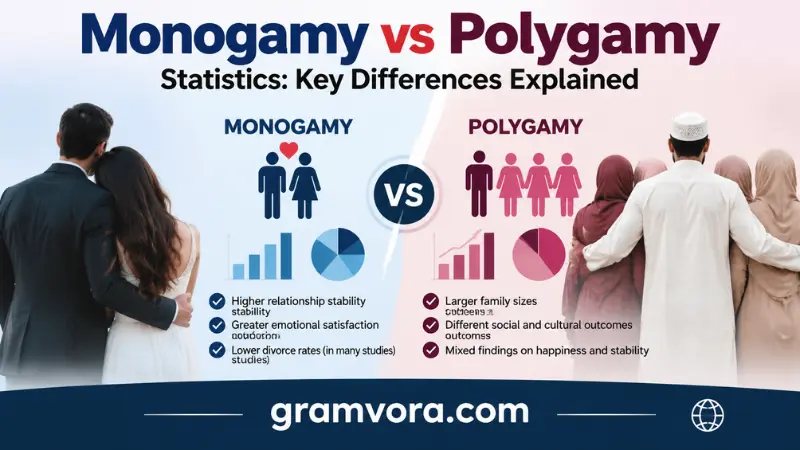
When people search for monogamy vs polygamy statistics, they are usually looking for two things: the difference between the terms and the numbers showing how common each arrangement is.
The basic distinction is straightforward. Monogamy means having one spouse or mate at a time. Polygamy means having more than one spouse at the same time.
The statistics are more complicated.
There is no single worldwide percentage that perfectly measures “monogamy” because researchers may measure marriage status, household composition, relationship behavior, or whether a society legally or culturally permits polygamy. Those measurements can produce very different numbers.
For that reason, the safest comparison is to define the terms first and then explain what the available statistics actually tell us.
Quick Answer
Monogamy is the practice or state of having one spouse or partner at a time.
Polygamy is the practice of being married to more than one person at the same time.
For population statistics, monogamy is much more common than polygamy in terms of people living in polygamous households. A widely cited global analysis found that only about 2% of the world’s population lived in polygamous households, while in 104 of 130 countries studied, fewer than 1% of people lived in such households.
That does not mean exactly 98% of the world is legally or behaviorally monogamous. The two percentages should not be treated as a perfect opposite pair.
The main reason is measurement: researchers can count households differently from marriages, relationships, or social rules.
Why People Confuse Them
The words look similar because they share the ending -gamy, which relates to marriage. Their prefixes create the central contrast.
Mono- means one. Poly- means many.
So the basic word structure points toward the difference:
- Monogamy: one spouse at a time.
- Polygamy: more than one spouse at the same time.
Confusion often begins when people use polygamy to mean every form of having more than one romantic relationship. That is too broad.
Polygamy specifically concerns marriage. A person can have multiple romantic relationships without being legally or socially married to multiple people.
Another source of confusion is the difference between polygamy and polygyny. Polygamy is the broader term for marriage involving more than one spouse. Polygyny specifically refers to a marriage system in which a man has multiple wives.
For this article, the comparison remains focused on the broader terms monogamy and polygamy.
Key Differences At A Glance
| Feature | Monogamy | Polygamy |
|---|---|---|
| Basic meaning | One spouse at a time | More than one spouse at the same time |
| Main grammatical role | Noun | Noun |
| Number of spouses | One | Two or more |
| Marriage structure | Two-person marriage | Multi-spouse marriage |
| Global household prevalence | Much more common | Relatively uncommon globally |
| US legal status | Standard legal marriage structure | Multiple simultaneous legal marriages are unlawful |
| Main statistical caution | Marriage data do not automatically equal monogamy data | Legal permission does not equal widespread practice |
The most important statistical point is that rare does not mean nonexistent.
Polygamous households are concentrated in particular regions and populations. They are much less common in most countries, but they can represent a substantial share of households in certain communities.
Meaning and Usage Difference
Monogamy describes a relationship or marriage arrangement involving one spouse or mate at a time.
For example:
They chose monogamy when they got married.
The word can also be used in discussions of animals. In that setting, it can describe a species or individual mating with a single mate during a particular period.
Polygamy describes a marriage arrangement involving more than one spouse at the same time.
For example:
The study examined communities where polygamy is culturally accepted.
The terms therefore describe opposite points on the number-of-spouses scale.
However, the statistical comparison requires care.
A researcher might ask, “How many people live in polygamous households?” That is different from asking, “How many people are monogamous?” Someone who is divorced, widowed, single, or unmarried may not belong to either category at that moment.
Likewise, a country can legally permit polygamy while only a small percentage of its population actually lives in polygamous households.
This is why legal status, cultural acceptance, and actual prevalence are separate measurements.
Tone, Context, and Formality
Both monogamy and polygamy are standard formal nouns. They are common in academic, legal, social, cultural, and everyday discussions.
Examples include:
- “The researchers studied monogamy across several populations.”
- “The law prohibits polygamy.”
- “The documentary examines the history of polygamy.”
- “They decided that monogamy was right for their relationship.”
Neither word is inherently informal.
The main context difference is practical. Monogamy is commonly used when describing one-spouse relationships, while polygamy becomes relevant when discussing multiple-spouse marriage systems.
In US legal writing, polygamy can also overlap with discussions of bigamy, but the terms should not automatically be treated as exact synonyms in every context.
Which One Should You Use?
Use monogamy when you mean a marriage or relationship involving one spouse or mate at a time.
Use polygamy when you mean marriage involving more than one spouse at the same time.
For statistics, choose the term that matches what the numbers measure.
If the statistic counts people living in households with multiple spouses, say people living in polygamous households.
If a statistic describes a society where multiple-spouse marriage is legally or culturally permitted, say societies that permit polygamy.
Do not automatically turn a statistic about permission into a statistic about practice.
For example, this is more accurate:
Polygamy is legally permitted in some countries, but that does not mean most people in those countries practice it.
This is less accurate:
Most people in countries where polygamy is legal are polygamous.
The second statement assumes a behavior that the legal statistic does not establish.
When One Choice Sounds Wrong
The word monogamy sounds wrong when the subject clearly involves simultaneous marriage to multiple spouses.
For example:
The community traditionally recognizes marriage to several spouses.
Calling that arrangement simply “monogamy” would change the meaning.
Likewise, polygamy sounds wrong when a person has had several relationships one after another but only one spouse at a time.
For example, someone might marry, divorce, and later remarry. That does not automatically make the person polygamous.
The same principle applies to statistics.
A country’s divorce rate is not a direct measure of polygamy. A country’s marriage rate is not a direct measure of monogamy. Those statistics describe different things.
Common Mistakes (and Quick Fixes)
Mistake 1: Treating polygamy as any non-exclusive relationship
Fix: Use polygamy for multiple-spouse marriage. Other relationship structures require their own terminology.
Mistake 2: Saying that legal polygamy means widespread polygamy
Fix: Separate legal status from actual practice.
Mistake 3: Calling serial marriage polygamy
A person may have several spouses over a lifetime without being married to more than one person simultaneously.
Fix: Look at whether the marriages overlap.
Mistake 4: Assuming global polygamy statistics are the exact opposite of monogamy statistics
Fix: Check what the research measured. A household study may not include everyone who is single, divorced, widowed, or living separately from a spouse.
Mistake 5: Using “polygamy” and “polygyny” as if they always mean exactly the same thing
Fix: Polygamy is the broader term; polygyny is a specific form involving one man and multiple wives.
Everyday Examples
Here are natural examples showing the difference:
- “The couple chose monogamy.”
This means their relationship involves one partner at a time. - “The article discusses monogamy in modern marriage.”
The subject is the one-spouse relationship structure. - “Some cultures have historically practiced polygamy.”
The subject involves marriage to multiple spouses. - “The survey measured people living in polygamous households.”
This is a precise statistical description. - “Polygamy is uncommon in most countries.”
This describes broad prevalence rather than saying that every other person is monogamous. - “He married, divorced, and later remarried.”
This does not by itself establish polygamy because the marriages may not have overlapped. - “The country permits polygamous marriages under certain conditions.”
This describes legal status, not the percentage of people who practice polygamy. - “The study compared monogamous and polygamous unions.”
Both terms are being used as standard descriptions of marriage arrangements.
Dictionary-Style Word Details
Verb
- Monogamy: Not commonly used as a verb in standard US English. The noun describes the relationship or marriage arrangement.
- Polygamy: Not commonly used as a verb in standard US English. The noun describes the practice or marriage arrangement.
Verb forms should not be invented from either noun.
Noun
- Monogamy: A noun meaning the state or practice of having one spouse or mate at a time.
- Polygamy: A noun meaning the practice or state of having more than one spouse at the same time.
Both are countable in some pluralized contexts, but they are normally used as abstract nouns when discussing relationship systems.
For example:
Monogamy is common in modern US marriage.
Polygamy occurs in some cultural and religious settings.
Synonyms
- Monogamy: There is no perfect everyday synonym. “One-spouse marriage” can serve as a plain descriptive alternative when clarity matters.
- Polygamy: “Multiple-spouse marriage” is a clear descriptive alternative, although it is not a perfect replacement in every sentence.
Neither word should casually be replaced with a broader term such as “nonmonogamy,” because the meanings are not identical.
Antonyms: In the context of marriage structure, polygamy can function as a direct contrast to monogamy, but they are not always dictionary-style antonyms in every context because relationship and marriage terminology can be more detailed than a simple two-word opposition.
Example Sentences
Monogamy
- “Monogamy remains the standard marriage structure in the United States.”
- “The researchers discussed social expectations surrounding monogamy.”
- “They decided that monogamy best suited their relationship.”
Polygamy
- “Polygamy is legal in some countries but not in the United States.”
- “The researchers examined polygamy in several communities.”
- “Polygamy can be uncommon nationally while still being concentrated in particular regions or groups.”
Word History
Monogamy comes through French and Late Latin from Greek elements associated with “one” and “marriage.” Merriam-Webster records an early English use from the 17th century.
Polygamy is built from Greek elements associated with “many” and “marriage.” The term has long been used to describe marriage involving multiple spouses.
The exact historical development of marriage practices is much more complicated than the simple word origins, so the terms should not be treated as labels for one universal historical pattern.
Phrases Containing
Monogamy
- monogamous marriage
- monogamous relationship
- serial monogamy
- lifelong monogamy
- social monogamy
Polygamy
- polygamous marriage
- polygamous relationship
- polygamous household
- practice of polygamy
- legal polygamy
- polygamy laws
The adjective forms monogamous and polygamous are especially common when describing a person, relationship, marriage, household, or society.
FAQs
Is monogamy more common than polygamy?
Yes. Monogamy is much more common globally. Available household research shows that polygamous households represent a small share of the world’s population, while most people do not live in polygamous households.
What percentage of people practice polygamy?
A widely cited global estimate found that about 2% of the world’s population lives in polygamous households. This figure measures household arrangements, so it should not be treated as an exact percentage of everyone who practices or identifies with polygamy.
What percentage of people are monogamous?
There is no single reliable worldwide percentage for monogamy. Statistics may measure marriages, households, relationship behavior, or legal arrangements, and these categories do not produce the same result.
What is the main difference between monogamy and polygamy?
Monogamy involves one spouse at a time, while polygamy involves more than one spouse at the same time. This is the simplest and clearest distinction between the two terms.
Is polygamy common in the United States?
No. Polygamy is uncommon in the United States. Multiple simultaneous legal marriages are unlawful, and most US marriages follow a monogamous structure.
Is polygamy legal in the United States?
Multiple simultaneous legal marriages are unlawful in every US state. However, laws and legal circumstances surrounding relationships and households can be more complicated than simply asking whether people maintain multiple relationships.
Does legal polygamy mean that most people in a country practice it?
No. Legal permission and actual practice are different measurements. A country can permit polygamous marriage while only a relatively small portion of its population lives in polygamous households.
Where is polygamy most common?
Polygamous households are particularly concentrated in parts of West and Central Africa. They are much less common in most other regions of the world.
Is serial monogamy the same as polygamy?
No. Serial monogamy generally describes having one spouse or partner at a time across different relationships. Polygamy involves having multiple spouses at the same time.
Are monogamy and polygamy opposites?
They represent contrasting marriage structures based on the number of spouses involved, but statistics do not always divide the entire population neatly into only these two categories. People can also be single, divorced, widowed, or unmarried.
Conclusion
The clearest difference between monogamy vs polygamy is the number of spouses involved at the same time.
Monogamy means one spouse or mate at a time. Polygamy means more than one spouse at the same time.
The available statistics show that polygamous households are relatively uncommon worldwide, although they are much more concentrated in certain regions and communities. A widely cited global estimate puts the share of people living in polygamous households at about 2%.
The most important caution is that this does not create a simple “98% monogamy” statistic. People can be single, divorced, widowed, unmarried, cohabiting, or living in arrangements that do not fit neatly into a household-based measurement.
So when reading monogamy vs polygamy statistics, always ask what the number actually measures: marriage, household composition, legal permission, or actual relationship practice.


