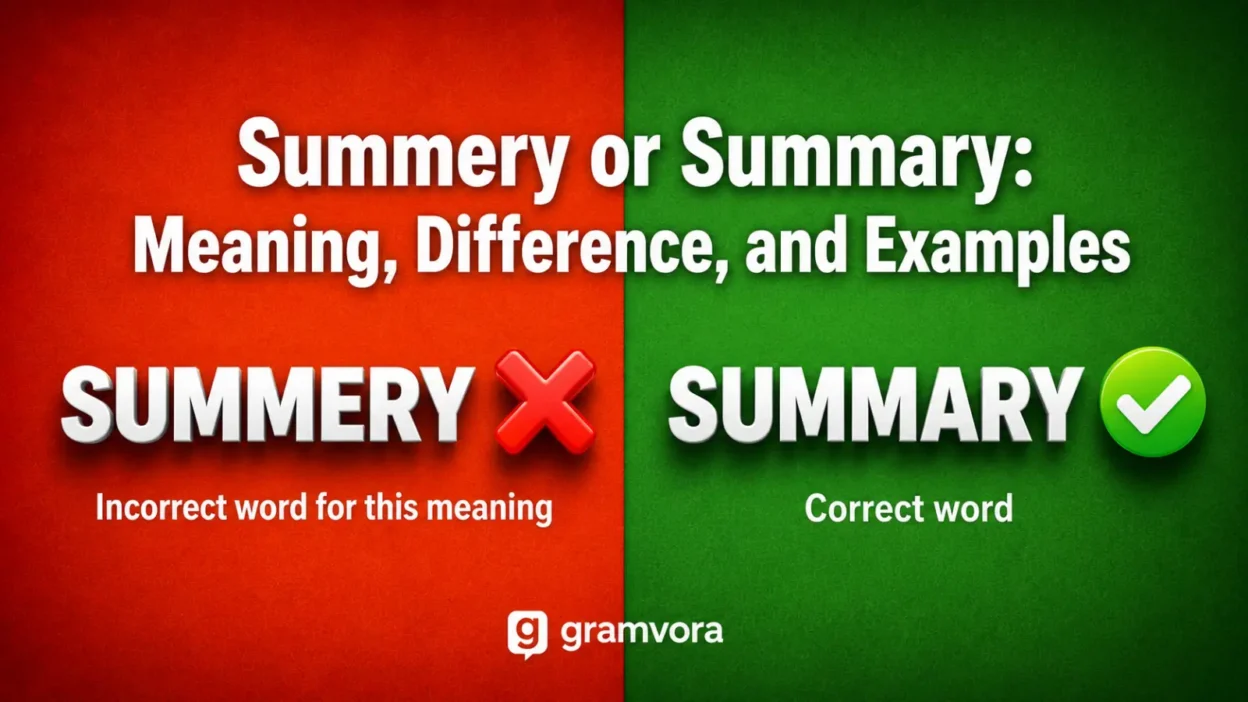
Summary is correct when you mean a short version of something longer. Summery is correct when you mean something feels, looks, or seems like summer.
These two words are easy to mix up because they look almost the same and can sound very similar. But they do not mean the same thing.
Use summary for reports, books, meetings, articles, emails, and main points. Use summery for weather, clothes, colors, food, rooms, scents, or moods that feel like summer.
Quick Answer
Choose summary when you mean “a brief account of the main points.”
Choose summery when you mean “typical of summer” or “suitable for summer.”
Correct:
Please send me a summary of the meeting.
Correct:
She wore a summery white dress.
Wrong:
Please send me a summery of the meeting.
That mistake changes the meaning. A meeting can have a summary, but it does not have a summery unless you are describing its summer-like mood, which would be unusual.
Why People Confuse Them
People confuse summery and summary for three main reasons.
First, the spelling differs by only one letter pattern: -ery and -ary.
Second, the words often sound close in fast speech. In everyday US pronunciation, both may sound like SUM-uh-ree.
Third, summary is much more common in school, work, and online writing. Because readers see it often, they may accidentally type summery when they mean summary.
The safe check is simple: if you mean “main points,” use summary. If you mean “summer-like,” use summery.
Key Differences At A Glance
| Context | Best Choice | Why |
|---|---|---|
| A short version of a report | summary | It gives the main points. |
| A recap of a meeting | summary | It condenses what happened. |
| A short account of a book | summary | It tells the main ideas or events. |
| A warm, bright outfit | summery | It looks suitable for summer. |
| Light food for hot weather | summery | It feels right for summer. |
| A sunny room or cheerful color palette | summery | It suggests a summer mood. |
Meaning and Usage Difference
Summary is usually a noun. It means a short statement, account, or version that gives the main points without all the details.
Examples:
The manager sent a summary of the budget changes.
Write a one-page summary of the article.
The app showed a summary of my weekly spending.
Summary can also work as an adjective. In that role, it means brief, condensed, or done without the usual full process.
Examples:
The report includes a summary table.
The judge issued summary judgment.
Summery is an adjective. It describes something that is typical of summer, suitable for summer, or gives a summer feeling.
Examples:
The patio looked summery with yellow cushions and fresh flowers.
This lemon pasta tastes light and summery.
He picked a summery shirt for the cookout.
Pronunciation can add to the confusion. In normal speech, summery and summary can sound nearly the same. In writing, though, the meanings stay separate.
Tone, Context, and Formality
Summary is neutral and works in almost every setting. It fits school, business, law, news, medicine, customer service, and everyday writing.
Examples:
Can you give me a quick summary?
The report begins with an executive summary.
Here is a summary of your order.
Summery has a more descriptive tone. It often appears in lifestyle writing, weather talk, fashion, food, home design, travel, and casual description.
Examples:
The forecast finally feels summery.
That playlist has a relaxed, summery vibe.
The salad is bright, crisp, and summery.
Neither word is slang. The difference is not about formal versus informal grammar. It is about meaning and context.
Which One Should You Use?
Use summary when you are talking about information.
Good uses of summary:
a summary of a book
a summary of the meeting
a summary of the main points
a summary report
a payment summary
Use summery when you are describing a seasonal feeling or quality.
Good uses of summery:
summery weather
a summery dress
summery colors
a summery meal
a summery scent
Ask yourself this quick question:
Can I replace the word with short version or main points? Use summary.
Can I replace the word with summer-like? Use summery.
When One Choice Sounds Wrong
Summery sounds wrong when the sentence is about information, notes, reports, or main ideas.
Wrong:
I wrote a summery of the chapter.
Correct:
I wrote a summary of the chapter.
Wrong:
Send me a summery after the call.
Correct:
Send me a summary after the call.
Summary sounds wrong when the sentence is clearly describing a summer mood, style, or feeling.
Wrong:
She wore a summary dress to the beach party.
Correct:
She wore a summery dress to the beach party.
Wrong:
The room had a summary feel with bright curtains and fresh flowers.
Correct:
The room had a summery feel with bright curtains and fresh flowers.
Common Mistakes (and Quick Fixes)
Mistake 1: Using summery for a recap.
Wrong:
Here is a summery of today’s class.
Correct:
Here is a summary of today’s class.
Mistake 2: Using summary to describe summer style.
Wrong:
I bought summary sandals for vacation.
Correct:
I bought summery sandals for vacation.
Mistake 3: Forgetting that summary can describe another noun.
Correct:
The summary page lists the main results.
Here, summary describes the type of page. It does not mean the page is summer-like.
Mistake 4: Assuming they are alternate spellings.
They are not alternate spellings. Summery and summary are separate words with separate meanings.
Everyday Examples
Summary examples:
Before the interview, I read a summary of the company’s latest report.
The teacher asked for a summary, not a full essay.
I missed the meeting, so Jordan sent me a quick summary.
The receipt includes a summary of charges.
Her email gave a clear summary of the next steps.
Summery examples:
The backyard felt summery after we added string lights and flowers.
This peach iced tea is sweet, cold, and summery.
He wore a summery linen shirt to dinner.
The paint color gives the kitchen a summery look.
The weather turned warm and summery by noon.
Compact comparison:
- Summary: main points, short account, recap, condensed version.
- Summery: summer-like, warm, bright, seasonal, suitable for hot weather.
- Summary fits information.
- Summery fits description.
- They may sound alike, but they are not interchangeable.
Dictionary-Style Word Details
Verb
Summery: Not commonly used as a verb in standard US English.
Summary: Not commonly used as a verb in standard US English. The verb you usually want is summarize.
Correct:
Please summarize the article.
Not natural:
Please summary the article.
Noun
Summery: Not commonly used as a noun in standard US English. It is mainly an adjective.
Summary: A noun meaning a short account of the main points.
Example:
The summary helped me understand the full report faster.
Plural:
summaries
Example:
The team reviewed three summaries before choosing a plan.
Synonyms
Summery: Closest plain alternatives include summer-like, sunny, warm-weather, bright, and seasonal, depending on the sentence.
Example:
a summery dress = a summer-like dress or a warm-weather dress
A useful opposite is wintry when the contrast is seasonal.
Summary: Meaning-matched alternatives include overview, recap, synopsis, abstract, and digest, depending on context.
Example:
a summary of the article = an overview of the article or a recap of the article
A clear opposite is not always available. In many contexts, the contrast would be full text, full report, or detailed account, but those are not exact single-word opposites.
Example Sentences
Summery:
The café added a summery drink menu with lemonade and iced tea.
Her apartment looked bright and summery after the new curtains went up.
We had a summery afternoon at the park.
Summary:
The project summary listed the goal, cost, and deadline.
I need a short summary before the client call.
The final page gives a summary of the findings.
Word History
Summery: The word is formed from summer plus the adjective ending -y. That pattern gives the sense “like summer” or “full of summer qualities.”
Summary: The word is connected with the idea of a sum, total, or condensed whole. In modern use, it most often means a short account that gives the main points.
The exact history is not needed to choose correctly. The practical difference is enough: summery points to summer; summary points to main points.
Phrases Containing
Summery:
summery weather
summery dress
summery colors
summery feel
summery vibe
summery meal
Summary:
summary of the report
executive summary
brief summary
summary page
summary judgment
in summary
FAQs
1. What is the correct spelling: summery or summary?
The correct spelling depends on the meaning. Summary means a short explanation of the main points of something. Summery means related to summer or having the qualities of summer.
2. What does summary mean?
A summary is a brief version of a longer text, speech, article, or event that includes only the most important information.
3. What does summery mean?
Summery is an adjective that describes something connected to summer, such as warm weather, sunshine, beaches, or a summer-like feeling.
4. Is summery a misspelling of summary?
No. Summery is a real English word, but it has a different meaning. Using it when you mean a short explanation is incorrect.
5. How can I remember the difference between summary and summery?
Remember that summary has “a” for “abstract” because it gives an abstract or shortened version of information. Summery has “e” for “environment” because it describes a summer environment.
6. Can summary and summery be used in the same sentence?
Yes, but they have different meanings. Example:
“After reading the article, I wrote a summary about its main ideas and described the summery beach scene.”
7. Is summary a noun or adjective?
Summary is mainly used as a noun. Example: “The teacher asked for a summary of the chapter.” It can also be used as an adjective in phrases like “summary report.”
8. Is summery a noun or adjective?
Summery is an adjective. It describes something that feels or looks like summer. Example: “She wore a summery dress.”
Conclusion
Use summary when you mean a short version of something longer. Use summery when you mean something looks, feels, tastes, or seems like summer.