
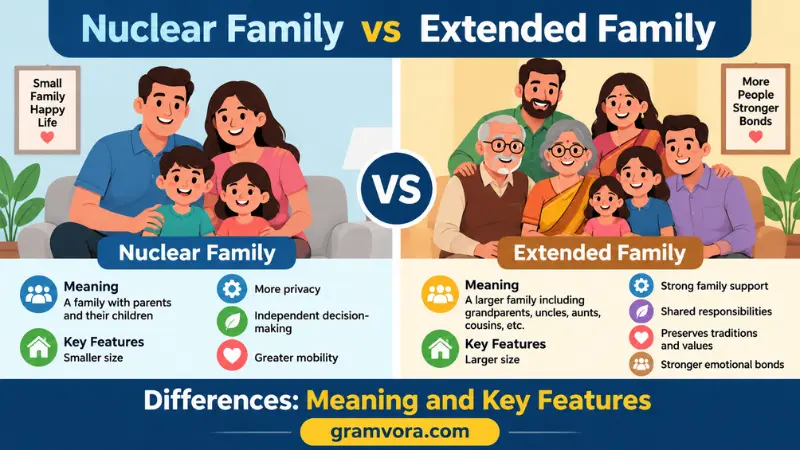
Families can be organized in different ways, and two common terms used to describe family structures are nuclear family and extended family. These terms describe who belongs to the family unit and, in many cases, who lives together.
A nuclear family generally centers on parents and their children. An extended family includes additional relatives, such as grandparents, aunts, uncles, cousins, or adult children and their families.
The difference is not simply about the number of people in a home. A family can have strong relationships with grandparents or cousins without everyone living under the same roof. The terms describe family structure, relationships, and household arrangements.
Understanding nuclear family vs extended family differences can make family-related discussions, school assignments, and everyday English much easier.
What Is a Nuclear Family?
A nuclear family is a small family unit consisting of parents and their children. Depending on the definition being used, it may include one or two parents and their immediate children.
For example, a household with two parents and their children can be described as a nuclear family. A single parent living with their children can also fit broader definitions of a nuclear family.
OpenStax describes the nuclear family as one or two parents with their immediate offspring. It also notes that family structures can vary across cultures and societies.
Simple example
Imagine a family with:
- Mom
- Dad
- Two children
If these four people form the immediate family unit, they represent a simple example of a nuclear family.
The children’s grandparents, aunts, uncles, and cousins may still be close family members. They simply are not part of the nuclear family unit itself.
What Is an Extended Family?
An extended family includes the nuclear family plus other relatives or additional family units.
These relatives may include:
- Grandparents
- Aunts
- Uncles
- Cousins
- Adult children
- Sons-in-law or daughters-in-law
- Grandchildren
- Other relatives
An extended family may live together in one home, but that is not always necessary. Family members can live in separate homes and still be part of an extended family network.
OpenStax describes extended families as family structures that can include multiple family units and several generations.
For example, grandparents, parents, children, and grandchildren might live in the same household. That would be a multigenerational form of an extended family.
Nuclear Family vs Extended Family at a Glance
| Feature | Nuclear Family | Extended Family |
|---|---|---|
| Basic structure | Parents and immediate children | Nuclear family plus other relatives |
| Generations | Usually one or two | Often several |
| Relatives included | Immediate family | Wider family network |
| Household size | Usually smaller | Often larger |
| Grandparents | Usually outside the unit | Often included |
| Aunts and uncles | Usually outside the unit | May be included |
| Cousins | Usually outside the unit | May be included |
| Living arrangement | Often one household | One or multiple households |
The key difference is scope. A nuclear family focuses on the immediate parent-and-child unit, while an extended family reaches beyond that unit.
The Main Difference Between Nuclear and Extended Families
The clearest difference is the number and type of relationships included in the family unit.
A nuclear family normally focuses on parents and their children. An extended family includes relatives beyond that immediate group.
Consider this example:
Nuclear family:
Maria, her husband, and their two children.
Extended family:
Maria, her husband, their two children, Maria’s parents, her brother, and her brother’s children.
The second group includes several generations and family branches.
However, these definitions should not be treated as rigid rules. Family structures vary across cultures, households, and individual circumstances.
The U.S. Census Bureau also distinguishes between a family and a household. A household refers to everyone living in a housing unit, while a family is defined through relationships such as birth, marriage, or adoption.
Does an Extended Family Have to Live Together?
No. This is one of the most important points to understand.
An extended family does not have to share one house. A grandmother living across town can still be part of someone’s extended family.
For example, suppose John lives with his wife and children. His parents live in another state, while his sister lives nearby.
John’s household may be a nuclear family household, but his broader family is an extended family.
The words family and household are therefore not interchangeable.
A household describes people who live together. Family describes relationships that may extend beyond a single home.
The Census Bureau similarly explains that a household can contain family members as well as unrelated people.
Can a Nuclear Family Be Part of an Extended Family?
Yes.
A nuclear family can exist inside a larger extended family network.
For example, a married couple and their children may form one nuclear family. The couple’s parents, siblings, nieces, nephews, and cousins can belong to their extended family.
This means the two terms are not always competing labels.
A person can belong to a nuclear family and an extended family at the same time.
For example:
Sarah lives with her husband and daughter.
Her household may be a nuclear family.
At the same time, Sarah is also part of a larger extended family that includes her parents, siblings, grandparents, nieces, and nephews.
This distinction helps prevent a common misunderstanding: nuclear and extended family are different levels of family structure, not necessarily two completely separate types of people.
Generations in Nuclear and Extended Families
Generations are another useful way to understand the difference.
A nuclear family often centers on parents and children. That can involve two generations.
An extended family may include three or more generations.
For example:
Two generations:
Grandparent → Parent → Child
Actually, this arrangement contains three generations and may represent an extended or multigenerational family.
A nuclear family might look like:
Parent → Child
An extended family could look like:
Grandparent → Parent → Child → Grandchild
The exact family structure can become more complex when adult siblings, cousins, in-laws, or other relatives live together.
The Census Bureau has documented household structures that include parents, children, grandparents, grandchildren, siblings, aunts, cousins, and other relatives.
Nuclear Family Examples
Here are several simple examples of nuclear family structures.
Example 1: Two parents and children
David and Lisa live with their two children.
This is a straightforward example of a nuclear family.
Example 2: One parent and children
Kevin lives with his daughter and son.
Depending on the definition being used, this can also be described as a nuclear family structure.
Example 3: Married couple with children
Emma and Noah live with their three children.
Their immediate household represents a nuclear family.
In each example, the focus is on the immediate parent-and-child unit.
Extended Family Examples
Extended families can take many forms.
Example 1: Grandparents living with parents
A couple lives with their children and the children’s grandmother.
The household includes an additional generation.
Example 2: Multiple family units
Parents, their adult son, his wife, and their children live together.
This arrangement includes more than one family unit.
Example 3: Wider family network
A child lives with their parents but regularly lives near grandparents, cousins, and an aunt.
Even if everyone has a separate home, the broader family can still be considered extended.
These examples show why living together is not the only factor.
Nuclear Family and Extended Family in the United States
Family structures in the United States are diverse. There is no single arrangement that describes every American family.
The U.S. Census Bureau classifies family households based on relationships such as birth, marriage, and adoption. Its data also include different types of family households and multigenerational arrangements.
Cultural expectations also influence family living arrangements.
OpenStax notes that some societies commonly have multiple generations living together, while US family patterns have often placed greater emphasis on independent households.
This does not mean every American family follows a nuclear model.
Many US households include grandparents, adult children, siblings, or other relatives. Economic conditions, caregiving needs, housing costs, cultural traditions, and personal choices can all influence household arrangements.
Advantages of a Nuclear Family
A nuclear family can offer a relatively simple household structure.
Parents and children may have more privacy and can make household decisions without involving a large number of relatives.
Other possible advantages include:
- More privacy
- Fewer people sharing household decisions
- Greater independence
- Easier coordination of daily routines
- A smaller household budget in some situations
However, these benefits depend heavily on the individual family.
A small household does not automatically mean a family has fewer responsibilities or stronger relationships.
Advantages of an Extended Family
An extended family can provide a wider support network.
Grandparents, adult siblings, aunts, uncles, and other relatives may help with childcare, transportation, household tasks, emotional support, or financial responsibilities.
Possible advantages include:
- More family support
- Shared responsibilities
- More interaction between generations
- Childcare assistance
- Stronger connections among relatives
- Shared cultural traditions
OpenStax notes that extended families can function as social and economic units because several adults may contribute to the household.
Still, extended-family living can also create challenges.
Challenges of a Nuclear Family
A smaller family unit can provide independence, but it may also have fewer people available to share responsibilities.
For example, parents may have to manage childcare, transportation, household work, and financial responsibilities largely on their own.
If grandparents or other relatives live far away, daily support may be limited.
This does not mean nuclear families are automatically difficult. It simply shows that family structure can affect how responsibilities are distributed.
Challenges of an Extended Family
Living with several relatives can provide support, but it can also create disagreements.
Different generations may have different expectations about privacy, parenting, household rules, money, or daily routines.
Common challenges can include:
- Less personal space
- More household decisions
- Different parenting styles
- Conflicts between generations
- Financial disagreements
- Different expectations about responsibilities
An extended family can work very well when family members communicate clearly and respect boundaries.
Nuclear Family vs Extended Family: Which Is Better?
There is no universal answer.
A nuclear family may work well for people who value independence and a smaller household. An extended family may work well for people who value shared responsibilities and close multigenerational relationships.
The better arrangement depends on the family’s needs.
For example, grandparents may benefit from living near adult children when they need support. Parents may also benefit from having relatives nearby when raising young children.
On the other hand, another family may prefer separate homes because they value privacy and independence.
The important point is that family structure is not a simple measure of family quality.
A loving and supportive family can take many forms.
Common Confusion: Family vs Household
One of the most common mistakes is treating family and household as identical terms.
They are related, but they do not mean exactly the same thing.
A household is generally about who lives together in a housing unit. A family is based on recognized relationships, such as birth, marriage, or adoption.
For example:
A grandmother lives three miles away from her daughter.
They belong to the same extended family, but they do not necessarily belong to the same household.
The Census Bureau specifically distinguishes these concepts in its definitions of family and household.
Common Mistakes
Mistake 1: Thinking an extended family must live together
Incorrect idea: Everyone in an extended family must share one house.
Better understanding: Extended family members can live in separate homes.
Mistake 2: Thinking nuclear family always means married parents
Some definitions use traditional married-parent language, but broader descriptions can include one or two parents and their children.
The exact definition can depend on the academic or demographic context.
Mistake 3: Assuming nuclear family means “small family”
The term refers to the family unit, not simply the number of children.
A couple with five children can still form a nuclear family.
Mistake 4: Assuming extended family means only grandparents
Grandparents are common examples, but extended family can include many other relatives.
Aunts, uncles, cousins, grandchildren, adult siblings, and in-laws may also be part of an extended family structure.
Nuclear Family vs Extended Family: Quick Comparison
| Context | Nuclear Family | Extended Family |
|---|---|---|
| Main focus | Parents and children | Wider group of relatives |
| Generations | Usually fewer | Often multiple |
| Grandparents | Usually outside the immediate unit | May be included |
| Cousins | Usually outside the immediate unit | May be included |
| Household | Often smaller | May include multiple family units |
| Family network | More immediate | Broader |
The simplest way to remember the difference is:
Nuclear = immediate family unit.
Extended = immediate family plus wider relatives.
Related Family Terms
Several terms can help explain family relationships more precisely.
Immediate family
Immediate family usually refers to the closest family members, such as parents, children, and sometimes siblings or a spouse.
The exact meaning can change depending on context.
Multigenerational family
A multigenerational family includes people from multiple generations.
For example, grandparents, parents, and children may live together.
This can overlap with an extended family structure.
Blended family
A blended family generally forms when partners create a household that includes children from previous relationships.
For example, a household may include a stepmother, father, and children from an earlier marriage.
A blended family is not automatically the same thing as an extended family.
Single-parent family
A single-parent family has one parent raising one or more children.
It can still be considered part of a larger extended family network.
FAQs
What is the main difference between a nuclear family and an extended family?
A nuclear family focuses on parents and their immediate children. An extended family includes additional relatives beyond that immediate unit.
Is a nuclear family always a husband, wife, and children?
Not necessarily. Broader definitions can include one or two parents and their immediate children. Family structures vary across households and cultures.
Does an extended family have to live together?
No. Extended family members can live in separate homes. Living together creates a particular household arrangement, but it is not required for relatives to be part of an extended family.
Are grandparents part of a nuclear family?
Usually, grandparents are considered part of the extended family rather than the nuclear family. The nuclear family generally focuses on parents and their immediate children.
Are cousins part of an extended family?
Yes. Cousins are commonly considered members of the extended family. They usually fall outside the immediate nuclear family unit.
Can a nuclear family and extended family exist at the same time?
Yes. A couple and their children can form a nuclear family while also belonging to a larger extended family that includes grandparents, siblings, cousins, and other relatives.
Which family structure is better?
Neither structure is automatically better. The best arrangement depends on the family’s relationships, needs, resources, culture, and living situation.
Mini Quiz
1. Which group best represents a basic nuclear family?
A. Parents and their children
B. Grandparents, cousins, and aunts
C. Three unrelated roommates
Answer: A
2. Which relative is commonly part of an extended family?
A. Grandparent
B. Neighbor
C. Coworker
Answer: A
3. Must an extended family live in one house?
A. Yes
B. No
Answer: B
4. What does “household” mainly describe?
A. People living in a housing unit
B. Only grandparents
C. Only children
Answer: A
Conclusion
The main nuclear family vs extended family differences involve the size and scope of the family unit. A nuclear family generally centers on parents and their immediate children, while an extended family includes relatives beyond that immediate group.
Remember that family and household are not always the same thing. Relatives can remain part of an extended family even when they live in different homes.
Understanding these terms makes family descriptions clearer and helps you recognize how different households and family relationships can be organized.
Research basis: Definitions and family-structure distinctions were checked against OpenStax and U.S. Census Bureau materials.


