
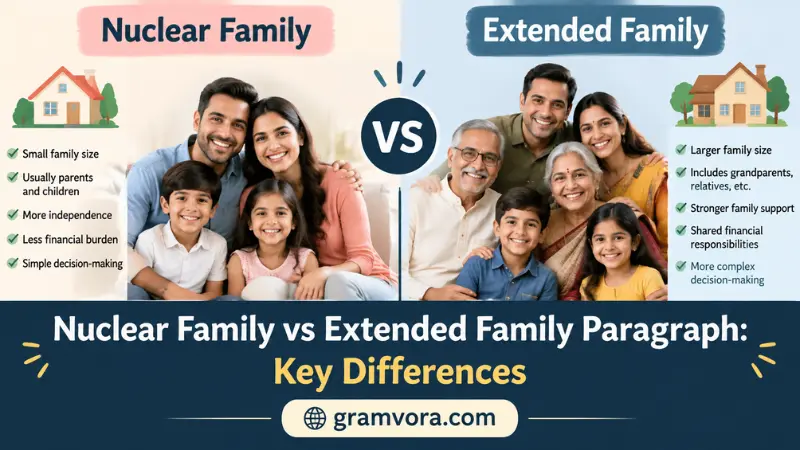
When writing about family structures, nuclear family and extended family are both correct expressions. The important difference is who the term includes.
A nuclear family generally refers to parents and their children as a core family unit. An extended family goes beyond that core to include relatives such as grandparents, aunts, uncles, and cousins.
For a school assignment or general explanation, the clearest approach is to define both terms and then show how their scope differs.
A useful sentence is:
A nuclear family consists of parents and their children, while an extended family includes additional relatives such as grandparents, aunts, uncles, and cousins.
That sentence captures the central difference without making either family structure sound better or worse than the other.
Quick Answer
Both nuclear family and extended family are correct.
Use nuclear family when you mean the core family unit of parents and children.
Use extended family when you mean the wider family group that includes relatives beyond that core.
For example:
- Nuclear family: Two parents and their children.
- Extended family: Parents and children plus relatives such as grandparents, aunts, uncles, or cousins.
The terms are not strict opposites. A nuclear family can be part of an extended family.
Why People Confuse Them
The expressions are closely related because they describe different scopes of the same family network.
A person may live with their parents and siblings while also having grandparents, aunts, uncles, and cousins who are part of the wider family. In that situation, both terms can apply, depending on what the speaker wants to describe.
Another source of confusion is the idea that an extended family must live together. That is not always necessary. In American English, the phrase can refer to relatives who live in different homes but remain part of the wider family group.
The key question is not simply, “How many people live together?” Instead, ask, “Which family members am I describing?”
Key Differences At A Glance
| Context | Best Choice | Why |
|---|---|---|
| Parents and their children as one family unit | Nuclear family | Focuses on the core unit |
| Grandparents are included | Extended family | Goes beyond the parent-child unit |
| Aunts and uncles are included | Extended family | Describes the wider family network |
| Cousins are part of the group being discussed | Extended family | Includes relatives beyond the core unit |
| Only parents and children are being discussed | Nuclear family | Keeps the meaning narrow |
| A wider group contains the parents-and-children unit | Extended family | The broader category can contain the nuclear unit |
A simple way to remember the difference is core versus wider family group.
The word nuclear in this expression does not mean anything about nuclear energy. It refers to the family unit viewed as a central social group.
The word extended signals that the family group has been extended beyond parents and children.
Meaning and Usage Difference
Nuclear family is a noun phrase used for a family unit consisting of parents and their children. Dictionaries commonly describe it as a social unit centered on parents and children.
Extended family is also a noun phrase. It refers to a broader group that includes relatives beyond the immediate parent-and-child unit.
The definitions can vary slightly in how specifically they describe the household. Some definitions emphasize people living together, while others allow for relatives who live nearby or remain closely connected.
That means you should not assume that every extended family shares one home.
For example:
Sarah lives with her husband and two children. Her nuclear family is small.
Here, the focus is the immediate family unit.
Now consider:
Sarah’s extended family includes her parents, two sisters, and several cousins.
The second sentence describes a much wider network of relatives.
The two descriptions can be true at the same time.
A person can say:
My nuclear family lives in California, but most of my extended family lives in Texas.
There is no contradiction. The first phrase identifies the core unit, while the second identifies relatives beyond that unit.
Tone, Context, and Formality
Both expressions are standard and neutral enough for everyday American English, educational writing, and discussions of family structure.
Nuclear family is especially common when the writer is discussing family structure, households, sociology, or relationships in a more specific way.
Extended family is common in both formal and everyday contexts.
For example:
The study examines communication within the nuclear family.
This sounds appropriate in academic or informational writing.
In ordinary conversation, someone might say:
We’re visiting my extended family this weekend.
The phrase is natural because it identifies relatives beyond the person’s immediate family.
Neither expression is inherently more polite or more formal than the other. The choice depends mainly on the group being described.
Which One Should You Use?
Choose nuclear family when your sentence focuses on parents and children as the central family unit.
Choose extended family when your sentence includes or emphasizes relatives beyond that core group.
For a paragraph, essay, or classroom response, define both terms before comparing them.
A strong structure is:
- Introduce both family types.
- Define the nuclear family.
- Define the extended family.
- Explain the difference in membership.
- Give a simple example.
- Conclude that both terms describe different family scopes.
A Ready-to-Use Paragraph
A nuclear family and an extended family describe two different ways of looking at family relationships. A nuclear family generally consists of parents and their children, while an extended family includes relatives beyond that core group, such as grandparents, aunts, uncles, and cousins. The two terms can overlap because a nuclear family may be part of a larger extended family. For example, parents and their children may form one nuclear family while also staying closely connected with grandparents and other relatives. Therefore, the main difference is not simply the number of people in the family but which relatives are included in the group being described.
This paragraph works because it explains the distinction without claiming that one family structure is universally better.
When One Choice Sounds Wrong
The two phrases should not be used as exact substitutes.
Consider this sentence:
My nuclear family includes my grandparents and several cousins.
If the writer means the whole group of relatives, extended family would normally be more precise.
A clearer version is:
My extended family includes my grandparents and several cousins.
Now consider the opposite:
My extended family consists only of my parents and their children.
If the writer specifically means the core parent-and-child unit, nuclear family is the more precise choice.
Another common mistake is assuming that an extended family must live under one roof.
This sentence can be misleading:
An extended family always lives in the same house.
The word always makes the statement too strong. Extended family can describe a wider family network even when relatives live in separate homes.
The safest approach is to focus on family membership rather than making an absolute claim about living arrangements.
Common Mistakes (and Quick Fixes)
Mistake 1: Treating the terms as exact opposites
Incorrect idea:
A person can have either a nuclear family or an extended family, but not both.
Better:
A nuclear family can be part of a larger extended family.
Mistake 2: Defining an extended family only by household size
Too simple:
An extended family is just a large family.
Better:
An extended family includes relatives beyond the core parent-and-child unit.
Mistake 3: Assuming grandparents are part of every nuclear family
Usually, grandparents are outside the nuclear family as the term is commonly defined.
Better:
Grandparents are generally included when describing the extended family.
Mistake 4: Assuming an extended family must live together
Better:
An extended family can include relatives who live in different homes.
Mistake 5: Saying one type is always better
Neither expression automatically describes a better family arrangement.
Better:
Nuclear and extended families describe different family structures or scopes.
Everyday Examples
The difference becomes easier when you see the terms in natural sentences.
My nuclear family moved to Denver last year.
The sentence focuses on the speaker’s core family unit.
My extended family lives in several different states.
The sentence refers to a wider network of relatives.
We invited our extended family to Thanksgiving.
Here, the invitation goes beyond the immediate family.
The apartment is large enough for their nuclear family.
The phrase identifies the parents and children living as a family unit.
She grew up close to her extended family.
The emphasis is on relatives beyond the core family.
For students, the following compact comparison is useful:
- Nuclear family: parents + children
- Extended family: nuclear family + additional relatives
- Main difference: scope of family membership
- Overlap: a nuclear family can exist within a larger extended family
Dictionary-Style Word Details
Verb
Nuclear family: Not commonly used as a verb in standard US English. It functions as a noun phrase.
Extended family: Not commonly used as a verb in standard US English. It also functions as a noun phrase.
The word extended by itself can have other grammatical uses, including as the past participle of extend, but extended family is a noun phrase.
Noun
Nuclear family: A noun phrase referring to a core family unit consisting of parents and their children.
Extended family: A noun phrase referring to a broader family group that includes relatives beyond the core unit.
Both expressions have plural forms:
- nuclear families
- extended families
For example:
Several nuclear families lived in the neighborhood.
The two extended families met for a reunion.
Synonyms
Neither phrase has a perfect one-word synonym that works in every context.
Nuclear family: Closest plain alternative: immediate family, although the meanings are not always identical in every context.
Extended family: Closest plain alternative: wider family or larger family network, depending on the sentence.
These alternatives should not automatically replace the original terms because family terminology can depend on context.
Example Sentences
Nuclear family:
Their nuclear family consists of two parents and two children.
The article examines communication within the nuclear family.
Extended family:
Her extended family includes grandparents, aunts, uncles, and cousins.
Our extended family gathers for Thanksgiving each year.
Both terms together:
A nuclear family can be part of a larger extended family.
The lesson explains the difference between nuclear and extended family structures.
Word History
The expression nuclear family has a documented history in English. Merriam-Webster gives 1924 as its first known use in the meaning defined by the dictionary.
Extended family is also an established English expression. Dictionary sources place its recorded history in the 20th century.
The important point for modern usage is that both expressions are established nouns describing family relationships. There is no need to rely on an elaborate historical explanation to understand the current distinction.
Phrases Containing
Common phrases include:
Nuclear family:
- nuclear family structure
- nuclear family unit
- nuclear family household
- within the nuclear family
- traditional nuclear family
Extended family:
- extended family members
- extended family structure
- extended family network
- within the extended family
- close extended family
These phrases are normally understood according to the same basic distinction: nuclear family identifies the core unit, while extended family identifies the wider family group.
FAQs
What is the difference between a nuclear family and an extended family?
A nuclear family generally consists of parents and their children. An extended family includes relatives beyond that core group, such as grandparents, aunts, uncles, and cousins. The main difference is the scope of family members included.
What is a nuclear family?
A nuclear family is a family unit made up of parents and their children. For example, two parents living with their children can be described as a nuclear family.
What is an extended family?
An extended family includes relatives beyond the parents-and-children unit. Depending on the context, it may include grandparents, aunts, uncles, cousins, and other relatives.
Can a nuclear family also be part of an extended family?
Yes. These terms can overlap. A couple and their children may form a nuclear family while also being part of a larger extended family that includes grandparents, aunts, uncles, and cousins.
Does an extended family have to live in the same house?
No. An extended family does not necessarily have to live together. Relatives can live in different homes or even different cities and still be part of the same extended family.
Are grandparents part of a nuclear family?
Generally, grandparents are not included in the nuclear family when the term is used in its usual sense. They are more commonly included when describing the extended family.
Is a nuclear family always smaller than an extended family?
Not necessarily. The terms primarily describe which relatives are included, rather than establishing a strict number of people. A nuclear family is centered on parents and children, while an extended family reaches beyond that core group.
Which is correct: nuclear family or extended family?
Both are correct. Use nuclear family when discussing the core parent-and-child unit. Use extended family when discussing a wider group that includes additional relatives.
How do I write a nuclear family and extended family paragraph?
Start by defining both terms. Explain that a nuclear family generally consists of parents and children, while an extended family includes relatives beyond that core unit. Then give an example and explain that a nuclear family can be part of a larger extended family.
What is a simple sentence comparing a nuclear family and an extended family?
A simple comparison is: A nuclear family consists of parents and their children, while an extended family includes additional relatives such as grandparents, aunts, uncles, and cousins.
Conclusion
For the keyword nuclear family vs extended family paragraph, the clearest answer is that both terms are correct, but they describe different scopes.
A nuclear family generally consists of parents and their children. An extended family includes relatives beyond that core group, such as grandparents, aunts, uncles, and cousins.
The categories can overlap. A nuclear family can be part of a larger extended family, so the terms should not be treated as absolute opposites.
If you need a simple comparison paragraph, focus on who is included, rather than assuming that family size or living arrangements alone determine the correct term.


