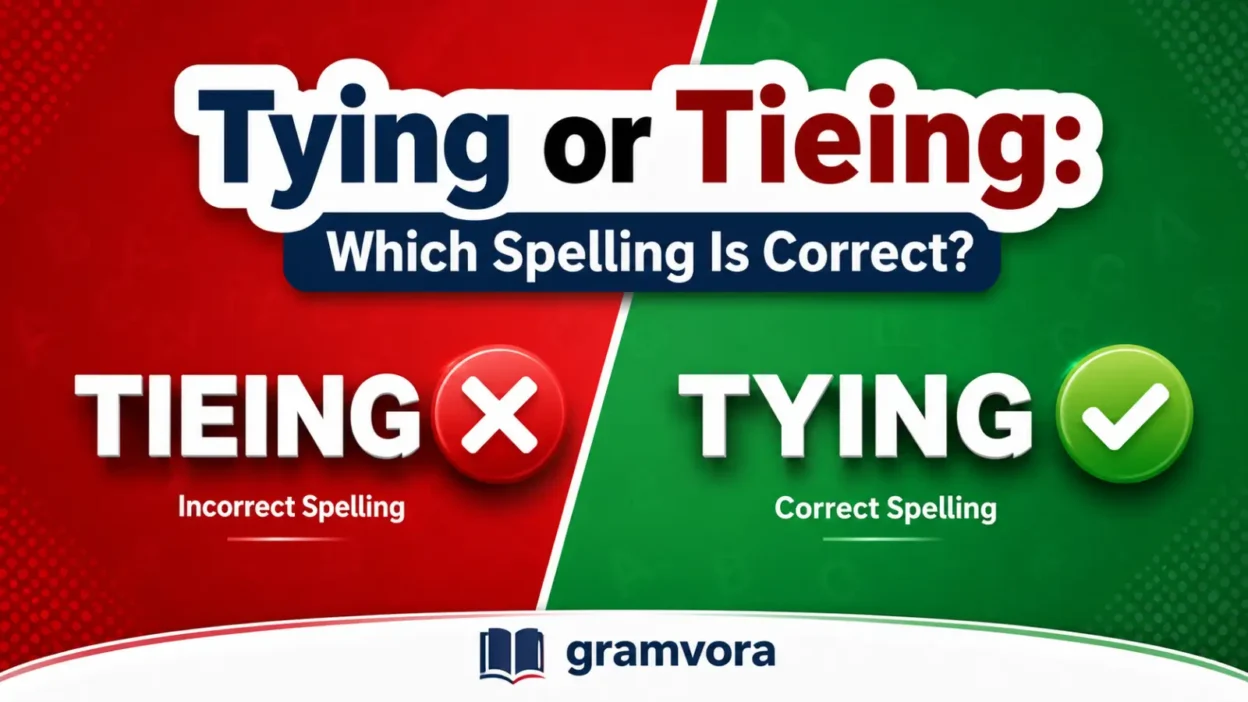
The standard spelling is tying. In modern US English, you should write tying your shoes, tying a knot, tying the score, and tying up loose ends.
The spelling tieing may look logical because the base verb is tie, but it is not the spelling most readers expect. Some dictionaries list tieing as an alternate form, so it is not best to call it impossible. Still, for clear, polished writing, tying is the right choice almost every time.
Quick Answer
Tying is the preferred standard spelling. Tieing is a rare alternate spelling listed in some dictionaries, but it often looks like a mistake in modern US writing. Use tying in schoolwork, business writing, articles, captions, emails, and everyday sentences.
Correct: She is tying her shoes.
Avoid: She is tieing her shoes.
Why People Confuse Them
People confuse tying and tieing because the base word is tie. Many English verbs drop a final silent e before -ing.
For example:
make → making
write → writing
move → moving
So a writer may expect:
tie → tieing
That spelling keeps the original word visible, but tie follows a different pattern. When a verb ends in ie, standard spelling usually changes ie to y before adding -ing.
So the expected form is:
tie → tying
die → dying
lie → lying
vie → vying
That small spelling change helps readers recognize the word quickly.
Key Differences At A Glance
| Context | Best Choice | Why |
|---|---|---|
| Modern US writing | tying | This is the standard and expected spelling. |
| School or test writing | tying | Teachers and editors normally expect this form. |
| Business writing | tying | It looks clean and professional. |
| Dictionary variant discussion | tieing | Some dictionaries list it as an alternate form. |
| Casual texting | tying | It is still the clearer spelling. |
| Phrases like “tying the knot” | tying | This is the fixed modern spelling readers expect. |
Are They the Same Word?
Yes. Tying and tieing refer to the same word form: the -ing form of the verb tie.
They do not have different meanings. Tying can mean fastening something with a knot, connecting ideas, limiting someone’s freedom, or matching a score. Tieing, when recognized, means the same thing.
Compact comparison:
• Tying: standard, common, recommended
• Tieing: rare alternate form, often treated as nonstandard in modern writing
• Meaning: the same
• Pronunciation: essentially the same, like “TIE-ing”
• Best everyday choice: tying
The main difference is not meaning. It is spelling acceptability and reader expectation.
US vs UK Preference
This is not a strong US-vs-UK spelling split like color and colour. The standard spelling in both US and UK English is tying.
Some dictionaries, especially broad American dictionaries, list tieing as an alternate form. That does not make it the best choice for normal writing. It only means the spelling has enough record to appear as a variant.
For a US audience, choose tying. For a UK audience, choose tying. For any formal or edited writing, choose tying.
Which Spelling Should You Use?
Use tying unless you have a very specific reason to discuss the alternate spelling.
Write:
I am tying my shoes.
The team is tying the game.
She is tying ribbon around the gift.
The report is tying several ideas together.
Do not write tieing in ordinary sentences. Even when a dictionary lists it, many readers will see it as a spelling error. That makes it a poor choice for clear communication.
A simple rule helps:
When tie takes -ing, change ie to y.
tie + ing = tying
When One Spelling Looks Wrong
Tieing looks wrong because it breaks the spelling pattern most readers learn for verbs ending in ie.
The issue becomes more noticeable in familiar phrases:
tying the knot
tying your shoes
tying a bow
tying for first place
tying up loose ends
In these phrases, tieing can distract readers. They may understand the sentence, but the spelling may still look unedited.
Tying almost never looks wrong. It is the safer form in every ordinary modern context.
Common Mistakes (and Quick Fixes)
Mistake: He is tieing his shoelaces.
Fix: He is tying his shoelaces.
Mistake: They are tieing for first place.
Fix: They are tying for first place.
Mistake: The article is tieing two ideas together.
Fix: The article is tying two ideas together.
Mistake: We are tieing ribbons to the chairs.
Fix: We are tying ribbons to the chairs.
Mistake: She kept tieing the rope too loosely.
Fix: She kept tying the rope too loosely.
The quick fix is easy: when you see tieing, replace it with tying.
Everyday Examples
Tying is natural in both literal and figurative sentences.
She was tying her sneakers before practice.
The florist is tying a ribbon around the bouquet.
We spent the afternoon tying balloons to the fence.
He is tying a knot at the end of the rope.
The editor is tying the final section back to the introduction.
The new policy is tying managers to stricter deadlines.
The home team is tying the score with two minutes left.
They are tying the knot next spring.
I am tying up a few loose ends before the meeting.
The lesson is tying spelling rules to real examples.
In each sentence, tying is the best spelling.
Dictionary-Style Word Details
Verb
Tying: The standard -ing form of the verb tie. It can describe fastening, connecting, restricting, joining, or matching a score.
Tieing: A rare alternate spelling of the same verb form. Some dictionaries record it, but it is not the recommended spelling for modern US writing.
Noun
Tying: Can function as a gerund, which means the action of tying.
Example: Tying strong knots takes practice.
It can also appear in specialized uses, such as fly tying, meaning the craft of making artificial fishing flies.
Tieing: Not commonly used as a noun in standard modern US English. Use tying instead.
Synonyms
For the shared meaning of tying, the closest plain alternatives depend on the sentence.
Closest plain alternatives:
fastening
binding
knotting
securing
joining
connecting
linking
Useful opposites:
untying
loosening
unfastening
separating
disconnecting
These alternatives do not belong to one spelling only. They match the meaning behind tying, not a special meaning of tieing.
Example Sentences
Tying: She is tying the package with brown string.
Tieing: Some dictionaries record tieing, but most modern writers should use tying.
Tying: The teams are tying at the end of the third quarter.
Tieing: The spelling tieing may be understood, but it can look nonstandard.
Tying: He kept tying the knot until it held.
Tieing: In edited US writing, tieing is best avoided.
Word History
Tying comes from the verb tie plus the -ing ending. The spelling changes because verbs ending in ie normally change ie to y before -ing.
That is why English has:
tie → tying
die → dying
lie → lying
vie → vying
Tieing exists as an alternate spelling in some dictionary records, but modern spelling practice strongly favors tying. The safest explanation is simple: tying is the standard form, while tieing is a rare variant that many readers will not accept.
Phrases Containing
Tying:
tying your shoes
tying a knot
tying a bow
tying the knot
tying up loose ends
tying for first place
tying the score
tying ideas together
fly tying
Tieing:
Not commonly used in standard modern phrases. Even if a source lists tieing as an alternate spelling, the phrase forms above should use tying.
Conclusion
Use tying in modern US English. It is the standard spelling, the form readers expect, and the best choice for polished writing.
Tieing is a rare alternate spelling recorded by some dictionaries, so it is more accurate to call it uncommon or nonstandard-looking than impossible. Still, it is not the form to choose in everyday writing.
When in doubt, remember the pattern: tie becomes tying, just as die becomes dying and lie becomes lying.