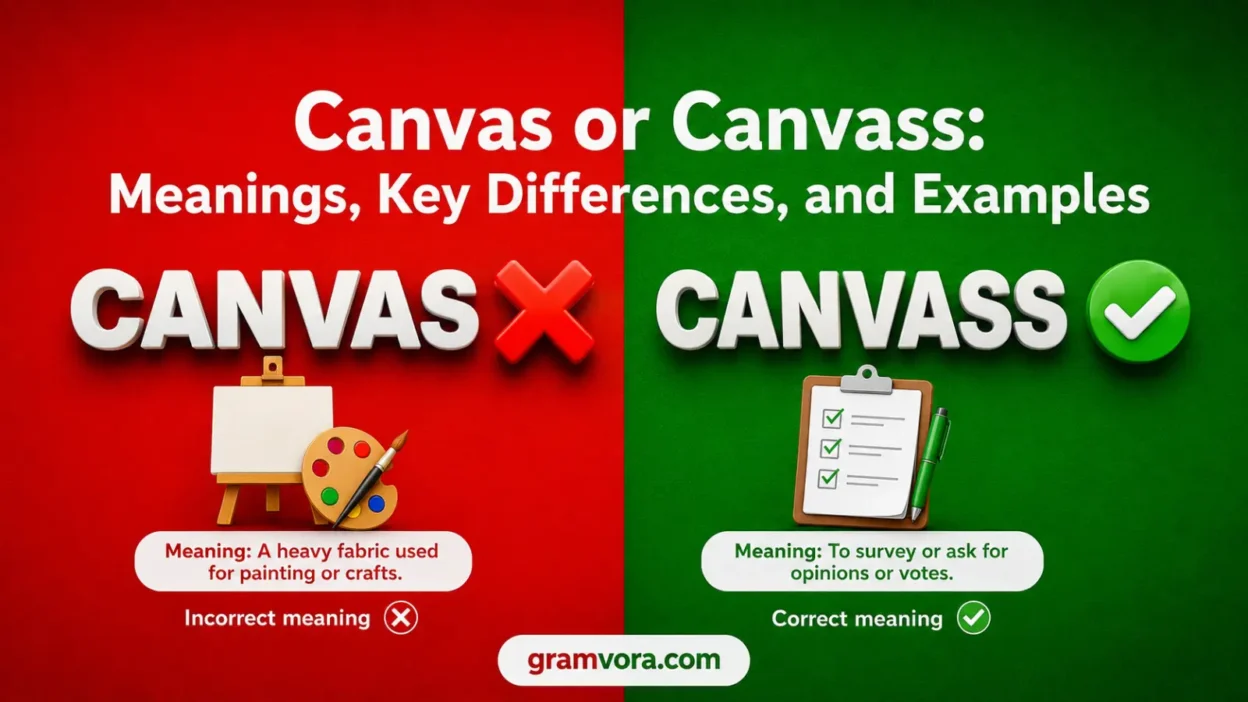
Both canvas and canvass are correct English words, but they usually belong in different situations. Canvas most often names a strong fabric, an artist’s painting surface, or something compared with a blank surface. Canvass usually means asking people for votes, support, orders, information, or opinions.
The words sound alike and differ by only one final s, so the wrong spelling can be easy to miss. The safest choice depends on the intended meaning, not on formality or regional spelling.
Quick Answer
Use canvas for fabric, painting surfaces, paintings, canvas bags, canvas shoes, and figurative creative space.
Use canvass when someone seeks votes, support, opinions, orders, or information. It can also mean examining a subject closely or officially reviewing election returns.
In standard edited US English, write canvas bag but canvass the neighborhood. A canvass can also be the outreach, survey, or official review itself.
Why People Confuse Them
Canvas and canvass are homophones. Both are commonly pronounced KAN-vuhs in US English. Because the sound is the same, listeners cannot identify the spelling without context.
Their written forms are also nearly identical. One word ends in a single s, while the other ends in ss. In addition, the words are historically related, which helps explain their similar forms.
A simple “thing versus action” reminder works in many sentences, but it is not complete. Canvass can also be a noun, as in “a voter canvass” or “the official canvass of election results.”
Key Differences At A Glance
| Context | Best Choice | Why |
|---|---|---|
| Strong fabric for a tent, bag, shoe, or sail | canvas | It names the material. |
| A surface for a painting | canvas | It names the cloth or prepared art surface. |
| A painting created on that surface | canvas | The word can name the finished artwork. |
| A figurative surface or setting for creation | canvas | “Blank canvas” suggests open possibility. |
| Asking voters for support | canvass | It describes political outreach. |
| Gathering opinions or information | canvass | It means surveying or questioning people. |
| Examining an issue or evidence closely | canvass | It can mean reviewing or discussing thoroughly. |
| Reviewing and confirming election returns | canvass | This is a formal US election-administration sense. |
- Canvas: normally a noun; plural canvases.
- Canvass: commonly a verb and also a noun; forms include canvasses, canvassed, and canvassing.
Meaning and Usage Difference
Canvas usually refers to a strong, closely woven cloth. People use it for tents, sails, tote bags, shoes, covers, and other durable items. In art, a canvas is the surface on which an artist paints. The word can also refer to the completed painting.
The noun has figurative uses as well. A person may call an empty room a “blank canvas” when it offers many design possibilities. In computing or design contexts, a canvas can be a working area where visual material is placed.
When canvas appears before another noun, it often describes the material without becoming a separate adjective. Examples include canvas shoes, canvas tent, and canvas tote.
Canvass most often works as a verb. To canvass people or an area is to contact people in order to seek votes, support, orders, information, or opinions. The word can also mean examining or discussing a subject thoroughly.
In US election administration, officials may canvass returns after Election Day. Here, the word refers to reviewing, reconciling, and confirming results before certification. The related noun is canvass, as in “the county canvass.”
Some dictionaries record canvas as a less common variant spelling of the verb canvass, and canvass as a variant in certain material senses. Those forms may be historically recognized, but they can distract modern readers. The standard distinction is clearer in ordinary edited writing.
Tone, Context, and Formality
Canvas is neutral and common in everyday, artistic, commercial, and technical contexts. It sounds natural in product descriptions, art discussions, home projects, clothing descriptions, and figurative expressions.
Canvass is also standard, but its tone changes with context. Political uses are familiar and neutral: volunteers canvass voters. Business and research uses can sound more formal: a company may canvass customer opinion. The sense meaning “examine thoroughly” often appears in formal discussion, reporting, or legal writing.
The election-review sense is specialized and official. In that context, a canvass is not a campaign visit or an opinion poll. It is a post-election review of returns and ballots under applicable procedures.
Because both words have the same usual pronunciation, tone does not help with spelling. Meaning and sentence role must guide the choice.
Which One Should You Use?
Ask what the sentence is describing.
Choose canvas when the word names:
- a durable cloth
- an art surface
- a painting
- a bag, shoe, tent, sail, or cover made from that cloth
- a figurative or digital working surface
Choose canvass when the word describes:
- contacting people for votes or support
- gathering opinions, orders, or information
- searching an area for witnesses or responses
- examining a question thoroughly
- reviewing election returns
- the outreach, survey, or official review as a noun
A useful memory aid is: the extra s in canvass can suggest seek support. Still, remember that the word covers more than political campaigning.
When One Choice Sounds Wrong
Use canvas when a physical material or art surface is intended.
Incorrect: The artist bought a new canvass.
Correct: The artist bought a new canvas.
Incorrect: She carried a canvass tote to class.
Correct: She carried a canvas tote to class.
Use canvass when people are being contacted, questioned, or surveyed.
Incorrect: Volunteers will canvas the district Saturday.
Correct: Volunteers will canvass the district Saturday.
Incorrect: Detectives canvased nearby stores for witnesses.
Correct: Detectives canvassed nearby stores for witnesses.
A rare dictionary variant may technically exist in some references, but the standard spellings above will be clearer to most US readers.
Common Mistakes (and Quick Fixes)
Mistake: Treating the final s as optional.
Quick fix: Match the spelling to the meaning. Material or art takes canvas; outreach or review takes canvass.
Mistake: Writing “canvas voters.”
Quick fix: Use canvass voters because the sentence describes seeking support or opinions.
Mistake: Writing “canvass shoes.”
Quick fix: Use canvas shoes because the word names the material.
Mistake: Assuming canvass is only political.
Quick fix: It can also mean survey, seek information, examine closely, or officially review election returns.
Mistake: Assuming canvass is only a verb.
Quick fix: It is also a noun for an outreach effort, survey, or formal election review.
Mistake: Misspelling the inflected forms.
Quick fix: Write canvasses, canvassed, and canvassing with double s.
Everyday Examples
The art teacher ordered six blank canvases for the workshop.
Her new sneakers have durable canvas uppers.
The muralist treated the entire wall as a giant canvas.
After the remodel, the empty office felt like a blank canvas.
Campaign volunteers will canvass three neighborhoods this weekend.
The nonprofit plans to canvass residents about park improvements.
Detectives canvassed nearby businesses for security footage.
The committee carefully canvassed the arguments before voting.
Our sales team completed a customer canvass last month.
County officials began the election canvass after all precinct reports arrived.
Dictionary-Style Word Details
Verb
- Canvas: Not normally used as a verb in standard edited US English. Some dictionaries record it as a less common variant of canvass, but canvass is the clearer modern choice for soliciting, surveying, or reviewing.
- Canvass: To seek votes, support, orders, opinions, or information; to question people across an area; to examine or discuss thoroughly; or to review election returns officially.
Noun
- Canvas: Strong woven cloth; a prepared painting surface; a painting on that surface; the floor of a boxing or wrestling ring; or a figurative background or working surface. The usual plural is canvases.
- Canvass: An organized effort to seek support, opinions, orders, or information; a survey or solicitation; or an official review of election returns. The plural is canvasses.
Synonyms
- Canvas: Exact synonyms depend on the sense. Closest plain alternatives include heavy cloth, painting surface, art surface, and backdrop. None replaces canvas naturally in every context.
- Canvass: Meaning-matched alternatives include survey, poll, solicit, campaign, question, examine, and scrutinize. For the noun, possible alternatives include survey, outreach effort, solicitation, and official review, depending on context.
Neither word has one clear antonym that works across all its meanings.
Example Sentences
- Canvas: Maya stretched the canvas before applying the first layer of paint.
- Canvas: The family packed a canvas shelter for the camping trip.
- Canvas: The designer saw the plain hallway as a blank canvas.
- Canvass: Organizers will canvass registered voters by phone.
- Canvass: Researchers canvassed local opinion before drafting the proposal.
- Canvass: The board completed its official canvass of the returns.
Word History
- Canvas: The word entered English through Anglo-French and Old French forms associated with hemp cloth. Its later senses grew from the material itself, including an artist’s surface and a painting made on that surface.
- Canvass: This word developed from canvas. Older verb senses involved tossing or sifting in a canvas sheet. The meaning later broadened to examining a matter and then to seeking votes, support, opinions, or information.
The historical relationship explains the similar spelling, but modern usage normally keeps the meanings separate.
Phrases Containing
- Canvas: blank canvas, oil on canvas, canvas bag, canvas shoes, canvas tent, under canvas, hit the canvas
- Canvass: canvass voters, canvass the neighborhood, canvass for support, canvass public opinion, door-to-door canvass, election canvass, canvass the evidence
FAQs
What is the main difference between canvas and canvass?
Canvas usually refers to strong fabric, an artist’s painting surface, or a painting. Canvass means to seek votes, support, opinions, orders, or information. It can also mean examining something carefully or officially reviewing election results.
Is it canvas or canvass a neighborhood?
The correct phrase is canvass a neighborhood. It means visiting or contacting people in an area to gather information, ask for support, or seek votes.
Example: “Volunteers will canvass the neighborhood before the local election.”
Is canvass only used as a verb?
No. Canvass can be both a verb and a noun. As a verb, it means to survey, question, or seek support. As a noun, it refers to the survey, outreach effort, or official review itself.
Example: “The organization completed a door-to-door canvass.”
Is it canvas bag or canvass bag?
Use canvas bag. In this phrase, canvas names the strong woven material used to make the bag.
The same rule applies to canvas shoes, canvas tents, and canvas covers.
How do you spell canvassing?
The correct spelling is canvassing, with double s before the ending.
Related forms include:
- canvass
- canvasses
- canvassed
- canvassing
Example: “The campaign team spent Saturday canvassing local voters.”
Can canvas be used as a verb?
Some dictionaries record canvas as a rare variant of the verb canvass. However, canvass is the clearer and more widely expected spelling when you mean survey, solicit, question, or examine.
For standard modern writing, use “canvass the area,” not “canvas the area.”
What does canvass mean in an election?
In campaigning, canvass means contacting voters to seek support or discuss issues. In election administration, a canvass is the official review and confirmation of election returns before results are certified.
The intended meaning depends on whether the sentence discusses campaigning or the formal vote-review process.
Are canvas and canvass pronounced differently?
No. In standard US English, both words are usually pronounced KAN-vuhs. Because they sound the same, their spelling must be chosen from the sentence’s meaning.
Use canvas for material or art and canvass for outreach, surveys, examination, or election review.
Conclusion
Both spellings are correct, but they are not freely interchangeable. Use canvas for strong cloth, an artist’s surface, a painting, or a figurative working space. Use canvass for seeking votes, support, opinions, orders, or information; examining a matter closely; or reviewing election returns.
The most dependable contrast is canvas material versus canvass people or results. Also remember that canvass can be a noun. Choosing by meaning will keep the extra s in the right place.