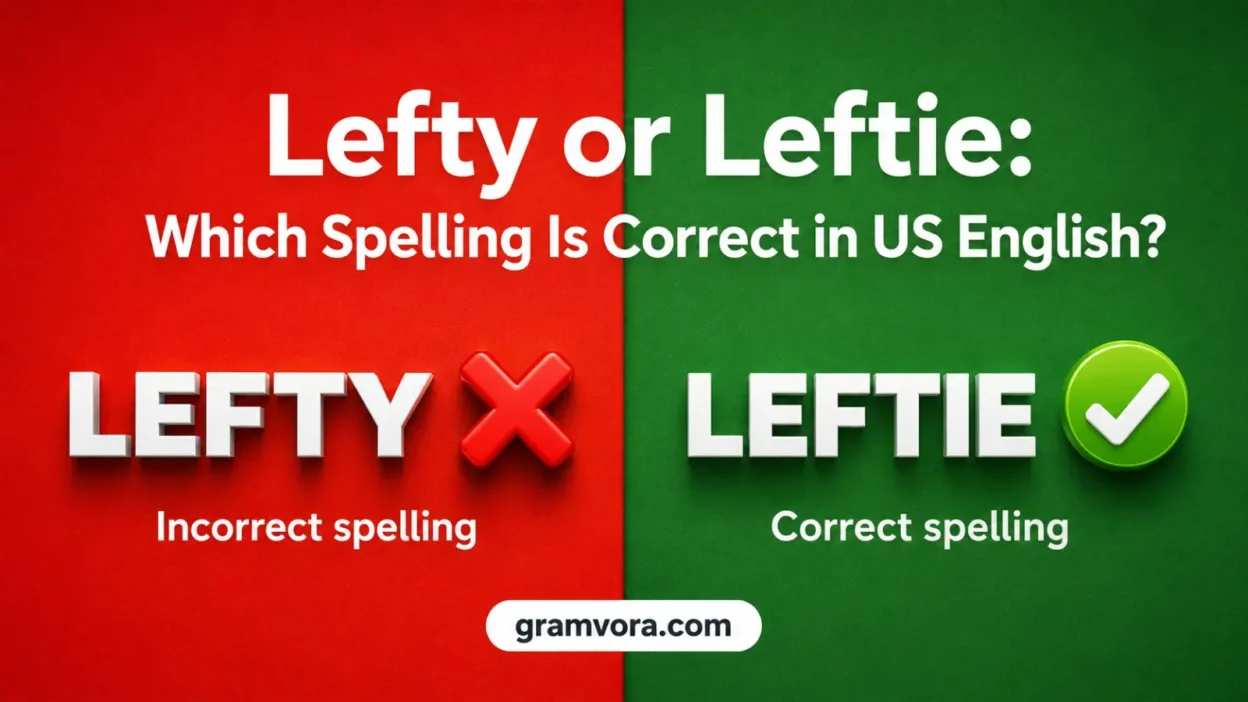
Both lefty and leftie appear in dictionaries and published writing. They are alternative spellings of the same informal word, but they are not equally common in every setting.
For a US audience, lefty is normally the best spelling. It is especially familiar when discussing a left-handed person, athlete, pitcher, batter, or golfer.
Leftie is also correct. However, it is less typical in American writing and appears more often in British informal language, particularly in political discussions.
Quick Answer
Both lefty and leftie are accepted spellings.
In American English, choose lefty in most situations:
- My brother is a lefty.
- The team signed another lefty pitcher.
- She writes lefty but plays tennis right-handed.
Leftie is a valid alternative, not a misspelling. It is more noticeable in British writing and is often used for someone with left-wing political views.
The two forms have the same pronunciation: LEFT-ee.
Why People Confuse Them
The confusion comes from the common English endings -y and -ie. Both endings can create informal labels for people.
Readers also hear no difference between the two forms. Because lefty and leftie sound identical, writers must choose the spelling from memory or follow a publication’s preferred style.
A further source of confusion is the plural. Both singular spellings become lefties:
- one lefty, two lefties
- one leftie, two lefties
Therefore, seeing lefties does not reveal which singular spelling the writer prefers.
Key Differences At A Glance
- Lefty: The usual and safest spelling in American English.
- Leftie: An accepted alternative that is more noticeable in British informal writing.
- Meaning: Both can describe a left-handed person or, depending on context, a person with left-wing political views.
- Pronunciation: Both are pronounced LEFT-ee.
- Plural: Both become lefties.
- Tone: Both are informal. The political sense may sound dismissive or critical.
- Grammar: Lefty has broader documented use as a noun, adjective, and sports-related adverb. Leftie is mainly used as a noun.
Are They the Same Word?
As nouns, lefty and leftie are spelling variants of the same word. They do not carry separate core meanings.
Both may refer to a person who mainly uses the left hand:
- Jordan is the only lefty in our family.
- The leftie used specially designed scissors.
They may also refer informally to someone associated with the political left:
- The columnist described himself as an old lefty.
- Critics dismissed the professor as a leftie.
Context determines the meaning, not the final letters.
In American sports writing, lefty can also describe a player or action:
- a lefty pitcher
- a lefty swing
- He bats lefty.
That broader grammatical use makes lefty more natural than leftie in many US sentences.
US vs UK Preference
American dictionaries consistently use lefty as the main entry. American readers are also familiar with it in baseball, golf, boxing, and everyday descriptions of handedness.
For that reason, US writers should normally use:
- lefty pitcher
- lefty batter
- a proud lefty
- the only lefty in the class
British usage is less absolute than a simple regional rule may suggest. British dictionaries accept both spellings. Leftie is particularly familiar in informal political language, but lefty is not incorrect in British English.
Therefore, the practical distinction is a preference rather than a firm rule:
- US English: strongly prefer lefty
- UK English: both occur; leftie is familiar, especially politically
- International writing: lefty is usually the clearer default
Which Spelling Should You Use?
| Context | Best Choice | Why |
|---|---|---|
| General American English | lefty | It is the standard US default |
| American baseball or sports writing | lefty | It is established sports language |
| Description of a left-handed person | lefty | It sounds natural to most US readers |
| British informal political writing | leftie or lefty | Both are accepted |
| Formal writing about handedness | left-handed person | It is clearer and less casual |
| Neutral political writing | left-wing voter or left-wing politician | It avoids an informal or critical tone |
| Quotation or organization name | Original spelling | Preserve the source’s chosen form |
Consistency also matters. Do not alternate between lefty and leftie in the same document unless you are reproducing someone else’s wording.
When One Spelling Looks Wrong
Leftie can look unusual in American sports reporting:
- Less natural in US writing: The coach brought in a leftie pitcher.
- More natural: The coach brought in a lefty pitcher.
However, unusual does not mean incorrect. The spelling may be suitable in a quotation, a British publication, a nickname, or a brand name.
Lefty may look out of place when a British publication has chosen leftie as part of its house style. In that case, consistency matters more than changing every form to the American preference.
Either spelling may also be inappropriate in formal political writing. Calling someone a lefty or leftie can sound mocking, dismissive, or overly casual. A neutral description such as left-wing politician is often safer.
Common Mistakes (and Quick Fixes)
Mistake: Treating leftie as a spelling error
Quick fix: Recognize it as an accepted alternative. Replace it only when American style or consistency calls for lefty.
Mistake: Claiming the spellings have different meanings
Quick fix: Let context establish whether the word refers to handedness or politics. The spelling itself does not create that difference.
Mistake: Writing leftys as the plural
Quick fix: Change the final y to ies:
- one lefty
- two lefties
The plural of leftie is also lefties.
Mistake: Using leftie’s as a plural
Quick fix: An apostrophe shows possession, not an ordinary plural:
- The leftie’s notebook was on the desk.
- Several lefties attended the event.
Mistake: Switching spellings without a reason
Quick fix: Choose one form and use it consistently. For American writing, choose lefty.
Everyday Examples
Lefty in American everyday use
- I did not realize Maya was a lefty until she started writing.
- Our new pitcher is a lefty with an excellent fastball.
- The store sells notebooks designed for lefties.
- He plays golf right-handed even though he is naturally a lefty.
- The manager wanted a lefty batter for the final inning.
Leftie as an accepted alternative
- My British cousin calls herself a proud leftie.
- The article described him as a lifelong political leftie.
- Several lefties requested different classroom desks.
- She bought the scissors as a gift for a leftie friend.
More formal alternatives
- The survey included both right-handed and left-handed participants.
- The candidate is associated with the political left.
- The team needs a left-handed relief pitcher.
Dictionary-Style Word Details
Verb
- Lefty: Not commonly used as a standard verb.
- Leftie: Not commonly used as a standard verb.
Use a fuller verb phrase instead, such as write with the left hand, throw left-handed, or bat left-handed.
Noun
- Lefty: An informal noun for a left-handed person or a person associated with left-wing politics. It is the normal American spelling.
- Leftie: An alternative informal noun with the same basic senses. It is less common in US writing and familiar in British usage.
The plural of both forms is lefties.
Synonyms
For the handedness sense, the closest plain alternatives are:
- left-hander
- left-handed person
- southpaw, especially in sports
For the political sense, possible alternatives include:
- leftist
- left-winger
- progressive, when the person’s views support that description
Possible opposites include right-hander for handedness and right-winger or rightist for politics. These are context-based opposites rather than perfect substitutes in every sentence.
Example Sentences
- Lefty: Our starting pitcher is a lefty.
- Leftie: She is the only leftie in her immediate family.
- Lefty: The newspaper called him a well-known lefty.
- Leftie: The British commentator described the group as lefties.
Word History
Lefty was formed in English from left and the informal -y ending. Historical dictionaries record it from the late 1800s, with strong early connections to American baseball and left-handed players.
Leftie is an accepted alternative spelling using -ie. Its existence does not indicate a separate meaning or pronunciation.
The spelling variation follows a broader informal pattern seen in words whose endings may appear as -y or -ie. Modern usage, regional preference, and publication style determine which form appears.
Phrases Containing
Common combinations with lefty include:
- lefty pitcher
- lefty batter
- lefty golfer
- natural lefty
- political lefty
- fellow lefties
Common combinations with leftie include:
- political leftie
- old leftie
- proud leftie
- fellow lefties
- group of lefties
In US sports writing, phrases beginning with lefty are far more natural than versions beginning with leftie.
FAQs
Is lefty or leftie the correct spelling?
Both lefty and leftie are correct. They are alternative spellings of the same informal word. In American English, lefty is the more common and natural choice. Leftie appears more often in British informal writing.
Is leftie incorrect in American English?
No, leftie is not incorrect. However, it may look unusual to American readers, especially in sports writing. For a US audience, lefty is normally the safer spelling.
Do lefty and leftie have different meanings?
No. The spelling does not change the meaning. Both words can refer to a left-handed person or, in informal political language, someone associated with the political left. The surrounding sentence shows which meaning is intended.
What is the plural of lefty and leftie?
The plural of both spellings is lefties.
Correct:
- One lefty joined the team.
- Three lefties joined the team.
- She is a leftie.
- Several lefties attended the meeting.
Do not write leftys or leftie’s when you mean more than one person.
Are lefty and leftie pronounced differently?
No. Both spellings are pronounced LEFT-ee. Because they sound exactly the same, writers often become unsure which ending to use. In US English, remembering that lefty is the standard preference makes the choice easier.
Is lefty formal or informal?
Lefty and leftie are informal. In formal writing, use left-handed person, left-handed player, or left-handed pitcher. In political writing, a neutral phrase such as left-wing politician may be more appropriate because lefty or leftie can sometimes sound dismissive.
Conclusion
Both lefty and leftie are correct spellings of the same informal word. They share the same pronunciation and can refer to either a left-handed person or someone associated with left-wing politics.
For American English, lefty is the best default. It is especially well established in everyday and sports writing.
Leftie remains a valid alternative, particularly in British informal usage. However, the regional difference is a preference, not an absolute rule.
Whichever spelling you choose, remember that the plural is always lefties. In formal contexts, consider using left-handed person, left-handed player, or a neutral political description instead.