
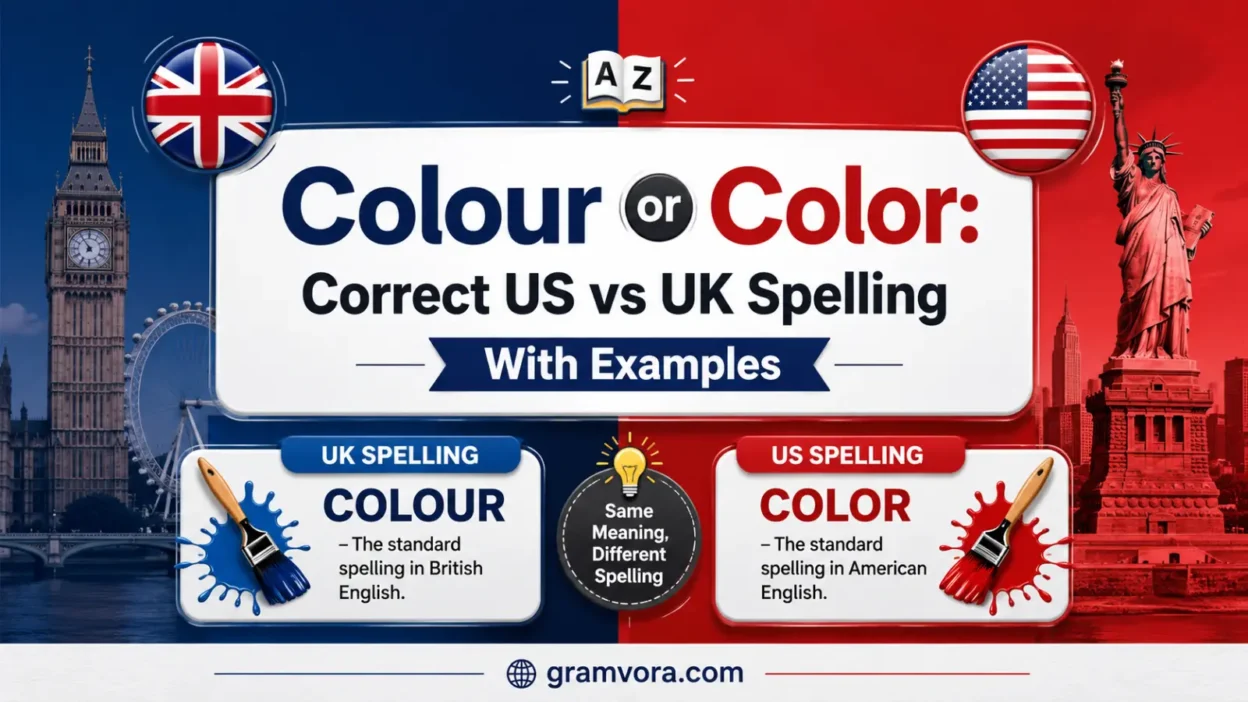
Both colour and color are correct spellings, but they are not used the same way everywhere. The spelling you choose should match your audience, document style, and version of English.
For a US audience, color is the standard choice. For British English and many Commonwealth contexts, colour is the standard choice. The words have the same basic meaning and pronunciation. The difference is spelling preference, not meaning.
Quick Answer
Use color in American English. Use colour in British English and in many Commonwealth varieties. Both spellings refer to the same word and can work as a noun or a verb. In US writing, colour usually looks British, formal, or inconsistent unless a name, title, quotation, or house style requires it.
Why People Confuse Them
People confuse colour and color because both spellings appear in real English. A US reader may see colour in British books, product labels, school materials, or international websites. A UK reader may see color in US apps, design software, or American publications.
The extra u also appears in related pairs, such as favour/favor, honour/honor, and behaviour/behavior. Once readers notice that pattern, they often wonder whether both spellings are allowed everywhere.
They are allowed in English overall, but not equally preferred in every context.
Key Differences At A Glance
| Context | Best Choice | Why |
|---|---|---|
| US school paper | color | Standard American spelling |
| US business email | color | Natural for a US audience |
| British publication | colour | Standard British spelling |
| Canadian or Australian context | colour | Often follows British spelling preference |
| Quoting a source | Keep the original spelling | Do not silently change quoted wording |
| Brand or product name | Follow the official name | Names keep their chosen spelling |
| Mixed international document | Follow one style consistently | Consistency prevents distraction |
Are They the Same Word?
Yes. Colour and color are spelling variants of the same word. They do not create a new meaning by themselves.
Both can refer to the visible quality of something, such as red, blue, green, or yellow. Both can also work as verbs meaning to add color, change color, or influence the way something seems.
They are usually pronounced the same: KUH-ler. The spelling changes, but the sound normally does not.
Compact comparison:
• colour: British-preferred spelling
• color: American-preferred spelling
• Meaning: the same
• Pronunciation: normally the same
• Grammar role: noun and verb
• Main rule: choose the spelling that fits your audience and style
US vs UK Preference
In American English, color is the normal spelling. A US teacher, editor, client, or reader will usually expect color in ordinary writing.
In British English, colour is the normal spelling. The same preference often appears in many Commonwealth settings, although local style can vary by country, publisher, school, or organization.
This is not a grammar difference. It is a spelling convention. The safest rule is simple: use color for US writing and colour for British-style writing.
Which Spelling Should You Use?
Use color when writing for readers in the United States.
Examples:
The logo uses one strong color.
Please change the background color.
The artist will color the final sketch later.
Use colour when writing for readers who expect British spelling.
Examples:
The logo uses one strong colour.
Please change the background colour.
The artist will colour the final sketch later.
For a website, brand guide, academic paper, or client project, follow the assigned style. If no style is given and your audience is American, choose color.
When One Spelling Looks Wrong
Neither spelling is wrong in all English. Still, one spelling can look wrong in the wrong setting.
In a US résumé, school essay, blog post, or business page, colour may look inconsistent or foreign to the audience. It can also look like an accidental British spelling if the rest of the document uses American forms such as favorite, honor, and behavior.
In a British-style document, color may stand out for the same reason. It can look inconsistent beside favourite, honour, and behaviour.
The real issue is not correctness alone. The real issue is matching the spelling system your readers expect.
Common Mistakes (and Quick Fixes)
Mistake: Mixing both spellings in one document
Fix: Choose one style and use it throughout.
Example: Use color palette, color photo, and background color in a US document.
Mistake: Changing a direct quote
Fix: Keep the spelling from the original quote.
Mistake: Using colour for a US audience because it “looks fancier”
Fix: Use color unless the project specifically requires British spelling.
Everyday Examples
The designer changed the button color to blue.
My favorite color is green.
Please print the flyer in full color.
The teacher asked the students to color the map.
The wall color looks warmer in daylight.
The app lets users choose a custom text color.
For a British-style version, the same sentences would use colour:
The designer changed the button colour to blue.
My favourite colour is green.
Please print the flyer in full colour.
The teacher asked the students to colour the map.
The wall colour looks warmer in daylight.
The app lets users choose a custom text colour.
Dictionary-Style Word Details
Verb
• colour: Used as a verb in British-style English. It can mean to add colour, fill something with colour, change colour, or affect how something is seen.
Example: The child will colour the picture after lunch.
• color: Used as a verb in American English. It can mean to add color, fill something with color, change color, or influence perception.
Example: The child will color the picture after lunch.
Noun
• colour: Used as a noun in British-style English. It can mean a visible shade, a bright quality, or the appearance of something.
Example: The room needs more colour.
• color: Used as a noun in American English. It can mean a visible shade, a bright quality, or the appearance of something.
Example: The room needs more color.
Synonyms
For both spellings, the closest plain alternatives depend on the sentence.
Closest plain alternatives: hue, shade, tint, tone, pigment.
These are not always exact replacements. For example, shade can mean a specific variety of a color, while pigment refers more to the substance that gives color.
A clear opposite does not fit every use. In some contexts, colorlessness, paleness, or lack of color may work.
Example Sentences
• colour: The curtains add a soft colour to the room.
• colour: Do not let one bad review colour your opinion of the whole team.
• colour: The garden was full of colour in spring.
• color: The curtains add a soft color to the room.
• color: Do not let one bad review color your opinion of the whole team.
• color: The garden was full of color in spring.
Word History
The spelling difference belongs to a larger -our and -or pattern in English. Modern British spelling often keeps -our in words like colour, favour, and honour. Modern American spelling usually uses -or in color, favor, and honor.
The shorter American forms are strongly linked with spelling reform traditions associated with Noah Webster. The important point for today’s reader is practical: the spelling difference is regional and stylistic, not a meaning difference.
Phrases Containing
• colour: in colour, full colour, colour scheme, add colour to, local colour
• color: in color, full color, color scheme, add color to, local color
In US writing, phrases such as color scheme, in color, and full color are standard. In British-style writing, the matching forms are colour scheme, in colour, and full colour.
FAQs
Is colour or color correct?
Both colour and color are correct spellings. The difference depends on the English style you are using. Color is the standard spelling in American English. Colour is the standard spelling in British English and in many Commonwealth contexts.
Which spelling should I use in the United States?
Use color in the United States. It is the normal spelling for school papers, business writing, websites, product descriptions, and everyday US communication. A US reader will usually expect color, not colour.
Is colour wrong in American English?
Colour is not wrong as a word, but it usually looks British in American English. In a US document, it may seem inconsistent unless you are quoting a British source, using an official name, or following a specific house style.
Do colour and color mean the same thing?
Yes. Colour and color mean the same thing. Both can refer to a shade, hue, or visual quality, such as red, blue, green, or yellow. They can also work as verbs meaning to add color or influence the way something appears.
Do colour and color sound different?
No. In normal speech, colour and color are pronounced the same way. The spelling changes by region, but the pronunciation usually stays the same.
Can I use both spellings in one article?
Avoid mixing them in one article unless you have a clear reason. For a US article, use color throughout. For a British-style article, use colour throughout. Consistent spelling makes your writing look cleaner and more professional.
Conclusion
Colour and color are both correct, but they belong to different spelling traditions. For American English, use color. For British-style English, use colour.
They mean the same thing, sound the same, and can work as both noun and verb. The safest choice is the spelling your audience expects. Once you choose one, keep it consistent across the whole document.
[…] There is no clean, simple US-vs-UK split here like color and colour. […]