
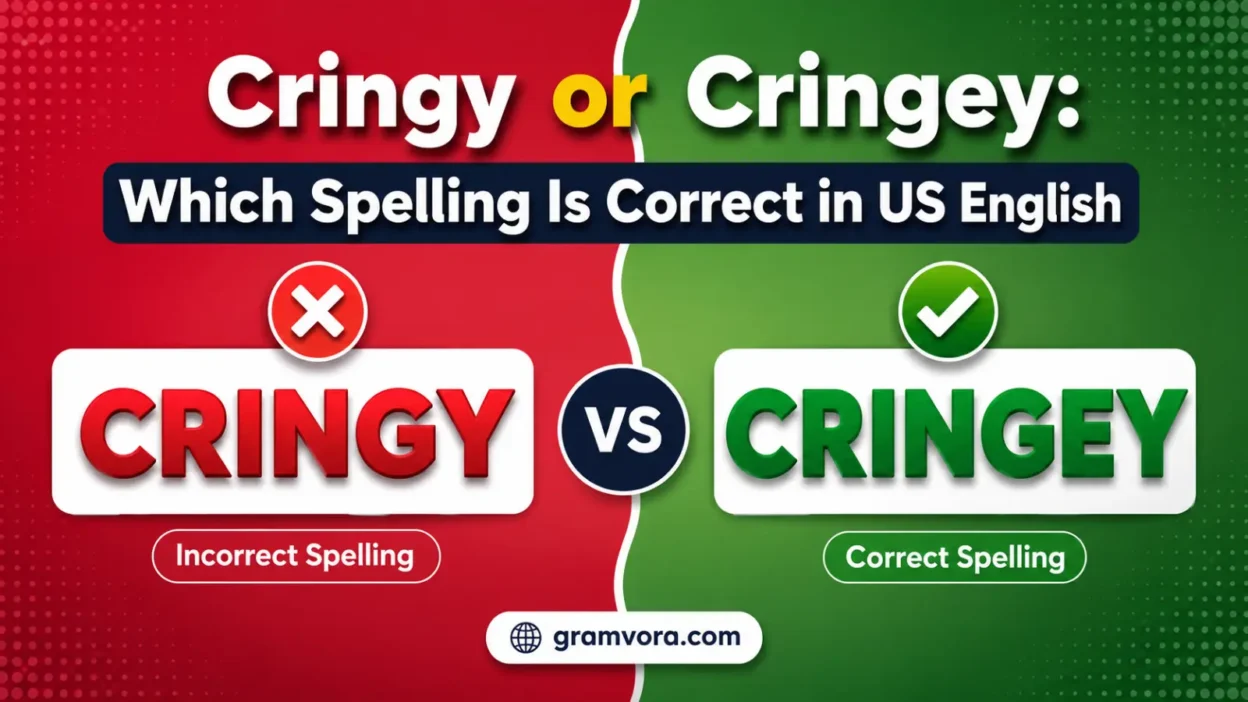
Both cringy and cringey are used in modern English, and both refer to something that makes people feel awkward, embarrassed, or uncomfortable. The confusion comes from spelling, not meaning.
For most US readers, cringey is the safer spelling. It is widely recognized, clearly connected to the base word cringe, and less likely to look like a mistake in edited writing. Cringy is also used and understood, especially in casual online writing, but it can look less polished to some readers.
Quick Answer
Cringey is the better choice for most US writing. Cringy is not wrong, but cringey is usually the safer and more accepted spelling. Both mean the same thing: awkward, embarrassing, or uncomfortable enough to make someone cringe.
Correct: That scene was so cringey.
Also acceptable: That scene was so cringy.
Why People Confuse Them
People confuse cringy and cringey because both come from the verb cringe. When English adds -y to some words ending in e, the final e often disappears.
That pattern makes cringy look possible.
However, cringy can also look strange because the spelling hides the base word cringe. Without the e, some readers may pause over cringy and wonder whether it should sound like “kring-y” instead of “crinj-ee.”
That is why cringey often feels clearer. It keeps the full base word visible: cringe + y = cringey.
Key Differences At A Glance
| Context | Best Choice | Why |
|---|---|---|
| General US writing | Cringey | Safer, clearer, and more widely accepted |
| Casual texts or comments | Cringy or cringey | Both are understood in informal use |
| School writing | Cringey | Less likely to be marked as odd |
| Edited articles or blog posts | Cringey | Better for consistency and readability |
| Social media captions | Either | Tone and audience matter more |
| Formal business writing | Avoid both if possible | Use awkward, embarrassing, or uncomfortable instead |
The main difference is not meaning. It is spelling preference. Cringey is the better default when you want your writing to look clean and standard.
Are They the Same Word?
Yes. Cringy and cringey are spelling variants of the same informal adjective.
They have the same basic meaning. A cringey joke and a cringy joke are both jokes that feel awkward, embarrassing, forced, or uncomfortable.
They also have the same pronunciation: KRIN-jee.
The difference is visual. Cringey keeps the e from cringe, so the connection is easier to see. Cringy drops the e, which follows a common spelling pattern but may look less natural to many readers.
Use this simple rule:
• Use cringey when you want the safer spelling.
• Use cringy only when your tone is casual and your audience will not mind.
US vs UK Preference
There is no strong, clean rule that says one spelling is only American and the other is only British.
In US English, cringey is the safer spelling for most public-facing writing. It looks more familiar in edited examples and is less likely to distract readers. Cringy still appears in casual US writing, especially in comments, captions, and informal posts.
In UK English, cringey is also common and natural. Cringy is understood there too, but it may look less standard depending on the reader or publication.
The honest answer is simple: this is not a strict US-vs-UK spelling pair like color and colour. It is mainly a preference and style issue.
Which Spelling Should You Use?
Choose cringey unless you have a reason to choose cringy.
Cringey works better in most of these places:
• articles
• school assignments
• captions for a broad audience
• reviews
• newsletters
• scripts
• polished blog posts
• professional social posts
Cringy works best when the tone is very casual:
• texts
• memes
• quick comments
• informal chats
• playful captions
Here is the practical choice:
Use cringey as your default. Use cringy only when a casual style fits.
That keeps your writing clear without pretending that cringy is wrong.
When One Spelling Looks Wrong
Cringy can look wrong when the surrounding writing is polished. For example, in a review, article, or school paragraph, some readers may see cringy and think it is a typo.
Less smooth: The campaign’s humor felt cringy and forced.
Smoother: The campaign’s humor felt cringey and forced.
Cringey can look slightly less natural only if your audience strongly prefers short internet-style spelling. That is rare in edited writing, but it may happen in very casual online spaces.
Both spellings can also look wrong if you mix them in the same piece.
Weak: The first joke was cringey, but the ending was even more cringy.
Better: The first joke was cringey, but the ending was even more cringey.
Pick one spelling and stay consistent.
Common Mistakes (and Quick Fixes)
Mistake 1: Saying cringy is always wrong
Wrong idea: Cringy is not a word.
Better idea: Cringy is an accepted informal spelling, but cringey is safer.
Mistake 2: Creating a fake meaning difference
Wrong idea: Cringy means awkward, but cringey means embarrassing.
Better idea: They mean the same thing.
Mistake 3: Using both spellings in one article
Weak: The scene was cringy, and the dialogue was cringey.
Better: The scene was cringey, and the dialogue was cringey.
Mistake 4: Using the adjective in very formal writing
Too casual: The presentation was cringey.
More formal: The presentation was awkward and uncomfortable to watch.
Mistake 5: Confusing cringe with cringey
Casual but different: That video is cringe.
Clearer adjective: That video is cringey.
In careful writing, cringey is the clearer adjective.
Everyday Examples
Here are natural US-English examples using the safer spelling first.
• The apology video felt cringey because it sounded rehearsed.
• I found my old posts, and they were painfully cringey.
• That joke was meant to be cute, but it came off cringey.
• The movie had a few cringey lines, but the ending worked.
• His attempt to sound trendy was a little cringey.
• The campaign was trying too hard, which made it feel cringey.
• I deleted the caption because it sounded cringey.
• The interview got cringey when he forgot the guest’s name.
• My middle school photos are cringey, but they are also funny.
• The skit was supposed to be ironic, not cringey.
Here is a compact comparison:
• Cringy: accepted, casual, shorter, sometimes less polished
• Cringey: accepted, safer, clearer, better for edited US writing
Dictionary-Style Word Details
Verb
• Cringy: Not commonly used as a verb in standard US English. Use cringe as the verb.
• Cringey: Not commonly used as a verb in standard US English. Use cringe as the verb.
Correct verb use: I cringed at the awkward speech.
Not standard: I cringeyed at the awkward speech.
Noun
• Cringy: Not commonly used as a noun in standard US English. It is mainly an adjective.
• Cringey: Not commonly used as a noun in standard US English. It is mainly an adjective.
For a noun, use cringe when the sentence allows it.
Example: The clip was pure cringe.
More standard adjective form: The clip was cringey.
Synonyms
• Cringy: Same word, different spelling preference in different contexts. Closest plain alternatives include awkward, embarrassing, uncomfortable, painful, and cringeworthy.
• Cringey: Same word, safer spelling for most US writing. Closest plain alternatives include awkward, embarrassing, uncomfortable, painful, and cringeworthy.
Possible antonyms depend on the sentence. Useful opposites may include smooth, natural, confident, or comfortable.
Do not treat these alternatives as exact matches in every context. Cringey often means awkward in a way that causes secondhand embarrassment.
Example Sentences
• Cringy: His pickup line was cringy, but at least he laughed at himself.
• Cringey: His pickup line was cringey, but at least he laughed at himself.
• Cringy: That old commercial feels cringy now.
• Cringey: That old commercial feels cringey now.
• Cringy: Back in high school, I posted something cringy.
• Cringey: Back in high school, I posted something cringey.
• Cringy: Near the end, the dialogue got cringy.
• Cringey: Near the end, the dialogue got cringey.
Word History
• Cringy: Built from cringe plus an adjective ending. It drops the final e, which follows a familiar spelling pattern in some English words.
• Cringey: Built from cringe plus an adjective ending, while keeping the e visible. That makes the link to cringe clearer for many readers.
The full history of the spelling preference is not as neat as a simple rule. Both forms exist because English spelling often balances pattern, pronunciation, and reader familiarity.
The safest practical point is this: cringey is easier for many readers to recognize as the adjective form of cringe.
Phrases Containing
• Cringy: cringy video, cringy joke, cringy caption, cringy scene, cringy moment, cringy behavior
• Cringey: cringey video, cringey joke, cringey caption, cringey scene, cringey moment, cringey behavior
The phrases mean the same thing. The spelling choice depends on tone and consistency.
For public writing, these versions usually look cleaner:
• cringey video
• cringey joke
• cringey scene
• cringey behavior
Conclusion
Cringy and cringey are both accepted spellings of the same informal adjective. They mean the same thing, sound the same, and describe something awkward, embarrassing, or uncomfortable enough to make someone cringe.
For US readers, cringey is the better default. It looks clearer, more familiar, and more polished in most writing. Cringy is still acceptable in casual contexts, but it can look less standard.
Best choice: use cringey unless your tone is very informal.
[…] spelling is wrong in all English. Still, one spelling can look wrong in the wrong […]