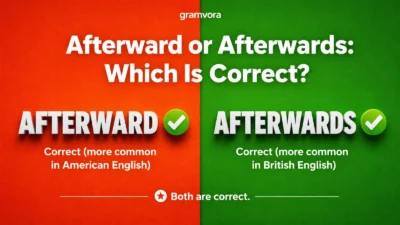

Acknowledgement or acknowledgment can be confusing because both spellings appear in edited English. The difference is not a difference in meaning. Instead, the choice mainly comes down to regional spelling preference.
For American English, acknowledgment is usually the better choice. British English generally prefers acknowledgement, with the extra e before -ment.
Quick Answer
Both acknowledgement and acknowledgment are correct spellings of the same noun. They have the same meanings and grammatical uses.
For a US audience, write acknowledgment. For a British audience, acknowledgement is generally the more familiar choice. If an employer, university, publisher, or other organization has its own style requirements, follow those requirements consistently.
Why People Confuse Them
The confusion comes from the related verb acknowledge. Because that verb ends in e, many writers naturally expect the noun to keep it:
acknowledge → acknowledgement
That spelling does exist. However, standard American usage commonly drops the e when forming the noun:
acknowledge → acknowledgment
Neither spelling creates a new meaning. The difference is simply a spelling convention.
Key Differences At A Glance
| Context | Best Choice | Why |
|---|---|---|
| American English | acknowledgment | Preferred US spelling |
| British English | acknowledgement | Common British preference |
| US school or university work | acknowledgment | Fits standard American spelling |
| British academic writing | acknowledgement | Fits standard British spelling |
| Organization with a house style | Follow its required form | Consistency takes priority |
| International writing | Either, used consistently | Both forms are established |
A simple comparison helps:
- acknowledgment: preferred for US English; drops the e
- acknowledgement: preferred for British English; keeps the e
- Meaning: the same
- Pronunciation: the spelling variation itself does not change the pronunciation
- Part of speech: both are nouns
Are They the Same Word?
Yes. Acknowledgement and acknowledgment are two spellings of the same noun.
Depending on context, the noun can refer to recognizing that something is true, showing recognition or appreciation, confirming receipt of something, or giving credit to people who provided help.
For example:
“Her acknowledgment of the mistake helped resolve the problem.”
In British spelling, the same sentence can use acknowledgement without changing the meaning.
The two forms also occupy the same grammatical role. There is no separate adjective or verb meaning created by adding or removing the e.
US vs UK Preference
In American English, acknowledgment is the preferred spelling. It is therefore the safest choice for US articles, business documents, school assignments, legal writing, and general professional communication.
British English commonly prefers acknowledgement. A British publication may therefore write “acknowledgement of receipt” where an American publication would normally write “acknowledgment of receipt.”
This distinction is a preference rather than a universal ban on the other spelling. English dictionaries recognize both forms, so seeing acknowledgement in an American context does not automatically make the sentence incorrect.
Which Spelling Should You Use?
If you are writing for readers in the United States, choose acknowledgment. It matches normal American spelling practice and is the most suitable default for US-focused content.
Use acknowledgement when you are following British English conventions. You may also need it when a school, publisher, employer, or client specifically requires that spelling.
Most importantly, avoid switching between the two forms without a reason. A document that uses acknowledgment in one paragraph and acknowledgement in another can look poorly edited even though both spellings are valid.
When One Spelling Looks Wrong
A spelling checker set to American English may prefer acknowledgment and flag acknowledgement. That does not mean the longer spelling is invalid everywhere. It may simply conflict with the selected regional convention.
The reverse situation can happen in British-oriented writing. Acknowledgment may look unusual to some British readers even though the form exists and is recognized.
Context therefore matters more than treating one spelling as universally right and the other as universally wrong.
Common Mistakes (and Quick Fixes)
One common mistake is assuming that acknowledgement has a different meaning because it contains an extra letter. It does not. Use regional preference, not meaning, to choose between the spellings.
Another mistake is changing the verb itself. The standard verb is acknowledge in both US and British English. Do not remove the e from the verb just because American English normally uses acknowledgment as the noun.
Writers also sometimes mix the two noun spellings in the same document. Pick the form that fits your audience or required style and stay consistent.
Everyday Examples
For American English, acknowledgment sounds natural in sentences such as:
“The company sent an acknowledgment of my application.”
“Her apology included an acknowledgment of the harm she caused.”
“Jake nodded in acknowledgment as I entered the room.”
“The author thanked her editor in the acknowledgments.”
“We are still waiting for an acknowledgment of payment.”
In British English, the same meanings can be written with acknowledgement:
“The company sent an acknowledgement of my application.”
“Her apology included an acknowledgement of the problem.”
“The author thanked everyone in the acknowledgements.”
Nothing about the underlying meaning changes.
Dictionary-Style Word Details
Verb
Acknowledgement: Not normally used as a verb. It is a noun spelling.
Acknowledgment: Not normally used as a verb. It is also a noun spelling.
The related verb for both forms is acknowledge:
“She acknowledged her mistake.”
“They acknowledged receiving the message.”
Noun
Acknowledgement: A standard spelling of the noun, especially common in British English.
Acknowledgment: The preferred American spelling of the same noun.
The noun may refer to recognition, admission, appreciation, confirmation of receipt, or credit given to another person. It can be countable or uncountable depending on the particular sense.
Plural forms are also valid:
acknowledgments — American spelling
acknowledgements — British spelling
Synonyms
The best synonym depends on the meaning.
For acknowledgment meaning recognition or acceptance, useful alternatives include:
- recognition
- acceptance
- admission
For acknowledgment meaning an expression of thanks, useful alternatives include:
- appreciation
- thanks
- recognition
Possible opposites in contexts involving admission or recognition include denial, rejection, and disavowal. These are context-dependent rather than universal opposites.
Both spellings take the same synonyms because they represent the same word.
Example Sentences
Acknowledgement:
“The report included an acknowledgement of the team’s contribution.”
“She received an acknowledgement that her request had been received.”
“The author added several personal acknowledgements at the end.”
Acknowledgment:
“The report included an acknowledgment of the team’s contribution.”
“She received an acknowledgment that her request had been received.”
“The author added several personal acknowledgments at the end.”
The spelling changes, but the meaning and sentence structure remain the same.
Word History
Both spellings are built from the verb acknowledge and the noun-forming ending -ment. The variation concerns whether the final e of acknowledge is retained before -ment.
Modern usage developed different regional preferences. American English generally favors acknowledgment, while British English more often retains the e in acknowledgement.
There is no need to assign different meanings to the two historical forms.
Phrases Containing
Both spellings appear in the same kinds of phrases. The choice changes according to regional convention.
American English commonly uses:
- acknowledgment of receipt
- acknowledgment of responsibility
- acknowledgment of a mistake
- in acknowledgment of
- acknowledgments section
British English may use:
- acknowledgement of receipt
- acknowledgement of responsibility
- acknowledgement of a mistake
- in acknowledgement of
- acknowledgements section
The phrases carry the same meanings in either spelling.
Conclusion
Both acknowledgement and acknowledgment are correct spellings of the same word. They do not differ in meaning, pronunciation because of the spelling, or grammatical function.
For American English, acknowledgment is the best default. British English generally prefers acknowledgement. When a specific organization or publication has its own required spelling, follow that style and use it consistently throughout your document.
So, for a US audience, the easy choice is acknowledgment.