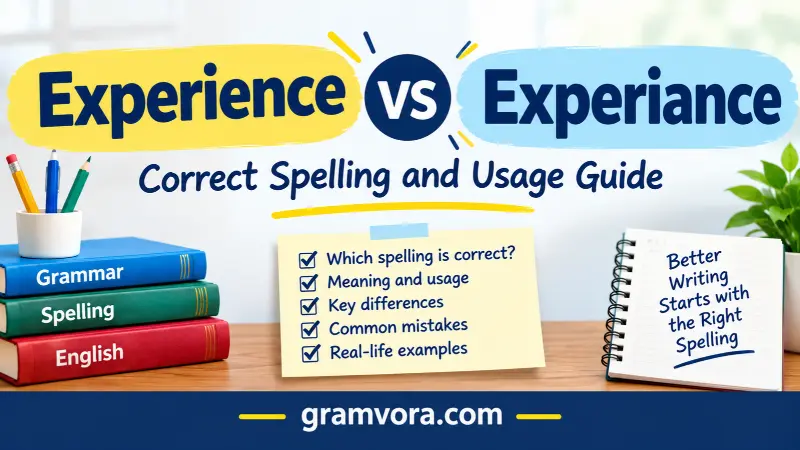
Choosing the correct spelling of a word can make a difference in school assignments, professional emails, resumes, and everyday communication. Some English words look almost identical, which makes it easy to type the wrong letters without noticing. “Experience” and “experiance” are an example of this problem.
Although the two forms look similar, they do not have the same status in standard English. Experience is the correct spelling. Experiance is a misspelling and should not be used as an alternative in standard American English.
The confusion often comes from the middle and ending of the word. English contains many words that end in “-ance” or “-ence,” and these endings can be difficult to remember. Because experience is pronounced with an unstressed final syllable, its spelling may not seem obvious to every learner.
Fortunately, the solution is straightforward. Learn the correct letter sequence, recognize the word in common expressions, and check your writing before submitting or publishing it.
This guide explains the difference between experience and experiance, shows how to use the correct form, and provides practical examples for students, job seekers, professionals, and English learners.
Quick Answer
Experience is correct. Experiance is incorrect.
Experience is a standard English word used as both a noun and a verb. As a noun, it can refer to knowledge or skills gained through practice, or to an event that someone has lived through. As a verb, it means to encounter, undergo, or feel something.
Experiance is a common misspelling of experience. It is not an accepted alternative spelling in standard American English.
Examples:
- Correct: I have three years of experience in customer service.
- Incorrect: I have three years of experiance in customer service.
- Correct: Traveling alone was a valuable experience.
- Incorrect: Traveling alone was a valuable experiance.
Remember that the correct word ends with the letters -ence, not -ance.
Why People Confuse Them
The main reason people confuse experience and experiance is that the words look similar. Only one letter in the ending changes, but that small difference determines whether the spelling is correct.
1. Similar-Looking Endings
English uses both “-ance” and “-ence” in many words. For example, importance ends in “-ance,” while difference ends in “-ence.” Since neither ending follows one simple rule that works for every word, writers sometimes choose the wrong one.
Experience belongs to the “-ence” group. Changing the ending to “-ance” creates a spelling error.
2. Pronunciation Can Be Misleading
In American English, experience is commonly pronounced approximately as “ik-SPEER-ee-uhns.” The final syllable is not strongly stressed, so a writer may not clearly hear the letters represented in the ending.
However, pronunciation does not determine every letter in English spelling. The best approach is to learn the written form alongside its pronunciation.
3. Fast Typing
People often make spelling mistakes when typing quickly on phones, laptops, or other devices. A writer may know the correct word but accidentally enter experiance because the letters look familiar.
This type of error can remain unnoticed during proofreading, especially when the sentence itself makes sense.
4. Limited Exposure to the Correct Form
Readers who do not frequently encounter the word in books, schoolwork, or professional writing may find it harder to remember. Seeing the correct form repeatedly helps build familiarity.
For example, reading “previous experience required” in a job advertisement reinforces the standard spelling.
Key Differences At A Glance
The key difference is spelling accuracy, not meaning. Experience is the established word, while experiance is an incorrect form.
| Feature | Experience | Experiance |
|---|---|---|
| Standard spelling | Correct | Incorrect |
| Accepted alternative | Yes, as the standard form | No |
| Standard American English | Use it | Avoid it |
| Part of speech | Noun and verb | Not a standard word form |
| Resume and job applications | Appropriate | Spelling error |
| Correct ending | -ence | Incorrectly uses -ance |
The two forms should not be treated as regional variations. American and British English both use experience. Changing the ending to experiance does not create a recognized regional spelling.
Main Comparison Table
| Context | Best Choice | Why |
|---|---|---|
| Resume or job application | Experience | Standard spelling for professional writing |
| School assignment | Experience | Correct in formal and academic writing |
| Personal story | Experience | Correct for describing an event |
| Business email | Experience | Appropriate for professional communication |
| Describing a difficult situation | Experience | Correct noun or verb, depending on the sentence |
| Proofreading an incorrect draft | Replace experiance with experience | Corrects the spelling error |
Are They the Same Word?
No. Experience is a standard English word, but experiance is not an accepted spelling variant of that word.
Experience has several common uses. It can describe knowledge gained through work, study, or practice. It can also refer to an event that affects a person’s thoughts, feelings, or understanding.
For example:
- “She has extensive experience in teaching.” Here, experience means professional knowledge and skill.
- “The concert was an unforgettable experience.” Here, experience refers to an event.
- “We experienced heavy traffic on the way home.” Here, experienced is the past-tense form of the verb.
Experiance does not have these standard uses. When a writer uses it in one of these sentences, the intended word is normally experience or one of its correctly formed grammatical forms.
The distinction is important because a misspelling can make a professional document appear less carefully prepared. It may also distract readers from the message the writer wants to communicate.
US vs UK Preference
There is no American-versus-British spelling difference between these two forms.
American English uses experience, and British English also uses experience. The misspelling experiance is not the standard British alternative.
This matters because some English words have recognized regional spellings. For example, American and British writers may choose different forms for certain words, such as color and colour. Those differences reflect established spelling conventions.
Experience does not follow that pattern. Writers should not assume that experiance is acceptable simply because English has regional spelling differences.
If you are writing for an American school, a British university, an international company, or a general English-speaking audience, choose experience.
The same advice applies to websites, applications, reports, presentations, and personal messages. There is no need to change the spelling according to the country of your intended reader.
Which Spelling Should You Use?
Use experience whenever you mean knowledge or skill gained through practice, an event someone has gone through, or something someone encounters.
The correct spelling works in both formal and informal writing. Your choice of sentence structure may change depending on the situation, but the spelling remains the same.
In Resumes and Job Applications
Employers often ask applicants to describe their work history and relevant skills. Correct spelling helps make these documents clear and professional.
Correct examples:
- I have five years of experience in retail management.
- My teaching experience helped me develop strong communication skills.
- The position requires previous experience with customer service.
Avoid writing experiance in a resume, cover letter, or application form.
In School and College Work
Students use experience when describing projects, practical activities, internships, and personal observations.
Correct examples:
- The science project was a valuable learning experience.
- My internship gave me experience working with a team.
- This experience helped me understand the topic more clearly.
In Everyday Communication
Experience is also common in casual conversations and personal messages.
Correct examples:
- That was a strange experience.
- I have experience with online classes.
- We experienced a short power outage last night.
In every case, experience remains the correct spelling.
When One Spelling Looks Wrong
Experiance may look believable because it resembles the correct word. However, looking familiar does not make a spelling standard.
In edited English writing, experiance should be corrected to experience.
Consider these examples:
Incorrect: I need more experiance before applying for the position.
Correct: I need more experience before applying for the position.
Incorrect: Her experiance as a teacher helped the students.
Correct: Her experience as a teacher helped the students.
Incorrect: We had a wonderful experiance during our vacation.
Correct: We had a wonderful experience during our vacation.
Incorrect: The company has experiance working with small businesses.
Correct: The company has experience working with small businesses.
When reviewing a document, pay attention to the complete word rather than only its first few letters. The opening “experi-” may look correct even when the ending contains an error.
If a word processor marks experiance as a possible spelling mistake, replace it with experience when that is the intended word.
Common Mistakes (and Quick Fixes)
The most reliable way to avoid this error is to recognize the correct spelling and check it in context.
Mistake 1: Using “-ance” Instead of “-ence”
The most direct mistake is writing experiance instead of experience.
Quick fix: Memorize the ending “-ence.” Write the word as experience every time.
Mistake 2: Making the Same Error in a Resume
A writer may proofread job responsibilities carefully but overlook the word experience in a sentence such as “Three years of experiance required.”
Quick fix: Review headings, summary statements, and skill descriptions separately. These areas often contain words that employers notice immediately.
Mistake 3: Assuming Both Forms Are Acceptable
Because the misspelling appears in online posts or unedited messages, readers may assume it is a valid alternative.
Quick fix: Check a reputable dictionary when a spelling seems uncertain. Do not treat repeated mistakes in informal writing as proof of acceptance.
Mistake 4: Correcting Only One Occurrence
A document may contain the same misspelling several times. Fixing the first instance does not guarantee that every later instance is correct.
Quick fix: Search the document for “experiance” and review each result. Replace it with experience when appropriate.
Mistake 5: Confusing the Base Word With Its Other Forms
Experience has several related forms, including experiences, experienced, and experiencing. These forms follow different grammatical patterns, but they all preserve the correct spelling of the base word.
Quick fix: Learn the base form first. Then practice the related forms in complete sentences.
Everyday Examples
The following sentences demonstrate the correct spelling in common American English situations.
Workplace Examples
- The company is looking for someone with experience in project management.
- My previous experience prepared me for this new role.
- She gained valuable experience during her summer internship.
- The manager has extensive experience in employee training.
- This position offers experience working with customers from different backgrounds.
School and Education Examples
- My teaching experience helped me become more confident in the classroom.
- The students shared their experience of working on the group project.
- Volunteering at the library was a rewarding experience.
- Practical experience can help students understand difficult concepts.
- The workshop provided a useful learning experience.
Everyday Life Examples
- Our trip to the mountains was an amazing experience.
- I learned from experience that planning ahead saves time.
- He had an unusual experience while traveling alone.
- We experienced heavy rain during the afternoon.
- Everyone experiences stress differently.
Incorrect and Correct Sentences
- Incorrect: I have two years of experiance in sales.
- Correct: I have two years of experience in sales.
- Incorrect: It was a great experiance for our family.
- Correct: It was a great experience for our family.
- Incorrect: She experiance many challenges at work.
- Correct: She experiences many challenges at work.
The last example contains a separate grammatical issue as well as the spelling pattern being discussed. When writing about a current situation, the verb must agree with its subject: “She experiences.” The correct base spelling remains experience.
Dictionary-Style Word Details
Verb
Experience: A standard verb meaning to encounter, undergo, or feel something. It can describe events, emotions, difficulties, changes, and other situations.
Examples:
- We experienced a delay at the airport.
- She experiences anxiety before public speaking.
- They experienced several changes during the project.
Experiance: Not a standard verb spelling. Use experience and its correctly formed verb forms instead.
For example, write “They experienced a delay,” not “They experiance a delay” when describing a past event.
Noun
Experience: A standard noun with two common uses.
First, it can mean knowledge or skill gained through practice, work, or observation. In this sense, it is often uncountable.
Example: He has considerable experience in accounting.
Second, it can refer to an event or activity someone goes through. In this sense, it can be countable.
Example: Visiting the national park was a memorable experience.
The plural noun is experiences when referring to separate events or particular experiences.
Experiance: Not an accepted standard noun spelling. Use experience for the singular noun and experiences for the plural when appropriate.
Synonyms
Experience: The closest alternatives depend on the sentence.
When experience means knowledge or skill, suitable alternatives may include expertise, practical knowledge, and familiarity. These words are not always interchangeable because each has its own emphasis.
When experience means an event or something that happens to a person, alternatives may include occurrence, event, or episode, depending on context.
When experience is used as a verb, possible alternatives include undergo, encounter, and go through.
Experiance: It has no separate set of standard synonyms because it is a misspelling. Choose a suitable alternative for the intended meaning of experience, not for the incorrect spelling.
Antonyms are not fixed for experience. Depending on the context, lack of experience or inexperience may express the opposite of having practical knowledge. These are contextual opposites rather than universal antonyms.
Sentences
Experience noun meaning knowledge or skill
- Her experience in education helped her manage the classroom.
- The job requires experience with spreadsheets.
- Years of experience improved his confidence.
noun meaning an event
- The museum visit was an enjoyable experience.
- Moving to a new city was a major experience in her life.
- Their first camping experience taught them to prepare carefully.
verb
- We experienced a brief internet outage.
- The team experienced several setbacks.
- Students experience different challenges as they learn.
Experiance — incorrect spelling
- Incorrect: I want to gain more experiance.
- Correct: I want to gain more experience.
- Incorrect: It was an interesting experiance.
- Correct: It was an interesting experience.
Word History
Experience has a long history in English and is related to the idea of trying, testing, or learning through direct involvement. Its spelling is established in standard modern English.
The ending in experience is “-ence.” It should not be changed to “-ance” when writing this word.
Experiance is a misspelling rather than a recognized historical or regional variant of experience. There is no need to assign it a separate meaning or spelling tradition.
For modern writing, the practical lesson is simple: use experience and preserve its established spelling in every grammatical form.
Phrases Containing
Experience appears in many common English expressions. Learning these phrases can make the spelling easier to remember.
- Work experience: Knowledge or skills gained through employment or practical work.
- Previous experience: Relevant knowledge or involvement gained before the present situation.
- Firsthand experience: Knowledge gained by directly seeing, doing, or experiencing something.
- Practical experience: Knowledge developed through actual practice.
- Learning experience: An activity or event that helps someone learn.
- Customer experience: A customer’s overall interactions with a business.
- From experience: Based on knowledge gained through previous events.
- In my experience: Used to introduce a personal observation or judgment based on what someone has encountered.
- Gain experience: To develop knowledge or skill through practice.
- Years of experience: A phrase often used to describe the length of someone’s professional background.
Experiance should not replace experience in any of these expressions.
For example, write “relevant work experience” and “firsthand experience,” not “relevant work experiance” or “firsthand experiance.”
FAQs
Which spelling is correct: experience or experiance?
Experience is the correct spelling. Experiance is a misspelling and is not accepted in standard American English.
What does experience mean?
Experience can mean knowledge or skills gained through practice, work, or study. It can also refer to an event someone has gone through.
Is experiance ever correct?
No. In standard English writing, use experience instead of experiance.
Why do people misspell experience as experiance?
People often confuse the endings “-ence” and “-ance.” Because the final syllable is unstressed, the correct spelling may be difficult to remember.
Is experience spelled the same way in American and British English?
Yes. Both American and British English use experience. Experiance is not a standard regional spelling.
How do you use experience in a sentence?
Example: “I have three years of experience in customer service.”
Here, experience refers to knowledge and skills gained through work.
Is experience a noun or a verb?
Experience can be both a noun and a verb.
- Noun: “Traveling abroad was a wonderful experience.”
- Verb: “We experienced heavy rain yesterday.”
What is the plural of experience?
The plural is experiences when referring to separate events or individual experiences.
Example: “Her travel experiences taught her many valuable lessons.”
What are some common phrases containing experience?
Common phrases include work experience, previous experience, practical experience, firsthand
How can I remember the correct spelling of experience?
Remember that experience ends in “-ence,” not “-ance.” Practice writing the word in sentences and check your spelling before submitting important documents.
Conclusion
The correct spelling is experience, while experiance is a misspelling. Both American and British English use experience, so this is not a regional spelling difference.
Use experience as a noun when discussing knowledge, skills, or an event. Use it as a verb when describing something a person encounters, undergoes, or feels. Related forms such as experiences, experienced, and experiencing also retain the correct spelling pattern.
The easiest way to avoid the mistake is to remember the ending: experience ends in “-ence,” not “-ance.”
Whether you are writing a resume, a school assignment, a business email, or a personal message, choosing the correct form makes your writing clearer and more professional. When you see experiance in a draft, correct it to experience before sharing or publishing the text.