
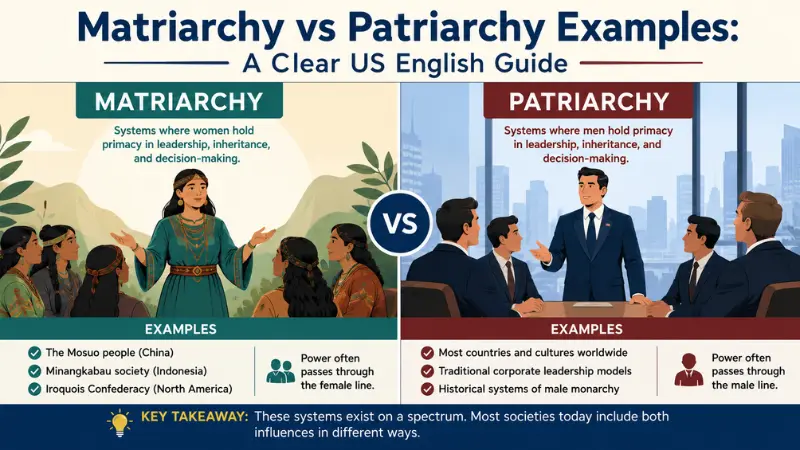
Matriarchy and patriarchy are both standard English nouns, but they describe different patterns of authority.
In basic usage, matriarchy refers to a system in which women or a female head hold central authority. Patriarchy refers to a system in which men or a male head hold central authority. Modern use of patriarchy can also describe broader social structures in which men hold a disproportionately large share of power.
The important point is that neither word should be chosen simply because one woman or one man is influential.
Quick Answer
Use matriarchy when the system being described centers on female authority.
Use patriarchy when the system centers on male authority.
For example:
- “The fictional kingdom is organized as a matriarchy.”
- “The novel examines how patriarchy affects family expectations.”
However, matriarchy and patriarchy are not always perfect mirror images. A society can trace descent through women without giving women overall political authority. Likewise, a woman can be a powerful family leader without the entire family structure being a matriarchy.
Why People Confuse Them
The two words look and sound similar because they share the ending -archy, associated with rule or government.
Their first parts point toward the basic contrast:
- matri- relates to mother or female-centered organization.
- patri- relates to father or male-centered organization.
The bigger source of confusion is that discussions of gender systems often involve several different ideas at once.
Family leadership, political authority, property, inheritance, and descent are related, but they are not identical. A society may pass property through the mother’s family while important decisions remain in the hands of men.
That is why matrilineal does not automatically mean matriarchal.
Key Differences At A Glance
| Feature | Matriarchy | Patriarchy |
|---|---|---|
| Basic focus | Female-centered authority | Male-centered authority |
| Main word type | Noun | Noun |
| Common setting | Family, group, society, fictional system | Family, institution, society, social system |
| Broader modern use | Usually refers to female-centered authority or a debated social model | Often refers to disproportionate male power |
| Related adjective | Matriarchal | Patriarchal |
| Main caution | Female-line inheritance alone does not prove matriarchy | One male leader alone does not prove patriarchy |
Meaning and Usage Difference
Matriarchy can refer to a family, group, or state governed by a matriarch. Merriam-Webster also gives a sense involving descent and inheritance through the female line.
In ordinary writing, however, the word often carries the larger idea of female-centered authority.
Patriarchy traditionally refers to father-centered social organization. In broader modern usage, it can describe systems in which men control a disproportionately large share of social power.
This difference affects how carefully you should use the two terms.
For example, if property belongs to women but community leadership remains mostly male, calling the entire society a matriarchy may be too broad. A more precise description would identify the female-line inheritance separately.
Likewise, calling a workplace a patriarchy requires more than noting that its CEO is a man. The term describes a meaningful pattern of male-centered authority, not simply the gender of one person.
Tone, Context, and Formality
Both words are standard and can appear in academic, educational, historical, cultural, and everyday writing.
Patriarchy is especially common in discussions of gender inequality, social institutions, family expectations, and unequal access to power. In those settings, it can carry a critical or analytical tone.
Matriarchy is often used when discussing female-centered authority, fictional societies, cultural systems, or debates about how societies organize power.
Neither word is inherently informal. The tone comes from the surrounding claim.
Compare:
- “The professor discussed patriarchy in the history of family structures.” — neutral academic use.
- “The novel imagines a matriarchy governed by senior women.” — neutral descriptive use.
- “The campaign challenged patriarchal expectations about leadership.” — critical but normal use.
- “The film creates a fictional matriarchy.” — descriptive use.
Which One Should You Use?
Choose matriarchy when female authority is the feature you are describing.
Choose patriarchy when male authority or disproportionate male power is the feature you are describing.
Use a more specific term when the evidence concerns only descent, inheritance, or one person’s leadership.
For instance:
- Female inheritance → describe the female line of inheritance if that is the only fact you know.
- A powerful grandmother → call her a matriarch if she is the family’s leading woman.
- Male-centered institutional power → patriarchy may be appropriate.
- A fictional society governed mainly by women → matriarchy may be appropriate.
The goal is to describe the actual structure rather than force every situation into one of two labels.
When One Choice Sounds Wrong
Matriarchy can sound too strong when you are describing only a matrilineal family system.
Incorrect or potentially misleading:
“The community is a matriarchy because children inherit property through their mothers.”
Better:
“The community follows a matrilineal inheritance system.”
Matrilineal societies are not automatically matriarchal. Anthropology references specifically distinguish descent through the mother’s line from broader structures of authority.
Patriarchy can also be too broad when the only evidence is that a man occupies one leadership position.
Weak:
“The company has a patriarchy because its president is a man.”
Better:
“The company has a male president.”
If the company has a wider pattern of male-dominated authority, decision-making, or institutional power, patriarchy may be a defensible description.
Common Mistakes (and Quick Fixes)
Mistake 1: Treating matriarchy as simply “women are in charge.”
A single woman in charge does not automatically create a matriarchy.
Fix: Look at the broader authority structure.
Mistake 2: Treating matrilineal as another word for matriarchal.
These terms describe different things.
Fix: Use matrilineal for descent or inheritance through the mother’s line when that is the specific point.
Mistake 3: Treating patriarchy as meaning “a family with a father.”
The modern word can describe much broader systems of male power.
Fix: Consider whether male authority is a meaningful organizing feature of the larger system.
Mistake 4: Assuming the two words are exact opposites in every context.
The terms are often contrasted, but definitions of matriarchy vary, especially in anthropology.
Fix: Explain the actual structure when precision matters.
Everyday Examples
Here are realistic examples showing how the words work in context:
- “The fantasy novel describes a matriarchy in which senior women make the major political decisions.”
- “The class examined how patriarchy can influence expectations about family roles.”
- “The grandmother was the family’s matriarch, but that did not mean the entire community was a matriarchy.”
- “The researcher separated matrilineal inheritance from the question of political authority.”
- “The documentary explores how patriarchal expectations affected the family’s decisions.”
- “The fictional island is organized as a matriarchy.”
- “The company was criticized for maintaining a male-dominated leadership structure.”
- “The professor explained why a matrilineal society is not necessarily a matriarchy.”
These examples show why context matters. The words describe systems of organization, not merely the presence of women or men in particular positions.
Dictionary-Style Word Details
Verb
- Matriarchy: Not commonly used as a verb in standard US English. It is a noun.
- Patriarchy: Not commonly used as a verb in standard US English. It is a noun.
The related adjectives are matriarchal and patriarchal.
For example:
- “The story presents a matriarchal society.”
- “The essay examines a patriarchal institution.”
Noun
- Matriarchy: A family, group, or state governed by a matriarch; the word can also describe a social organization associated with female-line descent. Its plural is matriarchies.
- Patriarchy: A social organization centered on father or male authority; in broader use, it can describe control by men of a disproportionately large share of power. Its plural is patriarchies.
Both terms are nouns, and both can describe broader systems rather than only individual people.
Synonyms
Neither word has one perfect synonym that works in every context.
- Matriarchy: closest plain alternatives include female-led system, female-centered authority, and rule by women.
- Patriarchy: closest plain alternatives include male-led system, male-dominated authority, and rule by men.
These are descriptive alternatives, not exact replacements in every sentence.
Example Sentences
Matriarchy:
- “The novel imagines a matriarchy governed by senior women.”
- “The researchers debated whether the community should be described as a matriarchy.”
Patriarchy:
- “The course examines patriarchy and its influence on family roles.”
- “The writer argues that the institution reflects patriarchal traditions.”
Word History
Matriarchy is a standard English noun with a recorded first known use of 1885 in Merriam-Webster. Patriarchy has a much older English history, with Merriam-Webster giving a first known use of 1632.
The two words are built around different gendered roots associated with mother and father, combined with the idea of rule or authority. Their present meanings, however, depend on context and should not be reduced entirely to their word origins.
Phrases Containing
Common constructions with matriarchy include:
- “a matriarchy”
- “under a matriarchy”
- “a matriarchal society”
- “matriarchy in fiction”
Common constructions with patriarchy include:
- “the patriarchy”
- “under patriarchy”
- “a patriarchal society”
- “patriarchy in the workplace”
- “patriarchy in family life”
The adjective forms matriarchal and patriarchal are often more natural when describing a specific culture, institution, or social practice.
FAQs
1. What is the difference between matriarchy and patriarchy?
Matriarchy refers to a system centered on female authority, while patriarchy refers to a system centered on male authority or broader male control of power.
2. What is an example of a matriarchy?
A fictional society in which women hold the primary political and social authority is an example of a matriarchy.
3. What is an example of patriarchy?
A social system in which men hold most positions of authority and have disproportionate control over major decisions can be described as patriarchal.
4. Is matriarchy the opposite of patriarchy?
They are commonly presented as contrasting concepts, but they are not always exact mirror images. Patriarchy has a broad modern meaning, while the definition and use of matriarchy can vary by context.
5. Is a matrilineal society the same as a matriarchy?
No. Matrilineal refers to descent or inheritance through the mother’s family line. It does not automatically mean that women hold overall political or social authority.
6. Can a family be called a matriarchy?
Yes, if the family is organized around the authority of a female head or women generally hold the primary decision-making power. However, having a strong mother or grandmother alone does not necessarily make a family a matriarchy.
7. Can a family be patriarchal?
Yes. A family may be described as patriarchal when authority and major decision-making are primarily centered on male members.
8. Is matriarchy a noun or an adjective?
Matriarchy is a noun. The related adjective is matriarchal.
- Noun: “The story describes a matriarchy.”
- Adjective: “The story describes a matriarchal society.”
9. Is patriarchy a noun or an adjective?
Patriarchy is a noun. The related adjective is patriarchal.
- Noun: “The novel examines patriarchy.”
- Adjective: “The novel examines patriarchal traditions.”
10. What is an easy example of matriarchy vs patriarchy?
A simple comparison is:
- Matriarchy: women hold the primary authority in a social system.
- Patriarchy: men hold the primary authority or a disproportionate share of power in a social system.
The key is to look at the overall structure of authority, not just whether one individual is a man or woman.
Conclusion
The basic distinction in matriarchy vs patriarchy examples is the location of authority.
Matriarchy refers to female-centered authority or, in some dictionary usage, organization connected with female-line descent. Patriarchy refers to father- or male-centered authority and, in broader modern usage, disproportionate male control of power.
The biggest mistake is confusing matriarchy with matrilineal. Female-line inheritance does not automatically establish female control over the whole society.
When you are describing a real family, community, institution, or society, focus on the specific pattern of authority you can support. That makes your word choice clearer, more accurate, and more natural in American English.


[…] Here are natural examples using imbalance in American English: […]