
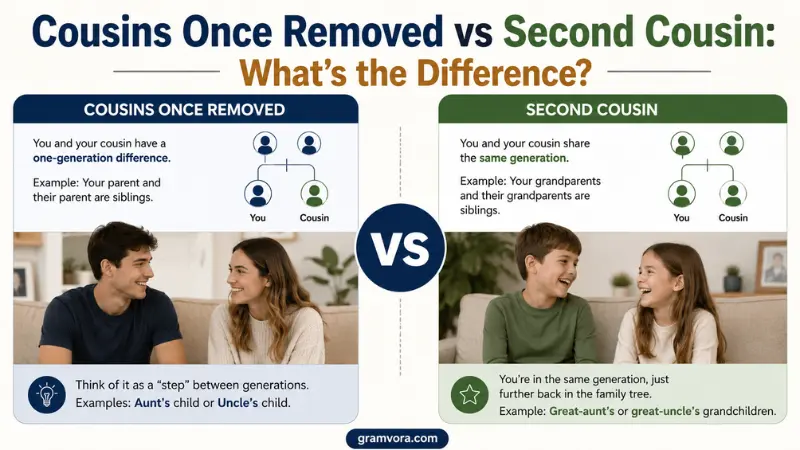
Cousins once removed and second cousin are related family terms, but they do not mean the same thing.
The key difference is simple: second cousin identifies a specific cousin relationship, while once removed describes a one-generation difference between two relatives.
That means someone can be a second cousin once removed, but “cousin once removed” by itself does not tell you the exact cousin degree.
Quick Answer
If you and another person are in the same generation and share the same great-grandparents, that person is your second cousin.
If you are one generation apart in a cousin relationship, the relationship is once removed. For example, your second cousin’s child is your second cousin once removed.
So, these terms answer different questions:
- Second cousin: What cousin degree are we?
- Once removed: How many generations apart are we?
If you know the exact relationship, use the more precise term.
Why People Confuse Them
The confusion comes from treating “second” and “once removed” as if they were competing labels.
They are not.
The word second identifies the cousin degree. The phrase once removed identifies a difference in generation.
For example, two second cousins are normally in the same generation. If one of those second cousins has a child, the child is one generation below the other second cousin. That child is the other person’s second cousin once removed.
The same “once removed” relationship can also go upward. Your parent’s second cousin is your second cousin once removed.
So “once removed” does not mean “second cousin.” It adds information to a cousin relationship.
Key Differences At A Glance
| Context | Best Choice | Why |
|---|---|---|
| Same generation, shared great-grandparents | second cousin | It identifies a specific cousin degree. |
| One generation apart in a second-cousin relationship | second cousin once removed | It identifies both the cousin degree and generation gap. |
| You know there is a one-generation cousin relationship but not the degree | cousin once removed | It can work generally, but it is less precise. |
| You want to name an exact relationship | second cousin or second cousin once removed | The complete term gives clearer family information. |
Compact comparison:
- Cousins once removed: A general expression for cousins who are one generation apart. The exact cousin degree may be unstated.
- Second cousin: A specific relationship involving people in the same generation who share great-grandparents.
- Second cousin once removed: A specific second-cousin relationship with a one-generation difference.
Meaning and Usage Difference
A second cousin is someone who shares great-grandparents with you while being in your same generation in the family tree.
For example, imagine that your grandfather and another person’s grandfather were siblings. Their children are first cousins, and you and the other person’s child are second cousins.
The phrase once removed works differently. It tells you that two relatives are separated by one generation.
Suppose your second cousin has a daughter. You and your second cousin are in the same generation, but his daughter is one generation below you. She is your second cousin once removed.
The relationship can also work in the opposite direction. Your parent’s second cousin is also your second cousin once removed, because that relative is one generation above you.
This is why cousins once removed is not as specific as second cousin. Without a number such as first, second, or third, the phrase does not identify the exact cousin degree.
Tone, Context, and Formality
Neither expression is inherently casual or formal. Both are standard ways to describe family relationships.
The main issue is precision.
In everyday conversation, someone might say, “He’s my cousin once removed,” especially when the exact cousin degree is already understood.
In genealogy or when explaining a family tree, a more complete label is usually clearer. You might say:
- “She’s my first cousin once removed.”
- “He’s my second cousin once removed.”
- “They’re my second cousins.”
The phrase cousins once removed can therefore sound incomplete when the listener needs to know exactly how the people are related.
Which One Should You Use?
Use second cousin when you mean a person who is your second cousin.
Use cousin once removed when the important fact is that the cousin relationship crosses one generation, but the exact degree is either already known or not important.
For maximum clarity, give the full relationship whenever you know it.
For example:
My aunt’s first cousin is my first cousin once removed.
And:
My second cousin’s son is my second cousin once removed.
Avoid replacing second cousin with cousin once removed simply because both describe relatives. They describe different features of the relationship.
When One Choice Sounds Wrong
“Second cousin” sounds wrong if the people are actually separated by one generation.
For example, if your second cousin has a child, that child is not your second cousin in the strict relationship terminology. The child is your second cousin once removed.
Likewise, “cousin once removed” can be too vague when you are trying to give an exact family-tree relationship.
If someone asks, “What exactly is she to you?” and you know she is your second cousin, say second cousin.
If she is your second cousin’s child, say second cousin once removed.
The problem is not usually grammar. It is choosing a label that gives the right amount of family information.
Common Mistakes (and Quick Fixes)
Mistake 1: Treating “once removed” as another word for “second cousin.”
Fix: Remember that “once removed” refers to the generation gap.
Mistake 2: Calling your second cousin’s child your third cousin.
Fix: Your second cousin’s child is your second cousin once removed. The cousin degree does not automatically increase just because one person’s child is involved.
Mistake 3: Assuming “once removed” always means an older relative.
Fix: A cousin once removed can be one generation older or one generation younger.
Mistake 4: Using “cousins once removed” when a more exact term is available.
Fix: If you know the degree, include it: first cousin once removed, second cousin once removed, and so on.
Mistake 5: Thinking “second cousin” and “second cousin once removed” are interchangeable.
Fix: A second cousin is in the same generation; a second cousin once removed is one generation apart.
Everyday Examples
Here are a few realistic examples:
Example 1: Same generation
“Megan is my second cousin. Our grandparents were cousins.”
Here, the relationship is second cousin.
Example 2: Your second cousin’s child
“Megan’s daughter is my second cousin once removed.”
Megan is your second cousin, and her daughter is one generation below you.
Example 3: Your parent’s second cousin
“My dad’s second cousin is my second cousin once removed.”
Your dad and that relative are in the same generation. You are one generation below them.
Example 4: General wording
“I have several cousins once removed in my family tree.”
This can be understood, but it does not specify whether those relatives are first, second, third, or another degree of cousin.
Example 5: Choosing the precise term
“She’s my second cousin, not my cousin once removed.”
This is appropriate when both people are in the same generation and share great-grandparents.
Dictionary-Style Word Details
Verb
- cousins once removed: Not a verb. The expression functions as a family-relationship noun phrase.
- second cousin: Not a verb. It functions as a family-relationship noun phrase.
The word removed itself has other uses as a verb form in English, but in the family expression “once removed,” it describes generational separation rather than an action.
Noun
- cousins once removed: A plural noun phrase referring generally to cousins separated from someone by one generation. Without a cousin degree, it can be less specific.
- second cousin: A countable noun phrase identifying a specific cousin relationship. A second cousin is a person in the same generation who shares great-grandparents with you.
The singular form is second cousin; the plural is second cousins.
Synonyms
These terms do not have exact synonyms that preserve all of their family-tree meaning.
- cousins once removed: Closest plain alternative: cousins one generation apart, although this explains the relationship rather than replacing the established family term.
- second cousin: Closest plain alternative: a relative who shares your great-grandparents, but this is a description rather than an exact synonym.
For accuracy, the established relationship terms are preferable when the exact family connection matters.
Example Sentences
- cousins once removed: “Our family tree includes several cousins once removed.”
- second cousin: “Jordan is my second cousin.”
- second cousin once removed: “Jordan’s daughter is my second cousin once removed.”
- cousins once removed: “The family reunion included cousins once removed from several generations.”
- second cousin: “My second cousin and I have the same great-grandparents.”
Word History
The words have older English histories, but the important point for modern usage is how the relationship terms function today.
Second cousin is an established English family term. Merriam-Webster records its first known use as 1660.
Removed has long been used to express distance or separation. In family relationships, it describes a person who is in a younger or older generation. The exact phrase cousin once removed follows that relationship pattern.
The historical details do not change the modern distinction: second cousin identifies cousin degree, while once removed identifies a one-generation difference.
Phrases Containing
Common relationship expressions include:
- cousin once removed — a cousin relationship with a one-generation difference.
- first cousin once removed — a first-cousin relationship with a one-generation difference.
- second cousin once removed — a second-cousin relationship with a one-generation difference.
- second cousin — a specific same-generation cousin relationship.
- second cousins — the plural form of second cousin.
The most precise phrasing combines the cousin degree with the removal when both pieces of information are known.
FAQs
1. Is a second cousin the same as a cousin once removed?
No. A second cousin is usually in the same generation as you, while a cousin once removed is one generation above or below you.
2. What does “once removed” mean in cousins?
“Once removed” means there is a one-generation difference between two relatives. It does not identify the cousin degree by itself.
3. Is my second cousin’s child my second cousin once removed?
Yes. Your second cousin’s child is your second cousin once removed because the child is one generation below you.
4. Is my parent’s second cousin my second cousin once removed?
Yes. Your parent’s second cousin is your second cousin once removed because that person is one generation above you.
5. What is the difference between second cousin and second cousin once removed?
A second cousin is in the same generation and shares great-grandparents with you. A second cousin once removed is one generation older or younger than you.
6. Can “once removed” refer to someone younger than me?
Yes. It can refer to someone one generation younger or one generation older than you.
7. Does “once removed” mean the person is less closely related?
Not exactly. “Once removed” describes the generation difference, not simply how close or distant the relationship is.
8. Is “cousin once removed” a complete relationship?
It can be used generally, but it is less precise. If you know the cousin degree, it is clearer to say first cousin once removed, second cousin once removed, or another specific degree.
9. Is my second cousin’s child my third cousin?
No. Your second cousin’s child is your second cousin once removed, not your third cousin.
10. Which is correct: “cousins once removed” or “second cousin”?
Both can be correct, but they describe different relationships. Use second cousin for a specific same-generation relationship and cousin once removed when the relatives are one generation apart.
Conclusion
Cousins once removed and second cousin are not interchangeable.
A second cousin is a specific same-generation relationship. A cousin once removed describes a cousin relationship in which the two people are one generation apart, but the phrase alone may not identify the exact cousin degree.
When you know the precise relationship, use the complete term. If someone is your second cousin’s child, for example, second cousin once removed is the clearest choice.
The easiest way to remember the difference is: the cousin number tells you the relationship level; “once removed” tells you there is a one-generation gap.


