
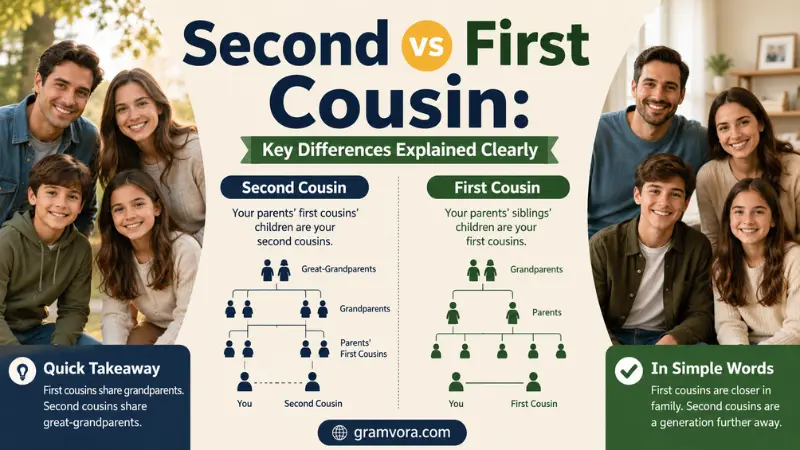
Both second cousin and first cousin are correct terms. The difference is the family relationship they describe.
A first cousin is generally the child of your aunt or uncle. You and your first cousin share grandparents.
A second cousin is the child of your parent’s first cousin. You and your second cousin share great-grandparents, but not grandparents.
The easiest way to choose the right term is to identify the closest shared ancestors.
Quick Answer
Use first cousin when you and the other person share grandparents.
Use second cousin when you and the other person share great-grandparents.
| Context | Best Choice | Why |
|---|---|---|
| Your aunt’s daughter | First cousin | You share grandparents |
| Your uncle’s son | First cousin | You share grandparents |
| Your parent’s first cousin’s child | Second cousin | You share great-grandparents |
| Your grandparent’s sibling’s grandchild | Second cousin | You share great-grandparents |
So, second vs first cousin is not a question of which term is grammatically correct. Both are correct. The correct term depends on where the person falls on your family tree.
Why People Confuse Them
The numbers can make the terminology seem harder than it is.
People often assume that a second cousin is simply a first cousin who is farther away in age. That is not the right way to determine the relationship.
Age does not decide whether someone is a first or second cousin. The important factor is the closest shared ancestor and the generation relationship between the two people.
For example, your 40-year-old first cousin and your 20-year-old first cousin are still first cousins. Their ages do not change the relationship.
Likewise, a second cousin can be older or younger than you. The term remains second cousin if you share the appropriate great-grandparents.
Key Differences At A Glance
The main difference is the generation level of the shared ancestors.
| Feature | First Cousin | Second Cousin |
| Closest shared ancestors | Grandparents | Great-grandparents |
| Your parents’ relationship | Siblings | First cousins |
| Typical relationship | Aunt or uncle’s child | Parent’s first cousin’s child |
| Same generation? | Usually yes | Usually yes |
| Basic term | First cousin | Second cousin |
A useful shortcut is to look at the family tree.
If your parent and the other person’s parent are siblings, you are first cousins.
If your parent and the other person’s parent are first cousins, you are second cousins.
Meaning and Usage Difference
First cousin refers to the child of your aunt or uncle. In a typical family structure, you and that person have the same grandparents.
For example:
My aunt’s son is my first cousin.
Second cousin refers to the child of your parent’s first cousin. You and that person have the same great-grandparents.
For example:
My mom’s cousin’s daughter is my second cousin.
The word first does not mean the person is your favorite, oldest, or closest cousin in everyday conversation. It identifies the degree of the cousin relationship.
Similarly, second does not simply mean “another cousin.” It identifies a specific family-tree relationship.
Tone, Context, and Formality
There is no major difference in tone or formality between first cousin and second cousin.
Both are ordinary nouns used in everyday American English.
You might say:
- “She’s my first cousin.”
- “He’s my second cousin.”
- “I met my second cousin at a family reunion.”
- “My first cousins are coming over this weekend.”
These terms are also common when people discuss family trees or family history.
In casual conversation, people sometimes simply say cousin when the exact degree is not important. If the relationship needs to be precise, however, first cousin or second cousin is clearer.
Which One Should You Use?
Choose first cousin if the person’s parent is the sibling of your parent.
For example, your mother’s sister has a son. That son is your first cousin.
Choose second cousin if the person’s parent is your parent’s first cousin.
For example, your mother’s cousin has a daughter. That daughter is your second cousin.
A simple way to remember the distinction is:
Grandparents = first cousins.
Great-grandparents = second cousins.
This shortcut works when both people are in the same generation relative to the shared ancestor.
When One Choice Sounds Wrong
Calling your aunt’s child your second cousin would be incorrect if you are describing the standard family relationship, because you share grandparents.
Likewise, calling your parent’s first cousin’s child your first cousin would skip a generation in the cousin relationship.
Consider this example:
My dad’s sister has a son. He is my second cousin.
That is incorrect. Your dad’s sister is your aunt, and her son is your first cousin.
Now consider:
My dad’s first cousin has a daughter. She is my first cousin.
That is also incorrect under the standard relationship. She is your second cousin.
The important point is that the number refers to the degree of the cousin relationship, not the person’s age or how often you see them.
Common Mistakes (and Quick Fixes)
Mistake: Treating age as the deciding factor
A younger or older relative can still be your first cousin.
Quick fix: Look at the shared ancestor, not the person’s age.
Mistake: Calling every cousin beyond your aunt or uncle’s children a second cousin
A cousin relationship can extend through several generations.
Quick fix: Check whether the closest shared ancestors are grandparents or great-grandparents.
Mistake: Thinking “second cousin” means your cousin’s child
Your first cousin’s child is not your second cousin. That relationship involves different generations.
Quick fix: A generation gap can require the term once removed.
Mistake: Assuming the two terms are interchangeable
They are not interchangeable when you are identifying a specific family relationship.
Quick fix: Use first cousin for shared grandparents and second cousin for shared great-grandparents.
Everyday Examples
Here are some simple modern examples:
Example 1
My uncle’s daughter is my first cousin.
This is a first cousin because you share grandparents.
Example 2
My mother’s first cousin has a son. He is my second cousin.
You share great-grandparents, making the relationship second cousin.
Example 3
I invited my first cousins to the family reunion.
This is natural when referring to the children of your aunts and uncles.
Example 4
I discovered several second cousins while building my family tree.
This is also natural. The relationship reaches back to shared great-grandparents.
Example 5
Sarah and I are second cousins, even though we grew up in different states.
Living far apart does not change the family relationship.
Dictionary-Style Word Details
Verb
- First cousin: Not commonly used as a verb in standard US English.
- Second cousin: Not commonly used as a verb in standard US English.
Both terms function primarily as nouns when they describe family relationships.
Noun
- First cousin: A noun referring to the child of your aunt or uncle.
- Second cousin: A noun referring to the child of your parent’s first cousin.
Both are countable nouns.
Examples include:
- one first cousin
- two first cousins
- one second cousin
- several second cousins
Synonyms
- First cousin: Cousin can be a closest plain alternative when the exact degree does not need to be stated.
- Second cousin: There is no common single-word replacement that preserves the exact meaning.
Neither term has a direct antonym. First cousin and second cousin describe different degrees of family relationship rather than opposite concepts.
Example Sentences
First cousin:
My first cousin lives in Chicago.
I grew up with several of my first cousins.
Second cousin:
I met my second cousin for the first time at a family reunion.
My second cousin and I share the same great-grandparents.
Word History
Both terms have a long history in English.
Merriam-Webster records first cousin as first known in 1649 and second cousin as first known in 1660.
The important point for modern usage is that both remain established family-relationship nouns in American English.
Phrases Containing
- First cousin: “first cousin once removed” describes a first-cousin relationship separated by one generation.
- Second cousin: “second cousin once removed” describes a second-cousin relationship separated by one generation.
The word removed changes the generation relationship; it does not simply mean that someone is a more distant cousin.
FAQs
1. What is the difference between a first cousin and a second cousin?
A first cousin is typically the child of your aunt or uncle, so you share grandparents. A second cousin is typically the child of your parent’s first cousin, so you share great-grandparents.
2. Is a first cousin closer than a second cousin?
Yes. A first cousin is one degree closer in the family tree than a second cousin. First cousins share grandparents, while second cousins share great-grandparents.
3. Who is considered a first cousin?
Your aunt’s or uncle’s child is your first cousin. You and your first cousin have the same grandparents.
4. Who is considered a second cousin?
Your parent’s first cousin’s child is your second cousin. You and your second cousin generally share great-grandparents.
5. Do first cousins share grandparents?
Yes. First cousins normally have the same grandparents because their parents are siblings.
6. Do second cousins share great-grandparents?
Yes. Second cousins normally share great-grandparents because their parents are first cousins.
7. Is my cousin’s child my second cousin?
No. Your first cousin’s child is generally your first cousin once removed, not your second cousin. “Once removed” describes a one-generation difference.
8. Can first cousins be different ages?
Yes. Age does not determine whether someone is your first cousin. The family relationship is based on your shared ancestors.
9. Can second cousins be the same age?
Yes. Two people can be the same age and still be second cousins. Their relationship is determined by their family tree, not their ages.
10. Are “first cousin” and “second cousin” interchangeable?
No. They describe different family relationships. Use first cousin for a relationship involving shared grandparents and second cousin for one involving shared great-grandparents.
Conclusion
The difference between second vs first cousin is straightforward once you identify the shared ancestors.
A first cousin is generally the child of your aunt or uncle, and you share grandparents.
A second cousin is generally the child of your parent’s first cousin, and you share great-grandparents.
Both terms are correct. The right choice depends on the family relationship you are describing.
When in doubt, trace the family tree back to the closest shared ancestors. Grandparents point to first cousins; great-grandparents point to second cousins.


