
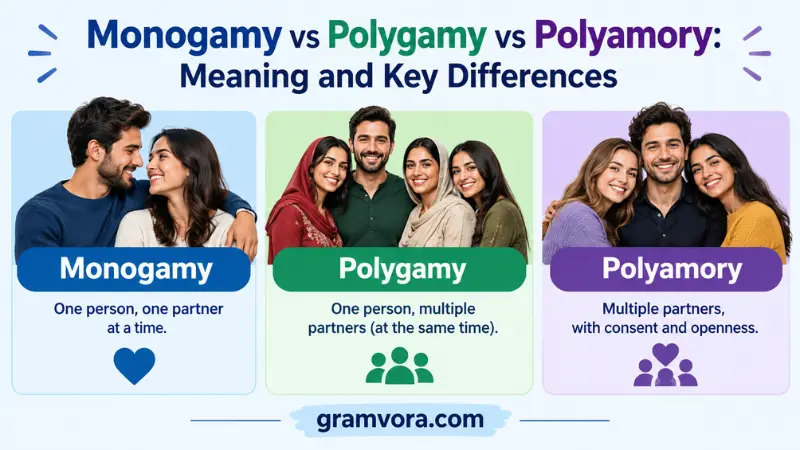
The terms monogamy, polygamy, and polyamory all describe ways people may structure romantic or intimate relationships. However, they do not mean the same thing.
The biggest difference involves the number of partners, the role of marriage, and whether multiple relationships are openly agreed upon. Monogamy generally involves an exclusive relationship with one partner. Polygamy refers specifically to marriage involving more than one spouse at the same time. Polyamory describes consensual romantic or intimate relationships involving multiple people.
These words can become confusing because people sometimes use them as if they were interchangeable. They are not.
Understanding the difference is especially useful when reading about relationships, marriage, sociology, anthropology, religion, or modern dating. The terms can also appear in discussions about ethical non-monogamy, open relationships, and family structures.
This guide explains what each term means, how the relationships differ, common examples, and several related terms that are often confused.
Quick Answer
Monogamy means having one romantic or marital partner at a time. Polygamy means being married to more than one person at the same time. Polyamory means having multiple romantic or intimate relationships with the knowledge and consent of everyone involved.
A simple way to remember them is:
Monogamy = one partner
Polygamy = multiple spouses
Polyamory = multiple consensual relationships
At a Glance
| Relationship type | Basic meaning | Marriage required? | Multiple partners? |
|---|---|---|---|
| Monogamy | One romantic or marital partner | No | Usually no |
| Polygamy | Marriage to multiple spouses | Yes | Yes |
| Polyamory | Multiple consensual romantic relationships | No | Yes |
These are broad definitions. Real relationships can have additional agreements, boundaries, and structures.
What Is Monogamy?
Monogamy is a relationship structure in which a person has one romantic or sexual partner at a given time.
The term can apply to dating, long-term partnerships, or marriage. A married couple, for example, may agree that neither partner will have another romantic or sexual relationship outside the marriage.
Monogamy is often associated with exclusivity. That means the partners agree that their romantic or sexual relationship is limited to the two people involved.
Examples of Monogamy
Consider these examples:
- Two people date exclusively and do not date others.
- A married couple agrees to remain romantically and sexually exclusive.
- Two partners live together and maintain an exclusive relationship.
The exact boundaries can vary. Some couples may define emotional intimacy differently from sexual activity, for example.
Monogamy Does Not Always Mean Marriage
A common misunderstanding is that monogamy automatically means marriage.
It does not.
Two unmarried people can have a monogamous relationship. Likewise, a married couple can describe their relationship as monogamous.
The key idea is relationship exclusivity, not necessarily legal marriage.
What Is Polygamy?
Polygamy is a marriage system in which a person has more than one spouse at the same time.
Marriage is the key distinction. Someone who has multiple romantic partners is not automatically practicing polygamy.
For example, if three adults have romantic relationships with one another but are not married, that situation may be described as polyamory rather than polygamy.
Polygamy is an umbrella term. Two more specific forms are polygyny and polyandry.
What Is Polygyny?
Polygyny refers to a marriage in which one man has multiple wives.
This is the form of polygamy that has historically been more common in societies that permitted plural marriage.
For example, if one man is legally or socially married to three women, the arrangement may be described specifically as polygyny.
What Is Polyandry?
Polyandry is the opposite gender arrangement.
It refers to a marriage in which one woman has multiple husbands.
Polyandry is distinct from both polygyny and the broader term polygamy.
Is Polygamy the Same as Having Multiple Girlfriends or Boyfriends?
No.
Having multiple romantic partners does not automatically mean a person is practicing polygamy.
Polygamy specifically involves multiple marriages. A person may have several romantic partners without being married to any of them.
That distinction is one of the easiest ways to separate polygamy from polyamory.
What Is Polyamory?
Polyamory refers to having multiple romantic or intimate relationships with the knowledge and consent of everyone involved.
The word combines ideas associated with “many” and “love.” Unlike polygamy, polyamory does not require marriage.
A polyamorous person may have two or more romantic relationships at the same time. The people involved generally understand the arrangement and agree to its boundaries.
Psychology Today describes polyamory as a form of consensual nonmonogamy involving multiple intimate relationships with the knowledge and consent of all parties.
Does Polyamory Mean Having Multiple Spouses?
Not necessarily.
Some polyamorous people may be married. Others may not be married at all.
For example, one person could have a long-term romantic partner and another romantic partner without being legally married to either person.
This is why polyamory and polygamy are not synonyms.
Polygamy centers on multiple marriages. Polyamory centers on multiple consensual romantic relationships.
Monogamy vs Polygamy vs Polyamory
The clearest difference is the structure of the relationship.
| Context | Best Choice | Why |
|---|---|---|
| One exclusive romantic partner | Monogamy | It describes an exclusive one-partner relationship |
| One person married to several spouses | Polygamy | It specifically involves multiple marriages |
| Multiple romantic relationships with everyone’s consent | Polyamory | It describes consensual multiple-partner relationships |
| One man married to several women | Polygyny | It is the specific form of polygamy |
| One woman married to several men | Polyandry | It is the specific form of polygamy |
These terms describe structures rather than automatically describing whether a particular relationship is healthy, successful, or satisfying.
The Role of Consent
Consent is an important distinction when discussing polyamory and other forms of consensual nonmonogamy.
In polyamory, the people involved generally know about the other relationships and agree to the arrangement. Communication and clearly understood boundaries are therefore important parts of the structure.
This does not mean that every polyamorous relationship follows the same rules.
Some people may have a primary partner. Others may avoid ranking relationships. Some may live together, while others maintain separate homes.
The specific structure depends on the people involved.
What About Cheating?
Cheating and consensual nonmonogamy are different concepts.
If someone secretly has another relationship against an agreed relationship boundary, that can be considered a breach of trust. Having multiple partners does not automatically make an arrangement dishonest.
For example:
Example 1:
A couple agrees that both partners can date other people. This is consensual nonmonogamy.
Example 2:
One partner secretly starts another relationship after agreeing to exclusivity. That breaks the couple’s agreement.
The important difference is whether the people involved understand and agree to the relationship structure.
Monogamy and Exclusive Relationships
Monogamy is often built around exclusivity.
A couple may agree that they will:
- Date only each other.
- Have sex only with each other.
- Build a long-term relationship together.
- Avoid romantic relationships outside the partnership.
These agreements can be different from couple to couple.
For instance, one couple may consider emotional involvement with another person a serious boundary violation. Another couple may define exclusivity mainly around sexual relationships.
The word monogamy gives the general relationship structure, while the partners decide many of the specific boundaries.
Polygamy and Marriage
Polygamy is different because marriage is central to its definition.
A person in a polygamous arrangement has multiple spouses at the same time. The arrangement can take different forms depending on the culture, religion, legal system, or community involved.
Polygamy has existed in different societies and historical settings. However, its legal status varies widely by jurisdiction.
In the United States, plural marriage is generally prohibited by state law. That legal issue should not be confused with the personal relationship structure called polyamory.
Current reference material also distinguishes the legal concept of polygamous marriage from polyamorous relationships.
Polyamory and Ethical Nonmonogamy
Ethical nonmonogamy, often shortened to ENM, is a broader term.
It can include several relationship structures in which people openly agree to have more than one romantic or sexual connection.
Polyamory can therefore be considered one form of consensual nonmonogamy.
Other arrangements may include open relationships, swinging, and other relationship structures with agreed boundaries.
However, these terms should not be treated as exact synonyms.
For example, an open relationship may allow sexual relationships outside a primary partnership without involving additional romantic relationships. Polyamory generally places more emphasis on the possibility of multiple romantic or emotional connections.
Common Confusions
Monogamy vs Monogamous
Monogamy is a noun.
Monogamous is an adjective.
Examples:
- “They practice monogamy.”
- “They have a monogamous relationship.”
Both refer to the same general relationship structure.
Polygamy vs Polygamous
Polygamy is the noun.
Polygamous is the adjective.
Examples:
- “The discussion focused on polygamy.”
- “The family came from a polygamous community.”
Polyamory vs Polyamorous
Polyamory is the noun.
Polyamorous is the adjective.
Examples:
- “She is learning about polyamory.”
- “They have a polyamorous relationship.”
Common Mistakes
Mistake 1: Calling Polyamory Polygamy
Not every relationship involving multiple partners is polygamous.
Better: Use polygamy when multiple marriages are involved. Use polyamory when multiple consensual romantic relationships are involved.
Mistake 2: Assuming Polyamory Requires Marriage
It does not.
A polyamorous relationship may involve unmarried partners.
Mistake 3: Assuming Polygamy Means Any Multiple-Partner Relationship
The term is specifically connected to marriage.
Dating several people without marrying them is not automatically polygamy.
Mistake 4: Treating Nonmonogamy as One Exact Relationship Type
Nonmonogamy is a broad category.
Different people may use different structures and agreements within it.
Are These Terms About Sexual Orientation?
Not necessarily.
Monogamy, polygamy, and polyamory describe relationship structures. They should not automatically be treated as sexual orientations.
Some people may consider polyamory an important part of their identity. Others may view it as a relationship preference or chosen structure.
The distinction matters because a relationship structure and a person’s sexual orientation are not the same concept. Current discussions of polyamory also note that there is disagreement about whether it should be considered an orientation.
Can Someone Be Married and Polyamorous?
Yes.
Marriage and polyamory describe different aspects of a relationship.
For example, a married person may have another consensual romantic relationship. In that case, the person may describe themselves as polyamorous.
However, being legally married does not mean that additional partners automatically become spouses.
That is one reason why polyamory should not be used as a synonym for polygamy.
Can Someone Move From Monogamy to Polyamory?
Some people do change their relationship structure over time.
A couple that began as monogamous may later discuss opening their relationship. Others begin relationships with an agreement that allows multiple romantic connections from the start.
Such changes require agreement from the people involved.
If one person wants multiple relationships while the other wants exclusivity, the couple may face a significant disagreement about relationship boundaries.
There is no single rule that determines how every couple should handle such a situation.
Why the Three Terms Matter
These terms are useful because they describe different relationship structures.
Calling every multi-partner relationship “polygamy” can create confusion. Likewise, calling every nonexclusive relationship “polyamory” can be inaccurate.
The simplest distinction is:
Monogamy: one romantic or marital partner at a time.
Polygamy: multiple spouses through marriage.
Polyamory: multiple consensual romantic relationships.
Once you understand those three definitions, related terms such as polygyny, polyandry, and ethical nonmonogamy become easier to understand.
Mini Quiz
1. A person is married to one spouse and has no other romantic partners. Which term fits?
Answer: Monogamy.
2. A person is married to three spouses at the same time. Which broad term fits?
Answer: Polygamy.
3. Three people have romantic relationships with each other and openly agree to the arrangement. What term may describe it?
Answer: Polyamory.
4. One man has several wives. What specific term describes this form of plural marriage?
Answer: Polygyny.
5. One woman has several husbands. What specific term describes this arrangement?
Answer: Polyandry.
FAQs
What is the difference between monogamy and polyamory?
Monogamy generally involves one romantic or sexual partner at a time. Polyamory involves multiple romantic or intimate relationships with the knowledge and consent of everyone involved.
Is polyamory the same as polygamy?
No. Polygamy specifically involves marriage to multiple spouses. Polyamory describes multiple consensual romantic relationships and does not require marriage.
Is polygamy legal in the United States?
Plural marriage is generally prohibited under US state laws. The legal rules can vary by jurisdiction, so a specific legal question should be checked under the applicable state law.
What is the difference between polygamy and polyamory?
Polygamy centers on having multiple spouses. Polyamory centers on having multiple consensual romantic relationships, whether or not marriage is involved.
What is the difference between polygyny and polygamy?
Polygamy is the broader term for marriage involving multiple spouses. Polygyny is a specific form in which one man has multiple wives.
What is polyandry?
Polyandry is a form of plural marriage in which one woman has multiple husbands. It is one specific form of polygamy.
Is polyamory a form of cheating?
Polyamory itself is not defined as cheating. It involves openly agreed relationships, while cheating generally involves violating an established relationship agreement or hiding a relationship from a partner.
Conclusion
Monogamy, polygamy, and polyamory describe different relationship structures.
Monogamy focuses on one partner, polygamy involves multiple spouses, and polyamory involves multiple consensual romantic relationships. Knowing these distinctions makes discussions about relationships, marriage, and nonmonogamy much easier to understand.
When you see these terms, first ask whether the situation involves one partner, multiple marriages, or multiple consensual relationships. That simple distinction usually tells you which word fits.


