
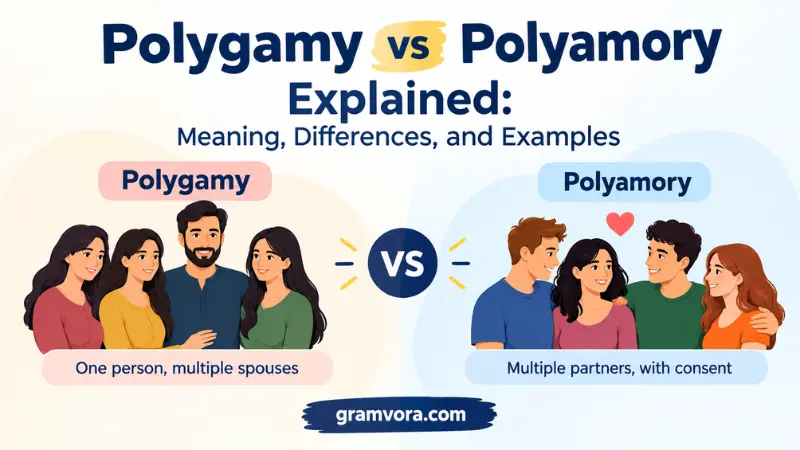
The terms polygamy and polyamory are often confused because both describe relationships involving more than two people. However, they do not mean the same thing.
Polygamy specifically refers to having more than one spouse at the same time. Polyamory refers to having multiple romantic or intimate relationships with the knowledge and consent of everyone involved.
The biggest difference is therefore marriage versus relationship structure. Polygamy centers on multiple spouses, while polyamory centers on multiple consensual romantic or intimate relationships.
This guide explains polygamy vs polyamory explained in plain English. It covers their meanings, differences, examples, related terms, common misunderstandings, and frequently asked questions.
Quick Answer
Polygamy means being married to more than one person at the same time. Polyamory means having, or being open to having, multiple romantic or intimate relationships with the knowledge and consent of everyone involved.
A person can therefore practice polyamory without being married to multiple people. Polygamy, by definition, involves multiple marriages or spouses.
TL;DR
- Polygamy involves multiple spouses.
- Polyamory involves multiple consensual intimate relationships.
- Marriage is central to the meaning of polygamy.
- Polyamory does not require marriage.
- Both can involve more than two people.
- Consent is central to polyamorous relationships.
What Does Polygamy Mean?
Polygamy is the practice of having more than one spouse at the same time.
The word is generally used for a marriage structure involving multiple spouses. It is broader than terms such as polygyny and polyandry.
For example:
A man has three wives at the same time.
That situation is an example of polygamy.
Polygamy is not limited to one gender in its basic definition. However, when a man has multiple wives, the more specific term is polygyny. When a woman has multiple husbands, the term is polyandry.
Simple definition
Polygamy = marriage to multiple spouses at the same time.
The term may appear in discussions about marriage, culture, religion, history, law, and family structures.
What Does Polyamory Mean?
Polyamory describes a relationship structure in which a person has, or is open to having, multiple romantic or intimate relationships with the knowledge and consent of the people involved.
Marriage is not required.
For example, imagine that Alex is dating Jordan and Sam. Jordan and Sam both know about the other relationship, and everyone agrees to the arrangement.
That could be described as polyamory.
Polyamory can include romantic relationships, sexual relationships, or both. The exact structure can vary from one group of people to another.
Simple definition
Polyamory = multiple consensual romantic or intimate relationships.
The word is commonly associated with consensual nonmonogamy, which is a broader category of relationship structures.
Polygamy vs Polyamory at a Glance
| Context | Best Choice | Why |
|---|---|---|
| Multiple spouses | Polygamy | The term specifically concerns marriage |
| Multiple romantic partners | Polyamory | Marriage is not required |
| Multiple husbands | Polyandry | This is a specific form of polygamy |
| One husband with multiple wives | Polygyny | This is a specific form of polygamy |
| Multiple consensual intimate relationships | Polyamory | Everyone involved knows and agrees |
The key distinction is simple: polygamy describes marriage, while polyamory describes consensual multiple relationships.
The Main Difference Between Polygamy and Polyamory
The easiest way to remember the difference is to focus on the word spouse.
If the situation involves multiple spouses, polygamy is the relevant term.
If the situation involves multiple romantic or intimate relationships but does not necessarily involve marriage, polyamory is usually the relevant term.
For example:
Example 1:
Chris has two wives.
This describes polygamy. More specifically, it describes polygyny.
Example 2:
Chris has two romantic partners, and both partners know about each other.
This may describe polyamory.
The two terms can overlap in some situations. Someone could be married to multiple people and also describe their relationships as consensual and emotionally intimate. However, the words still have different core meanings.
Is Polyamory the Same as Polygamy?
No.
Although both involve relationships with more than one person, the terms describe different concepts.
Polygamy focuses on multiple spouses.
Polyamory focuses on multiple consensual romantic or intimate relationships.
A polyamorous person might be married to one person and have another romantic partner. That person would not automatically be practicing polygamy because there are not multiple spouses.
Similarly, a polygamous marriage is not automatically polyamorous simply because several people are involved.
The terms can overlap in some individual relationships, but they should not be treated as interchangeable.
Does Polyamory Require Marriage?
No.
Marriage is not a requirement for polyamory.
A person may have several romantic relationships without marrying any of their partners. Another person may be married and also have additional consensual romantic relationships.
This is one of the clearest differences between the two concepts.
When people use polyamory, they are usually describing the structure of their romantic or intimate relationships. When they use polygamy, they are specifically referring to multiple spouses.
Does Polygamy Require Romantic Love?
The word polygamy itself identifies a marriage arrangement. It does not provide all the details about the emotional nature of every relationship within that marriage.
A person can therefore use the word to describe a marriage structure without explaining whether each relationship is romantic, emotional, cultural, religious, or based on other factors.
Polyamory places greater emphasis on multiple intimate or romantic relationships and informed consent among those involved.
That difference makes the terms useful for different situations.
Consent and Polyamory
Consent is an important part of how polyamory is commonly defined.
In a consensual polyamorous relationship, the people involved know about the multiple relationships and agree to the relationship structure.
This creates an important distinction between polyamory and cheating.
For example:
Taylor secretly dates another person while their partner believes they are exclusive.
That is not automatically polyamory.
Now consider:
Taylor and their partner agree that both can have additional romantic relationships.
That may be an example of consensual nonmonogamy, including polyamory depending on the relationships involved.
Polyamory does not mean that people have unlimited freedom without agreements. Partners may establish boundaries concerning dating, communication, time, intimacy, safer sex, and other areas.
Breaking an agreed relationship boundary can still cause serious problems.
Polygamy, Polygyny, and Polyandry
Three terms are often confused.
Polygamy
Polygamy is the broad term for having multiple spouses at the same time.
Polygyny
Polygyny refers specifically to a man having multiple wives.
Polyandry
Polyandry refers specifically to a woman having multiple husbands.
Both polygyny and polyandry are forms of polygamy.
A simple way to remember them is:
- Polygamy: multiple spouses
- Polygyny: one man, multiple wives
- Polyandry: one woman, multiple husbands
- Polyamory: multiple consensual romantic or intimate relationships
These terms should not be used as exact synonyms.
Is Polyamory a Type of Nonmonogamy?
Yes.
Polyamory is commonly described as a form of consensual nonmonogamy.
Nonmonogamy is a broad category. It can include different relationship arrangements in which people do not follow traditional one-partner exclusivity.
Polyamory is more specific because it commonly involves multiple romantic or intimate relationships.
Other forms of consensual nonmonogamy can include open relationships and swinging, although these terms describe different arrangements.
An open relationship, for example, does not necessarily involve multiple romantic relationships. The exact meaning depends on the agreements made by the people involved.
Common Examples of Polyamory
Polyamory can take different forms.
Example 1: Two romantic relationships
Maria is romantically involved with Alex and Jordan. Both relationships are known and agreed upon.
This can be polyamory.
Example 2: A married person with another partner
Sam is married to Taylor and has another romantic partner with Taylor’s knowledge and agreement.
This may be a polyamorous arrangement.
Example 3: Three people in a relationship
Three people are romantically involved with one another and agree to the arrangement.
This may be called a triad or throuple, depending on how the people involved describe their relationship.
Example 4: One person dating two people
Jamie dates Morgan and Riley, while Morgan and Riley are not dating each other.
This can also be a form of polyamory.
These examples show why polyamory is broader than marriage-based terminology.
Common Examples of Polygamy
Polygamy also has different forms.
Example 1: Multiple wives
A man is married to three women at the same time.
This is polygamy and, more specifically, polygyny.
Example 2: Multiple husbands
A woman is married to two men at the same time.
This is polygamy and, more specifically, polyandry.
Example 3: General description
The community has a historical tradition of plural marriage.
If the tradition involves multiple spouses, polygamy may be the appropriate general term.
The exact legal and cultural meaning can depend on the country, community, and circumstances.
Polygamy vs Polyamory: Common Mistakes
Mistake 1: Treating the words as synonyms
Incorrect:
Polyamory simply means being married to several people.
Better:
Polygamy refers to multiple spouses, while polyamory refers to multiple consensual intimate relationships.
Mistake 2: Assuming every polyamorous person has multiple spouses
That is incorrect.
A polyamorous person may not be married at all.
Mistake 3: Assuming every polygamous relationship is polyamorous
That is also too broad.
Polygamy describes a marriage structure. Polyamory describes a broader relationship structure centered on multiple consensual intimate relationships.
Mistake 4: Assuming polyamory means cheating
Cheating generally involves breaking an agreed relationship boundary.
Polyamory, by contrast, involves openness and consent among the people involved.
Polygamy and Polyamory in Everyday English
In everyday American English, both words usually appear in discussions about relationships and family structures.
Polygamy is more likely to appear in discussions involving marriage, religion, history, law, or culture.
Polyamory is more likely to appear in conversations about dating, relationship agreements, consensual nonmonogamy, and modern relationship structures.
For example:
The documentary examines the history of polygamy.
Here, the focus is marriage.
They decided to explore polyamory together.
Here, the focus is a consensual relationship structure.
Choosing the correct word depends on what you are actually describing.
Related Terms You Should Know
Several nearby terms can make these concepts easier to understand.
Monogamy
Monogamy generally refers to having one spouse or one romantic partner at a time, depending on context.
It is commonly contrasted with nonmonogamous relationship structures.
Nonmonogamy
Nonmonogamy is a broad term for relationship arrangements that do not follow traditional exclusivity between two partners.
Consensual Nonmonogamy
Consensual nonmonogamy describes nonexclusive relationship arrangements in which the people involved know about and agree to the arrangement.
Polyamory is one form of consensual nonmonogamy.
Open Relationship
An open relationship usually describes a relationship in which partners agree that some outside sexual or romantic activity is allowed.
However, the exact meaning varies between couples and groups.
Swinging
Swinging generally involves partners engaging in consensual sexual experiences with other people. It is not automatically the same as polyamory because emotional or romantic relationships may not be the focus.
Synonyms and Antonyms
Neither polygamy nor polyamory has a perfect synonym.
For polygamy, related expressions include:
- plural marriage
- multiple-spouse marriage
These expressions can overlap with polygamy, but context matters.
For polyamory, related expressions include:
- consensual nonmonogamy
- consensual non-monogamous relationship
These are related rather than exact synonyms.
Monogamy can function as a contrast to both concepts, but it is not a direct antonym in every context.
For example, someone might describe a relationship as nonmonogamous without specifically practicing polyamory.
How to Remember the Difference
A simple memory trick can help.
Think:
Polygamy = multiple spouses.
Polyamory = multiple loves or intimate relationships.
The first term focuses on marriage.
The second focuses on relationships.
The words share the prefix poly-, which relates to “many,” but the rest of each word points toward a different idea.
This distinction is especially useful when writing about relationships, family structures, religion, culture, or social issues.
FAQs
What is the difference between polygamy and polyamory?
Polygamy means having multiple spouses at the same time. Polyamory means having multiple romantic or intimate relationships with everyone’s knowledge and consent.
Is polyamory the same as having multiple wives?
No. Having multiple wives is specifically associated with polygyny, which is a form of polygamy.
Polyamory does not require marriage.
Can a person be both polygamous and polyamorous?
Potentially, yes. A person could have multiple spouses while also describing those relationships as consensual and emotionally intimate.
However, the two words still describe different aspects of the relationship structure.
Is polyamory legal in the United States?
Polyamory and marriage law are different issues. Polyamory itself does not automatically create multiple legal marriages.
Legal marriage rules govern who can be legally married, while polyamory describes a relationship structure.
Is polygamy the same as an open relationship?
No. Polygamy specifically concerns multiple spouses.
An open relationship can involve a legally married or unmarried couple that agrees to outside romantic or sexual relationships.
Does polyamory always involve sex?
No. Polyamory can involve romantic or intimate relationships, and not every polyamorous relationship has the same sexual structure.
Is polyamory a form of consensual nonmonogamy?
Yes. Polyamory is commonly described as a form of consensual nonmonogamy because everyone involved is expected to know about and agree to the multiple relationships.
Mini Quiz
1. A person has three spouses. Which term applies?
Answer: Polygamy.
2. A person has two romantic partners who both know and agree. What term may apply?
Answer: Polyamory.
3. What is one man having multiple wives called?
Answer: Polygyny.
4. What is one woman having multiple husbands called?
Answer: Polyandry.
5. Does polyamory require marriage?
Answer: No.
Conclusion
Understanding polygamy vs polyamory explained becomes easier when you focus on the central difference.
Polygamy concerns multiple spouses, while polyamory concerns multiple consensual romantic or intimate relationships. Neither term should automatically be treated as a synonym for the other.
When you encounter either word, first ask whether the discussion is about marriage or a broader relationship structure. That simple distinction will usually point you toward the correct meaning.


