English has many verbs that form their past tense by adding -ed. For example, walk becomes walked, help becomes helped, and open becomes opened. Because this pattern is so common, it is easy to assume that every verb follows the same rule.
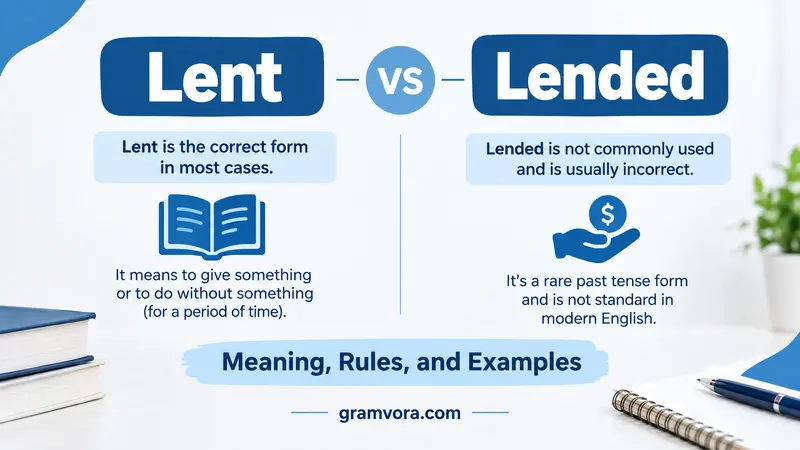
The verb lend creates a common problem. Some writers assume that its past tense should be lended. However, standard modern English uses lent as both the simple past tense and the past participle of lend.
For example, you should write, “I lent my friend a book yesterday,” rather than, “I lended my friend a book yesterday.”
This distinction matters in school assignments, professional emails, website articles, and everyday conversations. Using the standard form makes your sentences sound natural and helps readers understand your meaning without distraction.
In this guide, you will learn why lent is the correct form, why lended causes confusion, how to use lent in different sentence structures, and which mistakes to avoid.
Quick Answer
Lent is the correct standard past tense and past participle of lend. Lended is not the standard form in modern English.
The basic verb forms are:
- Present or base form: lend
- Simple past tense: lent
- Past participle: lent
- Present participle: lending
- Third-person singular present: lends
Examples:
- Present: I lend my books to classmates.
- Past: I lent my book to Sarah yesterday.
- Present perfect: I have lent Sarah several books.
- Past perfect: I had lent him my calculator before the exam.
- Continuous: I am lending my neighbor a ladder.
Remember this simple pattern:
Lend → Lent → Lent
Use lent whenever you describe a completed past action or use the past participle after a helping verb.
Why People Confuse Them
The confusion between lent and lended usually comes from a familiar English spelling pattern.
Most learners encounter regular verbs early in their studies. They learn that adding -ed often creates the past tense:
- Work → worked
- Call → called
- Help → helped
- Clean → cleaned
- Borrow → borrowed
After learning these examples, a writer may apply the same rule to lend. The result seems logical: lended.
However, English has many irregular verbs that do not follow this pattern. Their past forms must be learned separately.
Consider these common examples:
- Send → sent
- Spend → spent
- Bend → bent
- Keep → kept
- Feel → felt
- Lend → lent
These verbs demonstrate why adding -ed does not work for every English verb.
Another reason for the confusion is that lend ends with the letter d. Writers may expect to preserve that ending and add -ed. Standard English instead uses the established irregular form lent.
The mistake is understandable, especially for people learning English. Nevertheless, understanding the correct form helps prevent it from appearing in formal writing.
Key Differences At A Glance
The most important distinction is grammatical rather than a difference between two accepted spellings. Lent is the standard past form of lend, while lended is generally a nonstandard attempt to form that past tense.
| Context | Best Choice | Why |
|---|---|---|
| Describing a past action | Lent | It is the standard simple past form. |
| Using has, have, or had | Lent | It is the standard past participle. |
| Talking about a general habit | Lend or lends | The correct present form depends on the subject. |
| Describing an ongoing action | Lending | The -ing form follows the usual pattern. |
| Writing a school assignment | Lent | It follows standard English usage. |
| Writing a professional email | Lent | It is the accepted form in edited writing. |
| Using lended as the past tense | Avoid it | It is not the standard conjugation of lend. |
A few examples make the difference clear:
- Correct: My sister lent me her laptop.
- Incorrect in standard English: My sister lended me her laptop.
- Correct: He has lent his car to a friend.
- Incorrect in standard English: He has lended his car to a friend.
The intended meaning remains understandable in the incorrect examples, but the verb form should be corrected.
Are They the Same Word?
Lent and lended are not two standard spelling variants of the same word. The real issue is the formation of the past tense.
The verb lend means to give something to another person temporarily, usually with the expectation that it will be returned. Depending on the context, the item may be money, a book, a phone, a vehicle, or another possession.
For example:
“My coworker lent me her charger.”
This means the coworker allowed the speaker to use her charger, with the expectation that it would be returned.
The word lended is usually created when someone applies the regular -ed rule to lend. Although readers can often understand the intended meaning, it is not the standard past form.
Compare these sentences:
Correct: The bank lent the family money for their new home.
Incorrect in standard English: The bank lended the family money for their new home.
Both sentences attempt to express the same idea, but only the first uses the standard past form of lend.
There is no established meaning distinction in which lent refers to one kind of lending and lended refers to another. The difference is not about the amount of money, the type of item, the length of the loan, or the relationship between the people involved.
Instead, the correct form depends on the standard conjugation of the verb.
US vs UK Preference
American and British English both use lent as the standard past tense and past participle of lend.
There is no usual US-versus-UK spelling split in this case. American writers should use lent, and British writers should also use lent.
For example, an American might write:
“I lent my neighbor a lawn mower.”
A British writer might write:
“I lent my neighbor a lawn mower.”
The spelling of lent does not change between these varieties of English.
The same form works in formal writing, everyday conversation, educational materials, and professional communication. You do not need to switch to lended when writing for a particular English-speaking country.
American English also commonly uses loaned as the past tense of the separate verb loan. For instance, “The bank loaned us the money” is a standard sentence.
However, this does not make lended an accepted alternative. The two verb patterns are different:
- Lend → lent
- Loan → loaned
Both lent and loaned can express the act of providing money or something temporarily, depending on the sentence. Their existence does not change the correct past tense of lend.
Which Spelling Should You Use?
Choose lent whenever you need the past tense or past participle of lend.
The best way to make the correct choice is to identify the role the verb plays in your sentence.
Use lend for the present or base form.
Examples:
- I lend my notes to classmates when they miss a lecture.
- Can you lend me your umbrella?
- We will lend the equipment to the school.
- She may lend her car to her brother.
Notice that lend follows modal verbs such as can, will, may, and should.
Use lent for a completed past action.
Examples:
- I lent my notes to a classmate yesterday.
- He lent me his umbrella during the storm.
- We lent the equipment to the school last week.
- She lent her car to her brother on Saturday.
The action happened in the past, so lent is the correct form.
Use lent after have, has, or had.
Examples:
- I have lent him my calculator before.
- She has lent me several books.
- They had lent us their chairs before the guests arrived.
In these sentences, lent is the past participle.
One useful reminder is that the form remains lent even when the sentence becomes longer or more complicated. You do not need to add -ed because another verb appears before it.
When One Spelling Looks Wrong
The form lended can look reasonable because it follows a common spelling pattern. However, a form that looks logical is not necessarily the standard form.
English has developed many irregular verbs. Their established past forms do not always match the pattern that learners expect.
For example, most writers would recognize that the standard forms are sent, spent, and kept, rather than sended, spended, and keeped.
The same principle applies to lend.
In edited American English, lended should generally be corrected to lent when the intended verb is lend.
Consider the following examples:
- Incorrect: I lended him my headphones.
- Correct: I lent him my headphones.
- Incorrect: Our teacher has lended us extra books.
- Correct: Our teacher has lent us extra books.
- Incorrect: They lended their truck to a friend.
- Correct: They lent their truck to a friend.
You might occasionally encounter lended in nonstandard writing or other unusual contexts. Its appearance does not make it the normal past form in contemporary standard English.
For everyday writing, academic work, and professional communication, lent is the reliable choice.
Common Mistakes (and Quick Fixes)
Several errors often appear alongside the confusion between lent and lended. Learning the full verb pattern can help you avoid them.
Mistake 1: Adding -ed to lend
Incorrect: “I lended my friend twenty dollars.”
Correct: “I lent my friend twenty dollars.”
The verb is irregular. Replace lended with lent.
Mistake 2: Using lend for a completed past action
Incorrect: “She lend me her notes yesterday.”
Correct: “She lent me her notes yesterday.”
The word yesterday indicates that the action occurred in the past.
Mistake 3: Using lent after a modal verb
Incorrect: “Can you lent me your pen?”
Correct: “Can you lend me your pen?”
After a modal verb such as can, could, will, or should, use the base form of the main verb.
Mistake 4: Writing lended after has or have
Incorrect: “He has lended me his bike.”
Correct: “He has lent me his bike.”
The past participle of lend is lent.
Mistake 5: Confusing lend with borrow
Incorrect: “I borrowed my friend my calculator.”
Correct: “I lent my friend my calculator.”
Alternatively, write:
“I borrowed a calculator from my friend.”
The difference concerns who gives and who receives the item. The person who gives it lends it; the person who receives it borrows it.
Mistake 6: Mixing lend and loan
Incorrect: “The bank lended us the money.”
Correct: “The bank lent us the money.”
Another acceptable sentence is:
“The bank loaned us the money.”
The second correct example uses loan as the verb. Do not create lended by combining the two patterns.
A Simple Correction Checklist
Before submitting an assignment or publishing an article, ask yourself:
- Does the sentence describe a past action? Use lent.
- Does the sentence contain has, have, or had before the verb? Use lent.
- Does it contain can, will, or should before the verb? Use lend.
- Does the sentence describe an ongoing action? Consider lending.
- Does the sentence use lended as the past tense of lend? Replace it with lent.
These checks cover most common situations.
Everyday Examples
The easiest way to understand lent vs lended is to see how lent works in everyday American English. Remember that lent is the standard past tense and past participle of lend. The form lended is nonstandard in ordinary modern English.
Examples Using Lent
- I lent my friend twenty dollars yesterday.
- Sarah lent me her laptop while mine was being repaired.
- My brother lent me his car for the weekend.
- The teacher lent us extra books for our class project.
- She lent her neighbor a ladder to fix the roof.
- He lent me his phone charger during lunch.
- We lent our folding chairs to a friend for a birthday party.
- My parents lent me money to pay for my textbooks.
- The bank lent the business enough money to expand.
- I lent my sister my favorite novel last month.
Examples Using Lent With Helping Verbs
- I have lent my notes to several classmates.
- She has lent me her bicycle before.
- They had lent us their equipment before the event started.
- He has lent his support to the community project.
- We have lent our neighbors some gardening equipment.
Examples Using Lend in the Present or Future
- Can you lend me a pen?
- I will lend you my umbrella if it rains.
- My parents sometimes lend me their car.
- Could you lend me a few dollars until Friday?
- Our school will lend students books for the semester.
Incorrect vs Correct Examples
| Incorrect | Correct |
|---|---|
| I lended him my book. | I lent him my book. |
| She has lended me money. | She has lent me money. |
| They lended us their car. | They lent us their car. |
| He had lended his notes to me. | He had lent his notes to me. |
| My friend lended me a hand. | My friend lent me a hand. |
Quick Tip
Remember the three main forms:
Lend → Lent → Lent
Use lend for the base form, lent for the simple past tense, and lent after has, have, or had. This pattern will help you use the verb correctly in conversations, school assignments, and professional writing. grammatical structure.
Dictionary Style Word Details
Verb
Lent: The standard simple past tense and past participle of lend. It describes giving something temporarily or contributing a quality to something.
Examples:
- I lent him my textbook.
- Her experience lent credibility to the proposal.
- We have lent our support to the project.
Lended: A nonstandard form generally produced by adding -ed to lend. It is not the standard past tense or past participle in contemporary English.
Example to correct:
- Nonstandard: She lended me her notes.
- Standard: She lent me her notes.
Noun
Lent: When capitalized, Lent is also the name of a Christian season observed before Easter. This is a separate use of the same spelling.
Example: “The church holds special services during Lent.”
Lended: It is not the standard noun form of lend. In the comparison discussed here, it is an attempted verb form rather than an established noun.
Synonyms
Because lent is a form of lend, useful alternatives depend on the sentence.
Lent: Closest plain alternatives include loaned, provided temporarily, or allowed someone to use, where the meaning fits.
Example: “I lent him my bicycle” can be expressed as “I loaned him my bicycle.”
For figurative uses, lent credibility may be rephrased as gave credibility to or added credibility to.
Lended: Since it is not the standard form, it does not need a separate synonym list. Replace it with the appropriate form of lend, usually lent in past-tense sentences.
There is no single antonym that fits every use of lend. In a temporary-transfer context, keep or retain may express the opposite action in some sentences, but neither is a direct antonym in every context.
Example Sentences
Lent:
- I lent my sister my favorite novel.
- The company lent its equipment to a local school.
- He lent me his jacket because it was cold outside.
- Her calm attitude lent confidence to the entire team.
- We have lent our support to the neighborhood project.
Lended:
- Nonstandard: I lended my sister my favorite novel.
- Standard correction: I lent my sister my favorite novel.
- Nonstandard: Her calm attitude lended confidence to the team.
- Standard correction: Her calm attitude lent confidence to the team.
These examples show that lent works in both literal and figurative contexts.
Word History
Lent is the established irregular past tense and past participle of lend. The form belongs to a longstanding pattern of irregular English verbs, in which the past form differs from the base form rather than simply adding -ed.
The modern forms are:
- Lend: base form
- Lent: simple past
- Lent: past participle
It is not necessary to assign a specific date or historical event to explain the modern rule. The important point for present-day writers is that lent is the standard form.
The form lended follows the regular past-tense pattern, but that pattern is not the one used in standard modern English for this verb.
Phrases Containing
Lent:
- Lent a hand: helped someone.
- Lent support: provided support.
- Lent credibility: made something seem more believable.
- Lent money: provided money with an expectation of repayment.
- Lent a book: allowed someone to use a book temporarily.
Examples:
- My neighbor lent a hand when we moved.
- Her research lent credibility to the report.
- I lent money to my brother last month.
- The teacher lent a book to one of her students.
Lended: No standard phrases use lended as the accepted past form of lend. When you encounter expressions such as “lended a hand” or “lended support,” use “lent a hand” or “lent support” in standard English.
FAQs
Is it lent or lended?
Lent is the correct standard form in modern English. It is the simple past tense and past participle of lend. For example, “I lent my friend a book yesterday.”
Is lended a real word?
Lended may appear in nonstandard writing, but it is not the standard past tense of lend. In formal writing, school assignments, and professional communication, use lent instead.
What is the past tense of lend?
The past tense of lend is lent. For example, “She lent me her laptop last weekend.”
What is the past participle of lend?
The past participle of lend is also lent. Use it with helping verbs such as has, have, and had. For example, “I have lent him my notes.”
Why is lent correct instead of lended?
Lend is an irregular verb. Unlike regular verbs that form the past tense by adding -ed, it changes to lent. This is the standard form in modern English.
Is lent correct in American English?
Yes. Lent is the standard past tense and past participle of lend in American English. It is appropriate for academic, professional, and everyday writing.
Do British English speakers use lent or lended?
British English also uses lent as the standard past tense and past participle of lend. There is no usual American-versus-British spelling difference between these forms.
Is “I lended him money” grammatically correct?
No, not in standard English. The correct sentence is “I lent him money.” The verb lend takes the irregular past-tense form lent.
Should I write “I have lent” or “I have lended”?
Write “I have lent.” The past participle of lend is lent, so the sentence “I have lended” is nonstandard.
What are the three main forms of lend?
The three main forms are lend, lent, lent. Use lend as the base form, lent as the simple past tense, and lent as the past participle.
Conclusion
The choice between lent and lended is straightforward once you recognize that lend is an irregular verb.
Lent is the standard past tense and past participle of lend. Lended is not the standard form in modern English.
Use lend for the base form and present-tense situations, lent for past actions and perfect tenses, and lending for ongoing actions.
For example, write “I lent my friend my book yesterday” and “I have lent him my notes before.” Avoid “I lended my friend my book” in standard writing.
The same rule applies in American and British English. You do not need to change the spelling for different audiences.
Remember the simple pattern lend → lent → lent. Once you learn it, choosing the correct form becomes much easier in schoolwork, professional communication, and everyday writing.