
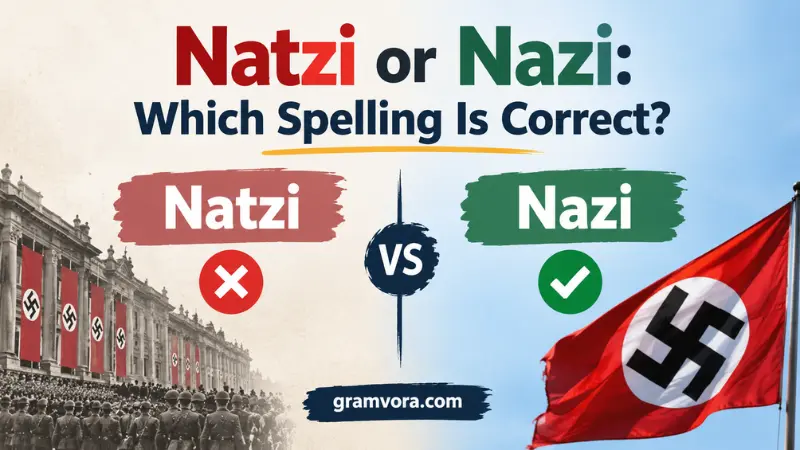
If you are unsure whether the correct spelling is “natzi” or “nazi,” the standard English spelling is Nazi. The form natzi is a misspelling and is not the standard spelling of the historical or political term.
Nazi refers to a member or supporter of the National Socialist German Workers’ Party, the political organization led by Adolf Hitler in Germany. The word is also used as an adjective when describing something connected with that movement, its government, or its ideology.
Although natzi may appear online because people sometimes spell unfamiliar words the way they sound, it is not the standard English form. If you are writing an essay, article, historical discussion, school assignment, or formal text, use Nazi.
Quick Answer
Nazi is the correct spelling.
Natzi is generally a misspelling.
Examples:
- Correct: The Nazi Party came to power in Germany in 1933.
- Incorrect: The Natzi Party came to power in Germany in 1933.
- Correct: The museum contains documents from the Nazi era.
- Incorrect: The museum contains documents from the Natzi era.
The correct form is written with one t? More precisely, it contains no “t” at all: N-A-Z-I.
What Does “Nazi” Mean?
Nazi is a shortened form of the German name associated with the National Socialist German Workers’ Party, commonly known in German as the NSDAP.
Historically, the term refers to the political movement and its members in Germany during the period when Adolf Hitler and the Nazi Party controlled the German government.
The Nazi regime ruled Germany from 1933 to 1945. It promoted an extreme form of nationalism, racism, antisemitism, dictatorship, and territorial expansion. The regime was responsible for the persecution and mass murder of millions of people, including approximately six million Jews during the Holocaust.
Because of this history, Nazi is a highly serious historical and political term. Its meaning should be understood from context rather than treated simply as an ordinary adjective.
Why Do People Write “Natzi” Instead of “Nazi”?
The spelling natzi can be an understandable mistake because of pronunciation.
When people hear the word Nazi, especially if English is not their first language, they may imagine that there is a “t” sound between the consonants. This can lead to spellings such as natzi, natzis, or other incorrect variations.
English spelling does not always correspond perfectly to pronunciation. When a word is learned mainly by hearing it rather than reading it, spelling mistakes are more likely.
For example, someone might hear:
“Nazi”
and mistakenly interpret the pronunciation as something like:
“nat-zee”
That can result in natzi.
However, standard written English uses Nazi, not natzi.
Nazi vs. Natzi: Key Difference
| Spelling | Status | Meaning |
|---|---|---|
| Nazi | Correct | Refers to the Nazi movement, party, ideology, regime, or its members, depending on context |
| Natzi | Incorrect | A common misspelling of Nazi |
The difference is only one letter, but that letter makes the spelling incorrect.
Nazi
Nazi is the established English spelling.
Example:
The Nazi regime ended in 1945.
Natzi
Natzi is not the standard spelling of the historical term.
Example:
The Natzi regime ended in 1945.
This sentence contains a spelling error. It should use Nazi.
Is “Nazi” a Noun or an Adjective?
Nazi can function as both a noun and an adjective.
Nazi as a Noun
As a noun, Nazi can refer to a member or supporter of the Nazi Party.
Example:
The historian studied how Nazi officials organized the government.
Another example:
Several Nazi leaders were prosecuted after World War II.
Here, Nazi identifies people associated with the Nazi movement.
Nazi as an Adjective
As an adjective, Nazi describes something associated with Nazi Germany, the Nazi Party, or Nazi ideology.
Examples include:
- Nazi Germany
- Nazi Party
- Nazi government
- Nazi propaganda
- Nazi ideology
- Nazi policies
- Nazi persecution
- Nazi regime
For instance:
The book examines Nazi propaganda during the 1930s.
Here, Nazi describes the type of propaganda being discussed.
Should “Nazi” Be Capitalized?
Yes. When referring to the historical movement or its members, Nazi is normally capitalized.
Examples:
- Nazi Party
- Nazi Germany
- Nazi regime
- Nazi ideology
- Nazi officials
- Nazi persecution
The capitalization is important in formal writing.
Writing nazi in lowercase is generally not appropriate when referring to the historical political movement.
Therefore, for formal English, use:
Nazi
rather than:
nazi
And certainly do not use:
natzi
when you mean the historical term.
What Is the Origin of the Word “Nazi”?
The word Nazi is derived from the German political movement associated with the National Socialist German Workers’ Party.
The German name was:
Nationalsozialistische Deutsche Arbeiterpartei
This was commonly abbreviated as NSDAP.
The short form Nazi developed from Nationalsozialist, meaning “National Socialist.” It became a common short designation for members and supporters of the party.
English adopted Nazi as the standard form.
That history helps explain why the spelling does not contain a t. The standard word developed from the German political name rather than from an English pronunciation.
Is “Natzi” Ever Correct?
If you are asking about the historical political term, natzi is not the standard spelling.
There could theoretically be unrelated names, usernames, fictional terms, or proper names that happen to contain the letters “natzi.” Such cases would depend on the specific context.
However, if your intended meaning is the historical term connected with Hitler and Nazi Germany, use:
Nazi
For normal English writing, natzi should not be used as a spelling variant of Nazi.
Common Mistakes With “Nazi”
Several spelling and usage mistakes can occur with this word.
1. Writing “Natzi”
Incorrect:
The Natzi Party ruled Germany.
Correct:
The Nazi Party ruled Germany.
2. Writing “Nazi” With a T
Incorrect:
Natzi Germany
Correct:
Nazi Germany
The extra t does not belong in the standard spelling.
3. Using Lowercase “nazi”
Less appropriate in formal historical writing:
nazi Germany
Standard:
Nazi Germany
4. Confusing Pronunciation With Spelling
A person may hear the word and assume its spelling contains a t. Remember that pronunciation is not always a reliable guide to spelling.
The written form is:
N-A-Z-I
Examples of “Nazi” in Sentences
Here are several examples showing how the word is used naturally.
- Nazi Germany invaded Poland in 1939.
- The museum displays documents from the Nazi era.
- Historians have extensively studied Nazi propaganda.
- The Nazi Party gained significant political power during the early 1930s.
- The book discusses persecution under the Nazi regime.
- Many victims of Nazi persecution were imprisoned or killed.
- The trial examined crimes committed by Nazi officials.
- Students learned about the Holocaust and Nazi Germany in history class.
- The documentary explores life under Nazi rule.
- Researchers continue to study Nazi-era documents and records.
Notice that the spelling remains Nazi in every example.
Nazi, Nazi Party, and Nazi Germany
These expressions are related but should not be treated as completely interchangeable.
Nazi
Nazi can refer to a member of the movement or can describe something connected to it.
Example:
The archive contains Nazi documents.
Nazi Party
Nazi Party specifically refers to the political organization led by Adolf Hitler.
Example:
The Nazi Party became the dominant political force in Germany after Hitler’s appointment as chancellor.
Nazi Germany
Nazi Germany is a commonly used historical term for Germany under Nazi rule, particularly from 1933 to 1945.
Example:
Nazi Germany pursued aggressive territorial expansion before and during World War II.
“Nazi” in Modern English
Today, Nazi remains primarily a historical term referring to the Nazi movement and its associated regime.
However, the word is sometimes used informally as an insult or exaggeration. For example, people may use expressions such as “grammar Nazi” to describe someone perceived as extremely strict about grammar.
This informal use is controversial because it compares ordinary behavior with a movement associated with dictatorship, persecution, and genocide.
In formal historical writing, it is better to use Nazi precisely and explain what person, organization, policy, or period you mean.
Why Correct Spelling Matters
Correct spelling becomes especially important when discussing history.
A spelling error can make an article appear careless or unreliable. This is particularly true when writing about well-known historical events, political organizations, or people.
For example:
The Natzi government introduced discriminatory laws.
The intended meaning may be understandable, but the spelling is incorrect.
A polished version is:
The Nazi government introduced discriminatory laws.
Using the established spelling helps readers immediately recognize the historical term and keeps the writing professional.
Memory Trick: How to Spell Nazi
A simple way to remember the spelling is:
NA + ZI = NAZI
There is no T.
Think:
Nazi = N-A-Z-I
Not:
Natzi = N-A-T-Z-I
If you frequently make this mistake, write the correct form several times:
- Nazi
- Nazi
- Nazi
- Nazi
The key point is to remember that the word goes directly from A to Z.
Natzi or Nazi in a Sentence
If you are deciding which spelling to use in a sentence, choose Nazi.
Example 1
❌ The Natzi Party controlled Germany.
✅ The Nazi Party controlled Germany.
Example 2
❌ The book focuses on Natzi Germany.
✅ The book focuses on Nazi Germany.
Example 3
❌ The museum has artifacts from the Natzi era.
✅ The museum has artifacts from the Nazi era.
Example 4
❌ Students studied Natzi propaganda.
✅ Students studied Nazi propaganda.
Example 5
❌ The documentary examines the Natzi regime.
✅ The documentary examines the Nazi regime.
The correction is straightforward: remove the unnecessary t.
Is “Nazi” the Same as “Nazism”?
No. Nazi and Nazism are related but have different grammatical functions.
Nazi generally refers to a person associated with the movement or describes something related to it.
Nazism refers to the political ideology associated with the Nazi movement.
Examples:
He studied Nazi Germany.
Here, Nazi works as an adjective.
The book examines Nazism in twentieth-century Europe.
Here, Nazism is the name of the ideology.
Using the correct form makes the meaning clearer.
Nazi vs. Nazism vs. National Socialism
These terms are connected but are not identical in every context.
- Nazi — a member of the Nazi movement or something associated with it.
- Nazism — the ideology and political system associated with the Nazi movement.
- National Socialism — the English name for the ideology promoted by the Nazi Party.
Examples:
Nazi officials
Nazi Germany
Nazism
National Socialism
If your sentence describes a person or something associated with the movement, Nazi may be appropriate. If you are discussing the ideology itself, Nazism may be the more precise term.
FAQs
Is “Natzi” or “Nazi” correct?
Nazi is the correct standard spelling for the historical political term. Natzi is a misspelling.
Is “Natzi” a real word?
“Natzi” can appear as an accidental spelling or in unrelated names, usernames, or other contexts, but it is not the standard spelling of Nazi.
Why do people spell Nazi as Natzi?
The mistake may come from pronunciation. Some people hear a sound that they interpret as a t, leading them to write natzi.
Does Nazi have a T?
No. The standard spelling is N-A-Z-I. There is no t.
Should Nazi be capitalized?
Yes. When referring to the historical Nazi movement, party, regime, or associated people and institutions, Nazi is normally capitalized.
Is Nazi a noun?
Yes. Nazi can be a noun referring to a member or supporter of the Nazi movement.
Is Nazi an adjective?
Yes. It can also be used as an adjective in expressions such as Nazi Germany, Nazi propaganda, and Nazi policies.
What is the plural of Nazi?
The plural is Nazis.
Example:
Several Nazis were tried after World War II.
What is the adjective for Nazi?
Nazi itself commonly functions as the adjective.
For example:
Nazi Germany
Nazi propaganda
Is “nazi” lowercase correct?
In standard historical writing, Nazi should be capitalized when referring to the Nazi movement or its members.
Conclusion
The correct spelling is Nazi.
Natzi is a common misspelling caused partly by the way the word may sound when spoken. The historical term is spelled N-A-Z-I, with no T.
Use Nazi when referring to the Nazi Party, Nazi Germany, Nazi officials, Nazi policies, Nazi propaganda, or a member of the Nazi movement.
Quick reminder
Correct: Nazi
Incorrect: Natzi
If you are writing a school assignment, historical article, or formal document, always use Nazi when that is the word you mean.


