
Bigamy vs polygamy can be confusing because both words describe situations involving more than one spouse. They overlap in meaning, but they are not exact synonyms.
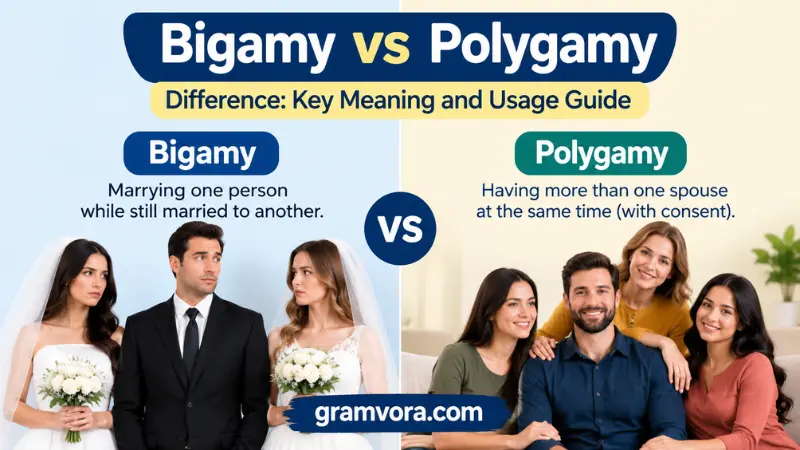
The clearest difference is one of focus. Bigamy refers more specifically to entering another marriage while an existing legal marriage is still in effect. Polygamy is the broader term for the practice or condition of having more than one spouse at the same time.
That means the right word depends on what you are describing. If the focus is a specific overlapping marriage, bigamy is usually the more precise choice. If the focus is a general marriage practice involving multiple spouses, polygamy is usually the better word.
Quick Answer
Use bigamy when you are describing a person who enters another marriage while still legally married to someone else.
Use polygamy when you are describing the broader practice or condition of having more than one spouse at the same time.
A simple way to remember the distinction is:
- Bigamy: a specific additional marriage while an earlier legal marriage remains in effect.
- Polygamy: the broader practice or condition of having multiple spouses.
Do not reduce the difference to the shortcut “bigamy means exactly two, while polygamy means three or more.” The more useful distinction is specific overlapping marriage versus broader multiple-spouse practice.
Why People Confuse Them
The confusion is understandable because both terms involve multiple spouses or marriages.
The words also look similar. Both contain -gamy, a word element associated with marriage. Their prefixes can make the distinction seem obvious: bi- suggests two, while poly- suggests many.
That can lead readers to assume that the number of spouses is the only difference.
Modern usage is more useful when viewed through context. Bigamy commonly identifies the act of entering a marriage while another legal marriage is still active. Polygamy describes the broader marital arrangement or practice.
Legal language can make the overlap even more confusing. A situation can be discussed broadly as polygamy while a particular additional marriage can be described more specifically as bigamy.
The terms therefore overlap, but they do different jobs in a sentence.
Key Differences At A Glance
| Context | Best Choice | Why |
|---|---|---|
| Someone marries another person while still legally married | Bigamy | It focuses on the overlapping marriage |
| A general discussion of multiple-spouse marriage | Polygamy | It describes the broader practice |
| A legal discussion of an alleged second marriage | Bigamy | It identifies the specific legal issue |
| A discussion of marriage customs involving multiple spouses | Polygamy | It describes the wider marital structure |
| You are describing a general condition of having several spouses | Polygamy | It is the broader term |
Compact comparison
- Bigamy: narrower, specific, and strongly associated with an overlapping legal marriage.
- Polygamy: broader, describing marriage involving more than one spouse at the same time.
- Both: nouns connected with multiple-spouse marriage.
Meaning and Usage Difference
Bigamy refers to the act of marrying another person while a previous legal marriage is still in effect.
For example:
The court case involved an allegation of bigamy because the defendant’s first marriage had not been legally dissolved.
The important point is the existing legal marriage. A person may have been separated from a spouse for a long time, but separation does not by itself mean the marriage has ended.
Polygamy, by contrast, refers to the practice or condition of having more than one spouse at the same time.
For example:
The sociology class discussed polygamy as a form of marriage found in different societies.
Here, the writer is talking about a type of marital arrangement rather than focusing on one particular second marriage.
The two terms can overlap. A person in a multiple-spouse arrangement may also commit bigamy if that person enters another marriage while an earlier legal marriage remains in force.
That is why the words should not be treated as perfect synonyms.
Both bigamy and polygamy function as nouns in standard US English.
Tone, Context, and Formality
Both terms are standard English, but they tend to appear in different contexts.
Bigamy has a strong legal association. It commonly appears in discussions involving criminal charges, marriage records, courts, divorce, or an allegedly invalid second marriage.
Common combinations include:
- accused of bigamy
- charged with bigamy
- a case involving bigamy
- an allegation of bigamy
- a bigamous marriage
Polygamy has a broader range of use. It can appear in discussions of history, culture, religion, sociology, family structures, and law.
For example:
The documentary examined polygamy as a form of plural marriage.
One important caution is that bigamy does not inherently mean secret marriage. Secrecy or deception may occur in individual cases, but it is not the basic meaning of the word.
Likewise, polygamy does not by itself establish what every person involved knows or agrees to. The word describes a marriage structure involving multiple spouses.
Which One Should You Use?
Choose bigamy when your sentence centers on a person entering another marriage before an existing legal marriage has ended.
For example:
The investigation focused on possible bigamy after officials discovered that his divorce had not been finalized.
Choose polygamy when your sentence discusses multiple-spouse marriage as a general practice, structure, or custom.
For example:
The book examines polygamy in several historical societies.
A useful test is to ask what your sentence is emphasizing.
If the emphasis is “What happened when this person married again?”, bigamy is likely the better choice.
If the emphasis is “What kind of marriage system or practice is being discussed?”, polygamy is likely more appropriate.
When One Choice Sounds Wrong
Consider this sentence:
The defendant was charged with polygamy after marrying another person before his divorce was final.
This may communicate the general subject, but bigamy is more precise when the sentence is specifically about entering another marriage while the earlier legal marriage remains in effect.
A clearer version is:
The defendant was charged with bigamy after marrying another person before his divorce was final.
Now consider the opposite:
The historian studied bigamy in several traditional marriage systems.
This wording can sound too narrow if the historian is actually discussing multiple-spouse marriage as a broader social or cultural practice.
In that context, polygamy is generally the better choice:
The historian studied polygamy in several traditional marriage systems.
The distinction is therefore not simply about which word is “correct.” Both are correct words. The question is which one accurately describes the situation.
Common Mistakes (and Quick Fixes)
Mistake 1: Treating bigamy and polygamy as exact synonyms
They overlap, but they do not have identical scope.
Quick fix: Use bigamy for the specific overlapping-marriage act and polygamy for the broader multiple-spouse practice.
Mistake 2: Assuming bigamy always means exactly two spouses
The prefix bi- can encourage this interpretation, but modern usage is better understood through the specific act of entering another marriage while an existing marriage remains in effect.
Quick fix: Focus on the existing legal marriage rather than simply counting spouses.
Mistake 3: Assuming bigamy must be secret
A bigamous situation may involve deception, but secrecy is not the defining feature of the word.
Quick fix: Look for the key circumstance: another marriage was entered while an earlier legal marriage was still in effect.
Mistake 4: Using polygamy for every relationship involving multiple romantic partners
Polygamy specifically concerns marriage or spouses.
Quick fix: Do not automatically use polygamy for relationships that do not involve multiple spouses.
Mistake 5: Using bigamy for a broad discussion of plural marriage
This can make the sentence sound unnecessarily narrow.
Quick fix: Use polygamy when discussing a broader marriage system, custom, or practice.
Everyday Examples
Here are practical examples showing how the two words work in modern US English:
Bigamy
The man faced a bigamy charge after investigators discovered that his first marriage was still legally active.
Bigamy
She did not realize that her previous divorce had not been finalized before she remarried.
Polygamy
The documentary explored the history of polygamy in different societies.
Polygamy
The professor used polygamy as an example when discussing different forms of marriage.
Bigamy
The attorney reviewed the marriage records for evidence related to the alleged bigamy.
Polygamy
The article discusses polygamy as a broader form of multiple-spouse marriage.
These examples show why context matters. The first group focuses on a particular overlapping marriage. The second group focuses on the broader marriage practice.
Dictionary-Style Word Details
Verb
- Bigamy: Not commonly used as a verb in standard US English. The normal noun is bigamy. A sentence would typically say commit bigamy or be accused of bigamy, rather than using bigamy as a verb.
- Polygamy: Not normally used as a verb in standard US English. The noun appears in phrases such as practice polygamy or polygamy is discussed.
Neither term should normally be treated as an ordinary English verb.
Noun
- Bigamy: The act or offense of entering another marriage while already legally married to someone else.
- Polygamy: The practice or condition of having more than one spouse at the same time.
Both are nouns, and both are generally used as uncountable nouns when referring to the general concepts.
Synonyms
Neither word has a perfect synonym that works in every context.
- Bigamy: Closest plain alternatives include marrying again while still married or an overlapping second marriage, when those descriptions accurately fit the situation.
- Polygamy: Closest plain alternatives include multiple-spouse marriage and plural marriage when the context supports those descriptions.
Antonym: Monogamy can serve as a useful opposite of polygamy when the intended contrast is marriage to one spouse at a time.
Example Sentences
- Bigamy: The prosecutor said the case involved alleged bigamy.
- Bigamy: His first marriage was still legally active when he married again.
- Polygamy: The course covered polygamy as one form of marriage.
- Polygamy: The researchers examined how different societies have practiced polygamy.
- Bigamy: The marriage records became important in the bigamy investigation.
- Polygamy: The article distinguishes polygamy from other forms of nontraditional relationships.
Word History
Bigamy comes through Middle English and Old French from Medieval Latin forms built from elements associated with being married twice. Its history supports the idea of a second or additional marriage, but modern English usage should not be reduced to the literal prefix alone.
Polygamy comes from Greek-based forms involving elements meaning “many” and “marriage.” It developed as a term for marriage involving multiple spouses.
The word histories help explain why the terms look related, but they do not replace their modern definitions.
Phrases Containing
Common phrases with bigamy include:
- accused of bigamy
- charged with bigamy
- commit bigamy
- an allegation of bigamy
- a bigamy case
- a bigamous marriage
Common phrases with polygamy include:
- practice polygamy
- polygamy in society
- polygamous marriage
- polygamy as a marriage system
- discussions of polygamy
- the history of polygamy
These patterns also show the difference in emphasis: bigamy frequently appears in legal contexts, while polygamy has broader social, cultural, historical, and legal uses.
FAQs
What is the difference between bigamy and polygamy?
Bigamy refers specifically to entering another marriage while an existing legal marriage is still in effect. Polygamy is the broader term for having more than one spouse at the same time.
Is bigamy the same as polygamy?
No. The terms overlap, but they are not exact synonyms. Bigamy focuses on an additional marriage made while an earlier legal marriage remains active, while polygamy describes the broader practice of multiple-spouse marriage.
Does bigamy mean having exactly two spouses?
Not necessarily. Although the word bigamy is associated with a second marriage, the important point is that a person enters another marriage while already legally married. The number alone does not fully explain the distinction.
Is bigamy always a secret marriage?
No. Secrecy is not part of the basic definition of bigamy. The key issue is that someone enters another marriage while an earlier legal marriage is still in effect.
What does polygamy mean?
Polygamy means having more than one spouse at the same time. It is generally used as a broad term for a multiple-spouse marriage arrangement or practice.
Which word should I use for a legal case involving a second marriage?
Bigamy is usually the more precise word when the issue is that someone entered a second marriage while a previous legal marriage had not ended.
Can someone commit bigamy in a polygamous situation?
The terms can overlap. A situation involving multiple spouses may be described broadly as polygamy, while a particular additional marriage entered while an existing legal marriage remains active may be described as bigamy.
Is polygamy a broader term than bigamy?
Yes. Polygamy generally has the broader meaning because it describes a type of marriage involving multiple spouses. Bigamy focuses more specifically on an additional marriage entered while another legal marriage remains in effect.
Are bigamy and polygamy nouns?
Yes. Both bigamy and polygamy are nouns in standard US English. You can say “a case involving bigamy” or “a discussion of polygamy.”
What is the easiest way to remember bigamy vs polygamy?
Think of bigamy as the specific issue of an overlapping additional marriage, while polygamy refers to the broader practice or condition of having multiple spouses at the same time.
Conclusion
The bigamy vs polygamy difference is mainly about scope and focus.
Bigamy is the more specific term for entering another marriage while an earlier legal marriage is still in effect. Polygamy is the broader term for the practice or condition of having more than one spouse at the same time.
Use bigamy when you are describing a particular overlapping marriage, especially in a legal context. Use polygamy when you are discussing multiple-spouse marriage as a broader practice, structure, or custom.
The two words can overlap, but they are not interchangeable in every sentence. Once you focus on whether you are describing a specific additional marriage or a broader multiple-spouse practice, the correct choice becomes much clearer.


