
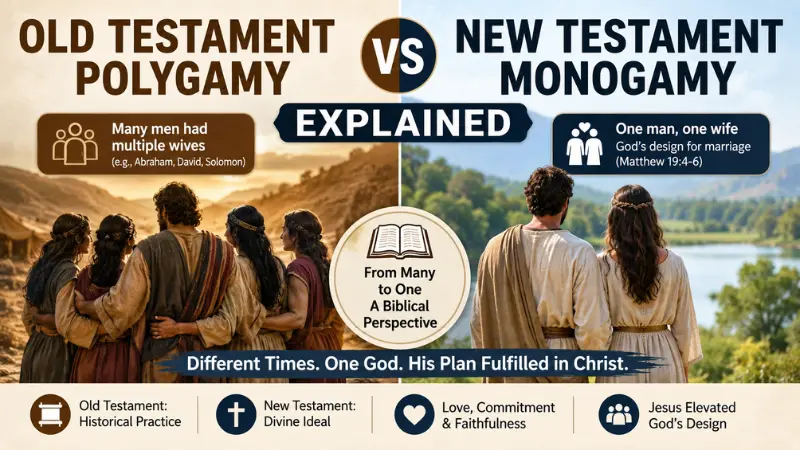
The phrases Old Testament polygamy and New Testament monogamy describe two patterns readers may notice when comparing marriage passages in the Bible.
The distinction is important, but it should not be reduced to “polygamy was right then and monogamy became right later.” The biblical picture is more complicated.
The Old Testament records men with multiple wives and even contains laws that regulate situations involving an additional wife. At the same time, Genesis presents a one-man, one-woman “one flesh” pattern.
In the New Testament, Jesus points back to that creation account when discussing marriage. Paul also describes marriage using one husband and one wife and gives church leaders a “husband of one wife” qualification.
Quick Answer
Old Testament polygamy refers to the practice of having more than one spouse at the same time as it appears in various Old Testament narratives and regulations.
New Testament monogamy refers to the one-spouse marriage pattern reflected in Jesus’ teaching and New Testament instructions.
Neither phrase is simply a matter of choosing the “correct” wording. They describe different marriage patterns.
The key point is this: the Old Testament records and regulates polygamous relationships, while the New Testament presents marriage through a strongly monogamous framework.
That does not mean every Old Testament example of polygamy was presented as morally ideal. Likewise, the New Testament does not contain a single standalone sentence that says, “Polygamy is forbidden.”
Why People Confuse Them
The confusion usually comes from reading biblical narrative as if every event described in Scripture were also approved by Scripture.
The Old Testament clearly includes men with multiple wives. Abraham, Jacob, David, and Solomon are well-known examples. Simply appearing in the biblical record does not automatically make a practice a command or ideal.
Another source of confusion is that Old Testament law sometimes addresses polygamous situations directly. For example, Exodus 21:10 discusses a man taking another wife and establishes responsibilities toward the first wife.
That kind of regulation can look like approval at first glance. A closer reading shows that regulation and endorsement are not necessarily the same thing.
The New Testament adds another important layer. Jesus discusses marriage by returning to the creation account and describing a husband and wife becoming “one flesh.” His argument emphasizes the original pattern rather than building his teaching around the polygamous examples found in Israel’s history.
Key Differences At A Glance
| Context | Best Choice | Why |
|---|---|---|
| Describing multiple-spouse marriages in Old Testament narratives | Old Testament polygamy | It accurately identifies the marriage pattern being described. |
| Describing the one-spouse marriage pattern in New Testament teaching | New Testament monogamy | It accurately identifies the pattern emphasized in those passages. |
| Explaining Genesis 2:24 | Monogamy | The passage describes a man united with his wife as one flesh. |
| Explaining Jesus’ marriage teaching | Monogamy | Jesus appeals to the creation account involving two people becoming one flesh. |
| Describing regulations involving an additional wife | Polygamy | The passage assumes a situation involving more than one wife. |
The most important distinction is description versus ideal. A biblical account can describe what someone did without presenting that action as the model readers should follow.
Meaning and Usage Difference
Polygamy is a noun meaning marriage to more than one person at the same time.
In this comparison, Old Testament polygamy describes the presence of such relationships in the Old Testament record.
Monogamy is also a noun. It refers to marriage involving one spouse at a time.
The New Testament’s marriage instructions repeatedly use a one-husband, one-wife framework. Jesus’ teaching in Matthew 19 is especially important because he refers back to Genesis and the “one flesh” creation pattern.
There is also an important distinction between the historical pattern and the teaching pattern.
The Old Testament contains examples of polygamy, but those examples should not automatically be treated as commands. The New Testament emphasizes marriage as a faithful union between a husband and wife.
Tone, Context, and Formality
Both polygamy and monogamy are formal terms used in religious studies, history, law, sociology, and general discussion.
For everyday writing, the clearest wording is often simple:
- “He had more than one wife.”
- “The passage describes a one-husband, one-wife marriage.”
- “The Old Testament records several polygamous marriages.”
- “Jesus returned to the creation pattern of marriage.”
When discussing biblical interpretation, polygamy is more precise than simply saying “multiple relationships.” The term specifically concerns marriage involving more than one spouse at the same time.
Monogamy is similarly useful when the focus is on a marriage involving one spouse.
Which One Should You Use?
Use Old Testament polygamy when you are discussing biblical figures or passages that involve a man having multiple wives.
Use New Testament monogamy when discussing the one-spouse marriage framework reflected in Jesus’ teaching, Paul’s instructions, or qualifications for church leadership.
Do not use the two phrases as synonyms. They describe contrasting marriage structures.
For a careful biblical explanation, it is also better to say that the Old Testament records and regulates polygamy rather than claiming that it simply commands polygamy.
Likewise, it is more accurate to say that the New Testament presents or assumes a monogamous pattern than to claim that every New Testament passage directly discusses polygamy.
When One Choice Sounds Wrong
Calling a marriage involving several wives monogamous would be inaccurate because monogamy concerns having one spouse.
Calling a marriage involving one husband and one wife polygamous would also be inaccurate.
Another common mistake is saying that the Old Testament “teaches polygamy” without qualification. The Old Testament certainly contains polygamous relationships and regulations concerning them, but that is different from saying that polygamy was God’s stated ideal.
It is also too broad to say that the New Testament contains a direct universal prohibition of polygamy in one explicit command. Its monogamous framework is established through several passages and patterns.
Common Mistakes (and Quick Fixes)
Mistake: “The Old Testament says polygamy is the ideal.”
Fix: Say, “The Old Testament records and regulates polygamous relationships, while also presenting a one-flesh creation pattern.”
Mistake: “Jesus explicitly used the word monogamy.”
Fix: Say, “Jesus described marriage through the creation account of a husband and wife becoming one flesh.”
Mistake: “Every biblical man with multiple wives was condemned for that reason.”
Fix: Avoid making that claim unless a particular passage clearly supports it.
Mistake: “The New Testament completely changes marriage from what the Old Testament taught.”
Fix: Explain that Jesus connects his teaching back to the creation account rather than treating the Old Testament examples of polygamy as the starting point.
Everyday Examples
Here are natural ways to use the terms when discussing biblical passages:
- “The Old Testament records several examples of polygamy.”
- “Jacob’s family is one example of a polygamous household in the biblical narrative.”
- “Genesis presents marriage as a man and his wife becoming one flesh.”
- “Jesus referred back to Genesis when teaching about marriage.”
- “The New Testament describes marriage through a husband-and-wife framework.”
- “The phrase ‘husband of one wife’ is important when discussing New Testament church leadership.”
- “Old Testament regulation of polygamy does not necessarily mean that polygamy was presented as the ideal.”
- “New Testament teaching places strong emphasis on faithful marriage between one husband and one wife.”
The wording should match the passage being discussed rather than forcing every biblical text into one simple category.
Dictionary-Style Word Details
Verb
Old Testament polygamy: Not commonly used as a verb in standard US English. Polygamy is a noun.
New Testament monogamy: Not commonly used as a verb in standard US English. Monogamy is a noun.
Related verbs such as “marry,” “take,” or “unite” belong to particular biblical sentences, but they should not be treated as verb forms of polygamy or monogamy.
Noun
Old Testament polygamy: A noun describing marriage to more than one spouse at the same time, applied here to polygamous relationships recorded in the Old Testament.
New Testament monogamy: A noun describing marriage to one spouse at a time, applied here to the one-husband, one-wife pattern emphasized in New Testament teaching.
Both terms are countable only in limited contextual constructions; normally, they refer to a general marriage practice or condition rather than to individual people.
Synonyms
Old Testament polygamy: Closest plain alternatives include plural marriage and marriage to multiple spouses, although these expressions can carry different meanings depending on context.
New Testament monogamy: Closest plain alternatives include one-spouse marriage and marriage to one spouse.
These alternatives are useful for explanation, but polygamy and monogamy are the more precise terms when discussing the specific marriage structures.
Example Sentences
Old Testament polygamy:
- “The Old Testament contains narratives involving polygamy.”
- “Old Testament law addresses certain responsibilities in a polygamous household.”
- “The presence of polygamy in a biblical narrative does not automatically establish it as an ideal.”
New Testament monogamy:
- “The New Testament presents marriage through a husband-and-wife framework.”
- “Jesus connected his teaching about marriage with the creation account.”
- “Paul’s instructions describe a husband and wife in a mutually responsible marriage.”
Word History
Polygamy: The English word comes from Greek elements associated with “many” and “marriage.” It is a standard noun for marriage involving more than one spouse at the same time.
Monogamy: The word comes from Greek elements associated with “one” and “marriage.” It is the standard noun for marriage involving one spouse.
The historical meanings of the two English terms are straightforward. The more important issue in this comparison is how those terms are applied to biblical passages.
Phrases Containing
Old Testament polygamy:
- Old Testament polygamy
- biblical polygamy
- polygamous marriage
- polygamous household
- polygamy in biblical narratives
New Testament monogamy:
- New Testament monogamy
- biblical monogamy
- monogamous marriage
- monogamous relationship
- monogamous marriage pattern
These phrases are most useful when the surrounding context makes clear whether the discussion concerns biblical narrative, biblical teaching, or the general meaning of the terms.
FAQs
1. Did God approve of polygamy in the Old Testament?
The Old Testament records polygamous marriages and sometimes regulates them, but describing or regulating a practice is not the same as presenting it as the ideal. Genesis provides a one-man, one-woman marriage pattern.
2. Did God change His view of marriage between the Old and New Testaments?
The Bible’s treatment is better understood as developing across different passages rather than as a simple change in God’s view. Jesus points back to the creation account when explaining the nature of marriage.
3. Did Jesus reject the polygamous marriages found in the Old Testament?
Jesus did not focus directly on individual Old Testament polygamous figures. Instead, when teaching about marriage, he appealed to Genesis and emphasized the union of a husband and wife as one flesh.
4. Why does Genesis matter when comparing polygamy and monogamy?
Genesis provides the creation pattern Jesus later used when discussing marriage. This makes Genesis 2:24 an important passage for understanding the biblical foundation of monogamous marriage.
5. Were Abraham, Jacob, David, and Solomon examples of polygamy?
Yes. The Old Testament describes these figures as having multiple wives or concubines. Their stories, however, should not automatically be treated as instructions that readers should follow.
6. Does the Old Testament condemn every man who had multiple wives?
No. The Old Testament does not give a single statement condemning every individual polygamous marriage. Its treatment includes narrative accounts as well as laws addressing particular circumstances.
7. What does “husband of one wife” mean in the New Testament?
The phrase appears in qualifications for church leaders. It is commonly understood as emphasizing a leader’s marital faithfulness and/or a one-wife marriage standard, although interpreters differ on some details of its meaning.
8. Does 1 Corinthians 7 support monogamy?
Yes. Paul’s instructions describe each man as having his own wife and each woman her own husband. The passage presents marriage through a one-husband, one-wife framework.
9. Is monogamy the biblical ideal?
The creation account and New Testament teaching provide strong support for understanding monogamy as the biblical marriage pattern. The existence of polygamy in Old Testament narratives does not by itself establish it as the ideal.
10. Why did Old Testament law regulate polygamy instead of simply banning it?
The Bible sometimes regulates existing social practices without presenting them as ideal. Passages concerning multiple wives can therefore establish responsibilities without necessarily endorsing the practice itself.
Conclusion
The clearest way to understand Old Testament polygamy vs New Testament monogamy is not to treat the Bible as if it simply switched from one marriage rule to another.
The Old Testament records multiple-wife marriages and contains regulations for some polygamous situations. Yet Genesis already presents a husband and wife becoming one flesh.
In the New Testament, Jesus returns to that creation pattern when discussing marriage. Paul’s instructions also consistently use a husband-and-wife framework, including the qualification concerning a church leader being the husband of one wife.
So the safest summary is: Old Testament polygamy describes a practice found and regulated in the biblical record, while New Testament monogamy describes the one-spouse marriage framework emphasized in Christian teaching.


