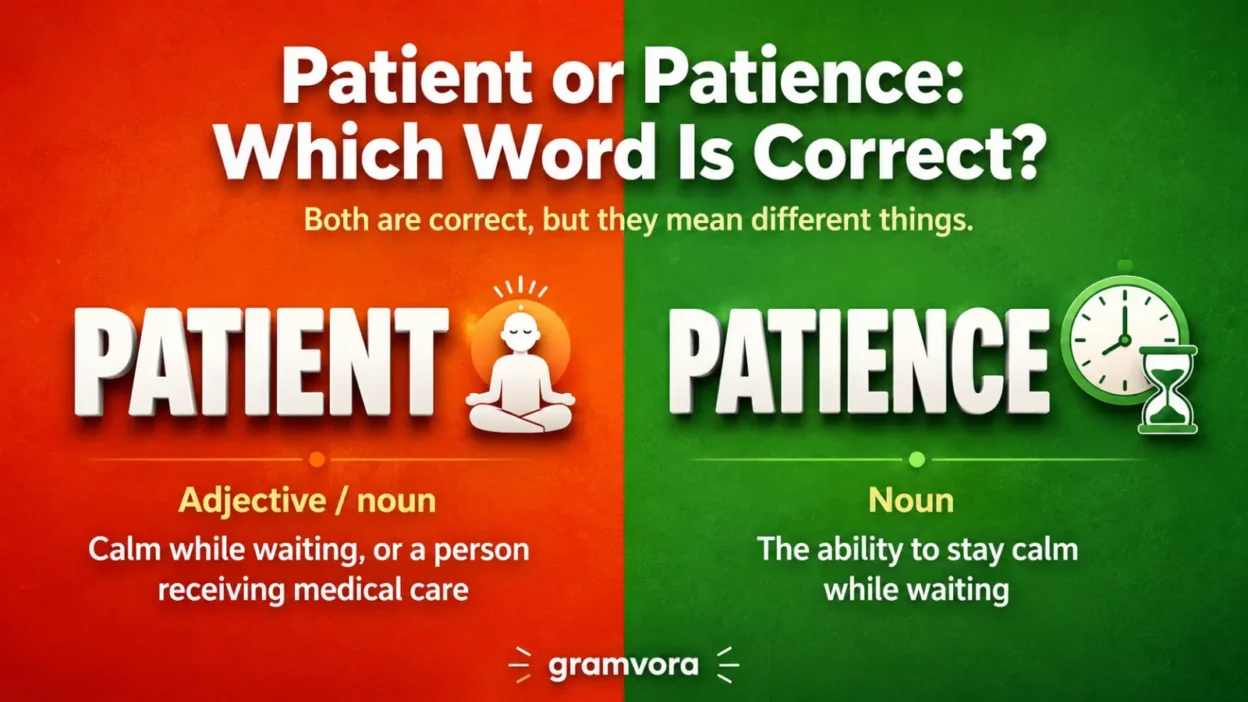
Patient and patience are both correct words, but they are not used the same way.
Use patient when you mean a calm person, a calm behavior, or a person receiving medical care. Use patience when you mean the quality of staying calm while waiting, dealing with trouble, or handling delay.
The easiest test is this: patient often describes someone. Patience names the quality that person has.
Quick Answer
Use patient when you need an adjective or a person.
Correct:
“She was patient while the app loaded.”
“The doctor has three patients waiting.”
Use patience when you need a noun for the quality of staying calm.
Correct:
“Thank you for your patience.”
“This project takes patience.”
Both words are connected in meaning, but they do different jobs in a sentence.
Why People Confuse Them
People confuse patient and patience because they look and sound very close. In everyday speech, the ending can be hard to hear.
They also share a meaning connection. A patient person has patience. That makes the pair easy to mix up in emails, schoolwork, customer messages, and medical writing.
The main difference is grammar. Patient can describe a person or name a person under medical care. Patience names the calm quality itself.
Key Differences At A Glance
| Context | Best Choice | Why |
|---|---|---|
| Describing a calm person | patient | It works as an adjective. |
| Thanking someone for waiting | patience | You thank them for the quality or behavior. |
| Talking about a person getting care | patient | It works as a medical noun. |
| Saying someone needs calm endurance | patience | It names the ability to stay calm. |
| Saying someone should not rush | patient | It describes the person’s behavior. |
| Talking about several people in a clinic | patients | That is the plural of the medical noun patient. |
Meaning and Usage Difference
Patient has two common uses.
First, it can be an adjective. It means calm, steady, and able to wait without getting upset.
Example:
“Please be patient while we update your account.”
Second, it can be a noun. In that use, a patient is a person receiving medical care.
Example:
“The nurse checked on the patient after lunch.”
Patience is a noun. It means the ability to stay calm during delay, stress, trouble, or repeated effort.
Example:
“Learning to drive in city traffic takes patience.”
A useful phrase test is simple:
- Say be patient when describing how someone should act.
- Say have patience when naming the quality someone needs.
- Say your patience when thanking someone for waiting.
The words are close in sound. In normal US speech, both are often heard as “PAY-shunts.” That is why context and spelling matter.
Tone, Context, and Formality
Patient is neutral. It works in casual, professional, and medical contexts.
Casual:
“Be patient. Dinner is almost ready.”
Professional:
“Thanks for being patient while we review your request.”
Medical:
“The patient is scheduled for a follow-up visit.”
Patience is also neutral, but it often sounds a little more polished in formal messages.
Casual:
“I’m running out of patience.”
Professional:
“Thank you for your patience as we resolve this issue.”
Neither word is more American than the other. The choice depends on meaning and sentence structure, not region.
Which One Should You Use?
Use patient when the word describes a person or names a person in care.
Correct:
“You were very patient with the new employee.”
“The patient filled out the intake form.”
Use patience when you mean calm endurance itself.
Correct:
“Your patience means a lot.”
“She showed real patience during the delay.”
Here is the quick choice pattern:
patient
- a patient teacher
- be patient
- a hospital patient
- three patients
patience
- have patience
- show patience
- lose patience
- thank you for your patience
When One Choice Sounds Wrong
Thanks for being patience sounds wrong because patience is a noun. After being, you usually need an adjective in this sentence. The correct version is:
“Thanks for being patient.”
Thanks for your patient also sounds wrong unless patient means a person receiving care, which would not fit most thank-you messages. The correct version is:
“Thanks for your patience.”
I need to be patience is wrong. Use:
“I need to be patient.”
I need more patient is wrong when you mean calm endurance. Use:
“I need more patience.”
Common Mistakes (and Quick Fixes)
Mistake:
“Please have patient with us.”
Fix:
“Please have patience with us.”
Mistake:
“Thank you for being patience.”
Fix:
“Thank you for being patient.”
Mistake:
“She is a patience teacher.”
Fix:
“She is a patient teacher.”
Mistake:
“The patience is waiting in room two.”
Fix:
“The patient is waiting in room two.”
Mistake:
“This job needs patient.”
Fix:
“This job needs patience.”
Everyday Examples
“I’m trying to be patient, but the line hasn’t moved.”
“Thank you for your patience while we reset your password.”
“The patient asked when the test results would be ready.”
“Good coaches need patience.”
“Please be patient with the new checkout process.”
“She showed patience when the meeting ran late.”
“The dentist saw one patient before lunch and two after.”
“I lost my patience after the third canceled appointment.”
Dictionary-Style Word Details
Verb
- patient: Not commonly used as a verb in standard US English. Use be patient, wait, or stay calm instead.
- patience: Not commonly used as a verb in standard US English. Use have patience, show patience, or wait calmly instead.
Noun
- patient: A person receiving medical care or treatment. Example: “The patient asked for a copy of the bill.”
- patience: The quality or ability to stay calm during waiting, stress, pain, or difficulty. Example: “The delay tested everyone’s patience.”
Synonyms
- patient: As an adjective, closest plain alternatives include calm, steady, tolerant, and understanding. As a medical noun, person receiving care is clearer than a true synonym. Antonyms for the adjective include impatient and restless.
- patience: Closest plain alternatives include calmness, self-control, tolerance, and endurance. Antonyms include impatience and restlessness.
Example Sentences
- patient: “The customer was patient while the manager checked the order.”
- patient: “Each patient must bring a photo ID.”
- patience: “The teacher handled the noisy class with patience.”
- patience: “Please have patience while the page loads.”
Word History
- patient: The word has long been tied to the idea of enduring or suffering, which helps explain both common meanings: a calm person who endures delay and a person receiving care.
- patience: The word names the quality of enduring difficulty, delay, or trouble calmly. The history supports the connection between the two words, but modern usage depends on grammar.
Phrases Containing
- patient: be patient, a patient person, patient care, hospital patient, new patient, patient portal
- patience: have patience, show patience, lose patience, test someone’s patience, thank you for your patience, run out of patience
Conclusion
Choose patient when you are describing someone as calm or naming a person receiving medical care.
Choose patience when you mean the quality of staying calm through waiting, stress, or difficulty.