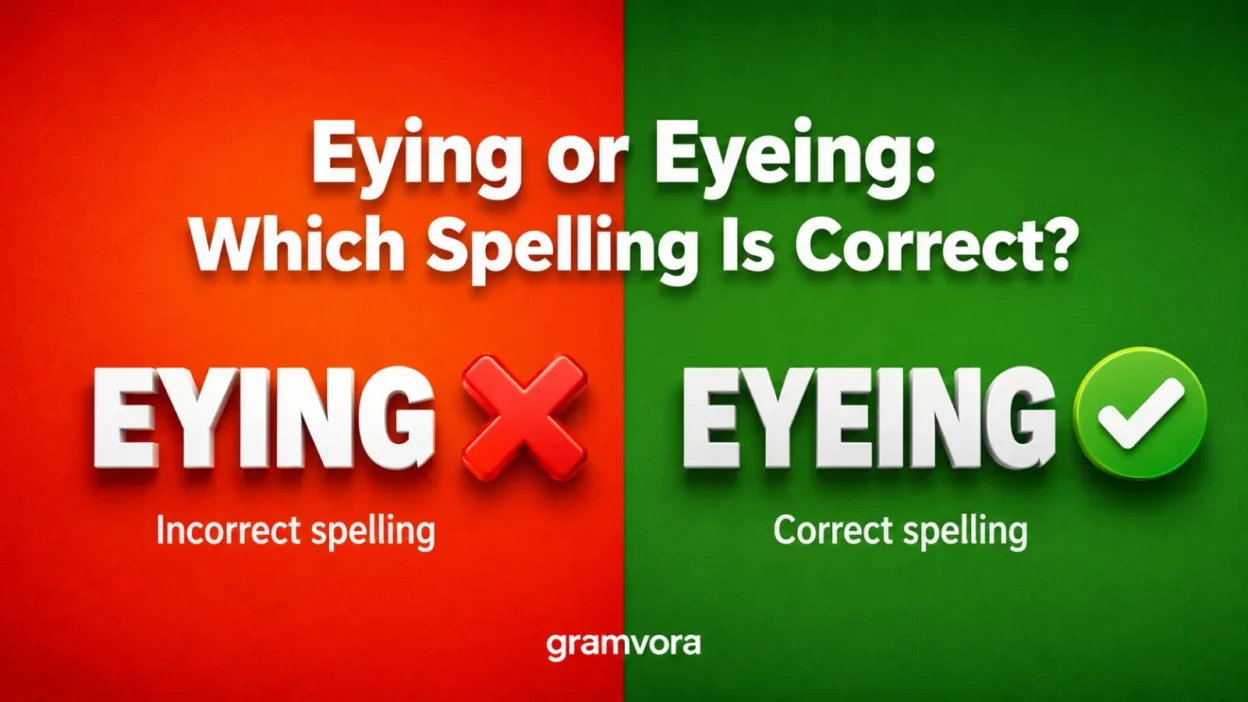
The spelling choice between eying or eyeing can look confusing because both forms appear in real English. The short answer is simple: both spellings are correct, but eyeing is the better choice for most modern US writing.
Use eyeing when you want the spelling that looks more familiar, clearer, and more natural to most readers. Use eying only when you have a reason to follow a specific style, preserve a quoted form, or match a text that already uses it.
The two spellings do not have different meanings. They are spelling variants of the same -ing form of the verb eye, meaning to look at, watch carefully, or consider with interest.
Quick Answer
Eyeing and eying are both accepted spellings.
However, eyeing is the safer everyday spelling in US English. It keeps the base word eye visible, so readers recognize it faster. That matters in school writing, emails, articles, captions, reports, and business copy.
Use this as your simple rule:
Choose eyeing unless a teacher, editor, publication, or style sheet asks for eying.
Examples:
She is eyeing a new apartment downtown.
The dog kept eyeing the sandwich on the table.
The company is eyeing a larger office next year.
You may see eying in edited writing too, but it can surprise readers because it looks less familiar.
Why People Confuse Them
People confuse eying and eyeing because English usually drops a final silent e before adding -ing.
For example:
make → making
write → writing
move → moving
So, many writers expect:
eye → eying
That spelling makes sense by the usual pattern. However, eyeing keeps the full word eye before -ing. This helps readers see the connection to the base word.
Without the extra e, eying can look odd at first glance. Some readers may pause because eying looks less like eye. That does not make it wrong, but it does explain why eyeing often feels more natural.
The confusion comes from spelling style, not from meaning.
Key Differences At A Glance
| Context | Best Choice | Why |
|---|---|---|
| Everyday US writing | eyeing | Most familiar and clear |
| School assignments | eyeing | Safer unless your teacher says otherwise |
| Business emails | eyeing | Looks more polished to most readers |
| News-style writing | eyeing | Common in current edited examples |
| Quoted text using “eying” | eying | Preserve the original spelling |
| A style sheet that prefers “eying” | eying | Follow the assigned house style |
| Explaining both spellings | eying or eyeing | Both are accepted variants |
The clean takeaway: eyeing is the best default, while eying remains an accepted alternative.
Are They the Same Word?
Yes. Eying and eyeing are the same word in different spellings.
Both are forms of the verb eye. In this use, eye means to look at someone or something carefully, with interest, suspicion, desire, or consideration.
Compact comparison:
- eyeing: accepted spelling; preferred default for most modern US writing
- eying: accepted spelling; less familiar to many readers
- meaning: the same
- grammar role: the same
- pronunciation: the same
- best practical choice: eyeing
Pronunciation is simple: both sound like EYE-ing. The spelling changes, but the sound does not.
US vs UK Preference
Do not treat eying vs eyeing as a clean American-versus-British spelling split.
Some spelling pairs have a strong regional pattern, such as color in US English and colour in UK English. This pair is different. Major references accept both forms, and the stronger practical point is not region. The stronger point is reader familiarity.
For a US audience, eyeing is the safer spelling. It looks clearer and more standard in everyday writing.
For UK or international readers, eyeing also works well. You may still see eying, but you should not call it the main UK spelling unless your specific style source says so.
The honest rule is simple: eyeing is the best general choice; eying is acceptable but less expected.
Which Spelling Should You Use?
Use eyeing in almost every normal situation.
Choose eyeing for:
school essays
blog posts
news-style writing
emails
social captions
business reports
product descriptions
professional bios
clear beginner-friendly writing
Use eying only when:
you quote a text that uses it
your editor asks for it
your style sheet prefers it
you need to explain the spelling variant itself
Consistency matters. Do not switch between eyeing and eying in the same article unless you are comparing the spellings. In normal writing, pick one spelling and stay with it.
For most writers, the best answer is: write eyeing.
When One Spelling Looks Wrong
Eying may look wrong because it removes the second e from eye. That makes the word shorter, but also less recognizable.
Still, eying is not automatically an error.
The problem is not correctness. The problem is reader reaction. Many readers know eyeing better, so eying can look like a typo even when it is accepted.
That matters in polished writing. A correct spelling can still distract readers if it looks unusual.
Compare these:
The cat was eyeing the fish bowl.
The cat was eying the fish bowl.
Both sentences mean the same thing. The first one will feel smoother to more readers.
When clarity matters, choose the spelling readers are least likely to question.
Common Mistakes (and Quick Fixes)
Mistake: Treating eying as always wrong.
Fix: Say eying is accepted, but eyeing is the safer default.
Mistake: Claiming the two spellings have different meanings.
Fix: They mean the same thing.
Mistake: Using both spellings randomly.
Fix: Choose one spelling for the full piece.
Mistake: Writing eyeing at someone.
Fix: Use eyeing someone or looking at someone.
Wrong: She was eyeing at the new phone.
Right: She was eyeing the new phone.
Mistake: Thinking the spelling changes pronunciation.
Fix: Both forms sound like EYE-ing.
The best quick fix is easy: when in doubt, write eyeing.
Everyday Examples
Here are natural US-style examples with eyeing:
I am eyeing the black jacket, but I want to wait for a sale.
The kids were eyeing the cupcakes before dinner.
Our team is eyeing a Friday launch.
She kept eyeing the empty seat near the window.
The coach is eyeing two players for the final roster spot.
The company is eyeing a move into Texas.
He was eyeing the clock during the last meeting.
The buyer is eyeing a used SUV with low mileage.
Here are examples with eying:
The cat was eying the bird from the porch.
They were eying a smaller office to cut costs.
She was eying the last slice of pizza.
These are correct too, but eyeing is still the smoother default for most readers.
Dictionary-Style Word Details
Verb
eying: A correct -ing form of the verb eye. It means looking at, watching carefully, or considering something.
eyeing: A correct -ing form of the verb eye. It has the same meaning and is the better default for most modern US writing.
Examples:
She is eyeing a new job.
He is eying the exit.
Both forms work as verbs in progressive tenses.
Noun
eying: Not commonly used as a stand-alone noun in everyday US English. It can function like a gerund when the action itself is being discussed.
eyeing: Can also function like a gerund, meaning the act of looking at or watching carefully. This use is possible, but not common in everyday writing.
Example:
His constant eyeing of the dessert table made everyone laugh.
In most cases, rewrite with a clearer noun such as look, glance, watching, or attention.
Synonyms
eying: Same closest plain alternatives as eyeing.
eyeing: Closest plain alternatives include watching, looking at, observing, studying, checking out, considering, and weighing.
Choose the alternative based on meaning:
For careful attention, use watching.
When you mean a simple visual action, choose looking at.
If someone is thinking about a choice, considering works better.
In casual writing, checking out can fit a relaxed tone.
Useful opposites include ignoring, overlooking, and disregarding. These work when the meaning is “not paying attention to” or “not considering.”
Example Sentences
eying: The customer was eying the display near the register.
eyeing: The customer was eyeing the display near the register.
eying: They are eying a new location for the store.
eyeing: They are eyeing a new location for the store.
eying: The puppy kept eying my breakfast.
eyeing: The puppy kept eyeing my breakfast.
The spelling changes, but the sentence meaning stays the same.
Word History
eying: This spelling follows the common pattern of dropping a final e before adding -ing.
eyeing: This spelling keeps the full base word eye, which makes the word easier to recognize.
Both spellings come from the verb eye, which developed from the noun eye. The spelling variation is best understood as a spelling preference around the -ing form, not a separate word history.
There is no need to invent a deeper rule. English simply allows both forms here.
Phrases Containing
eying: Same word, less common spelling in these phrase patterns.
eyeing: More familiar spelling in these phrase patterns.
Common patterns:
eyeing a purchase
She is thinking about buying something before the holiday sale.
eyeing a move
They are considering a move to a larger home.
eyeing someone suspiciously
The guard watched him with suspicion.
eyeing an opportunity
The startup is considering an opportunity in the local market.
eyeing up
This informal phrase can mean looking at someone or something with interest. Use it carefully because tone depends on context.
FAQs
Is eyeing or eying correct?
Both eyeing and eying are correct spellings. They are two accepted forms of the same word. However, eyeing is the better choice for most modern US writing because it looks clearer and more familiar. It also keeps the base word eye visible, which helps readers understand the word quickly.
Which spelling should I use in American English?
Use eyeing in American English. While eying is not wrong, eyeing is the safer and more natural spelling for schoolwork, emails, articles, captions, and professional writing. If you want your sentence to look polished and easy to read, choose eyeing.
Does eying mean something different from eyeing?
No. Eying and eyeing have the same meaning. Both mean looking at someone or something carefully, with interest, suspicion, desire, or consideration. For example, “She is eyeing a new phone” and “She is eying a new phone” mean the same thing.
Why does eyeing keep the letter e?
Eyeing keeps the e because it helps readers recognize the word eye. Many English words drop a final e before -ing, but this word often keeps it for clarity. Without the extra e, eying can look unusual, even though it is accepted.
Is eying a typo?
No, eying is not a typo. It is an accepted spelling variant. However, some readers may think it looks strange because eyeing is more familiar. That is why eyeing is usually the better choice in clear, everyday writing.
Conclusion
Eying and eyeing are both correct spellings of the same word. They have the same meaning, the same pronunciation, and the same basic grammar role.
The best choice for most US writing is eyeing. It looks clearer, keeps the word eye visible, and feels more familiar to most readers.
Use eying only when you have a reason, such as a style requirement, a quote, or a direct spelling comparison.