The choice between sung or sang depends on grammar, not meaning. Both words come from the verb sing, but they do different jobs in a sentence.
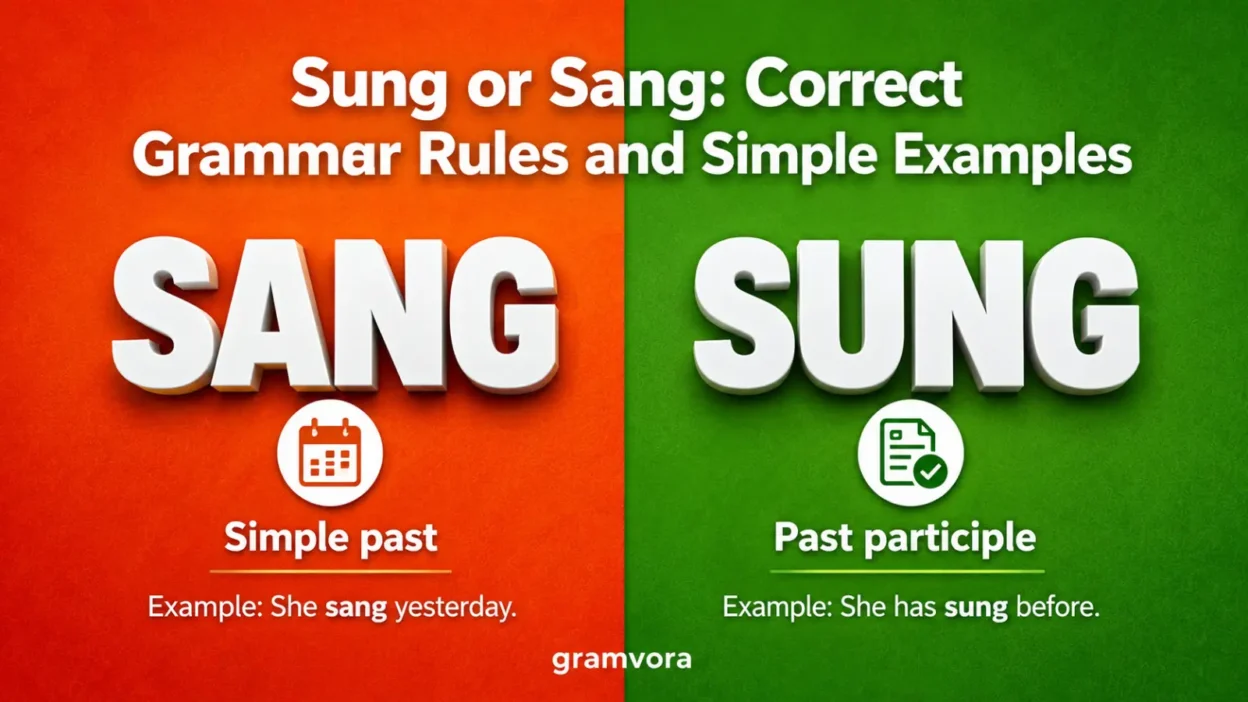
Use sang when you mean the simple past: “She sang at the concert.” Use sung when you need the past participle: “She has sung at that venue before.” The key difference is sentence structure. Sang can stand alone as a past-tense verb. Sung usually needs a helping verb.
Quick Answer
Use sang for the simple past tense. Use sung with a helping verb such as have, has, had, is, was, or were. The standard choice is “I sang the song,” not “I sung the song.” Write “I have sung that song before,” not “I have sang that song before.”
What Is Correct?
Both sang and sung are correct, but they are correct in different grammar patterns.
Sang is the normal simple past form of sing. It tells readers that the singing happened in the past.
Example: “Maya sang during the school assembly.”
Sung is the past participle. It appears in perfect tenses and passive structures.
Example: “Maya has sung at three school events.”
So the question is not whether one word exists. The real question is what kind of verb form your sentence needs.
The Core Grammar Rule
The verb sing is irregular. It does not become “singed” when you talk about singing in the past. Its main forms are sing, sang, and sung.
| Form or Pattern | Best Use | Why |
|---|---|---|
| sing | Present or base form | Used for now, habits, or after words like can and will |
| sang | Simple past | Stands alone for a completed past action |
| sung | Past participle | Used with helping verbs or passive structure |
The fastest rule is this: sang usually stands alone, while sung usually works with another verb.
When Each Form Is Correct
Use sang when the sentence talks about a completed action in the past and does not use a helping verb.
Correct: “We sang in the car on the way home.”
Correct: “He sang the last verse perfectly.”
Correct: “The crowd sang along with the band.”
Use sung after have, has, or had.
Correct: “We have sung that song many times.”
Correct: “She has sung with the choir since middle school.”
Correct: “They had sung together before the show started.”
Use sung in passive voice when the subject receives the action.
Correct: “The song was sung by the whole class.”
When It Is Incorrect or Less Natural
In standard US English, sung is not the best simple past form when it stands alone.
Less standard: “She sung the anthem.”
Standard: “She sang the anthem.”
The sentence needs a simple past verb, so sang is the expected form.
The reverse mistake also happens with perfect tenses.
Incorrect in standard writing: “She has sang at that venue.”
Correct: “She has sung at that venue.”
After has, the sentence needs a past participle, so sung is correct. The same rule applies after have and had.
Meaning, Structure, or Emphasis Differences
Sang and sung do not usually change the basic meaning. Both connect to the action of singing. The difference is grammar structure.
Sang presents the action as a finished event in the past.
Example: “I sang at the wedding.”
Sung connects the action to another verb pattern.
Example: “I have sung at weddings before.”
The first sentence focuses on one past event. The second connects past experience to the present. In passive voice, sung shifts the focus from the singer to the song.
Example: “The song was sung beautifully.”
Here, the sentence focuses on the song, not mainly on who sang it.
Real-World Examples
“I sang in the shower before work.”
“She sang the opening line, and everyone joined in.”
“Our team sang after the game.”
“I have sung that song so many times that I know every word.”
“He has sung with that band for years.”
“The choir had sung two songs before the ceremony began.”
“The national anthem was sung before kickoff.”
“That part should be sung softly.”
Each sentence works because the verb form matches the structure. Simple past uses sang. Perfect tense and passive voice use sung.
Common Mistakes (And Quick Fixes)
The most common mistake is using sung alone as if it were the simple past. You may hear this in casual speech, lyrics, or regional usage, but standard writing usually expects sang.
A second mistake is using sang after have, has, or had. Those helping verbs need the past participle sung.
Quick fixes:
• “I sung” → “I sang”
• “She sung” → “She sang”
• “We have sang” → “We have sung”
• “He had sang” → “He had sung”
• “The song was sang” → “The song was sung”
Grammar Rule Details
Rule
Use sang as the simple past tense of sing. Use sung as the past participle. The past participle appears with helping verbs such as have, has, and had, and it also appears in passive structures with forms of be.
Correct Usage
Correct simple past: “I sang at the party.”
Correct present perfect: “I have sung at parties before.”
Correct past perfect: “I had sung that song before I joined the choir.”
Correct passive voice: “The song was sung at the end of the ceremony.”
Incorrect or Less Natural Usage
“I sung at the party” is not the standard form for careful writing.
“I have sang at parties before” is also not standard, because have needs the past participle sung.
“The song was sang” sounds wrong in standard English because passive voice also needs sung.
Examples
“Jordan sang during the talent show.”
“Jordan has sung in three talent shows.”
“The closing song was sung by the seniors.”
“They had sung the chorus before the microphone stopped working.”
“My sister sang while she cleaned the kitchen.”
Common Mistakes
Writers often choose by sound instead of structure. Since sang and sung look similar, the mistake feels easy to make.
The better method is to check the word before the verb. If you see have, has, had, is, was, were, or be, you probably need sung. If the verb stands alone in the past, you probably need sang.
Exceptions
There is no major exception that changes the standard rule for everyday US writing. You may see sung used as a simple past form in older writing, song lyrics, dialect, or very informal speech. For school, business, articles, and edited writing, use sang for the simple past and sung for the past participle.
Quick Test
Ask this: “Is there a helping verb before it?” If yes, choose sung. If no, and the action happened in the past, choose sang.
“I ___ yesterday” becomes “I sang yesterday.”
“I have ___ before” becomes “I have sung before.”
Usage Notes
The word sung can sound correct to some readers because it appears in common phrases like “was sung” and “has sung.” That does not make it the best form in “I sung.” In standard US English, “I sang” is the safer and more polished choice.
FAQ
Is it “I sang” or “I sung”?
Use “I sang” in standard English. The sentence uses simple past tense, so sang is correct. “I sung” appears in casual speech, but it is not the best choice for formal or edited writing.
Is it “have sang” or “have sung”?
Use “have sung.” After have, has, or had, you need the past participle. The past participle of sing is sung, so write “I have sung,” “she has sung,” and “they had sung.”
Can sung be used by itself?
In standard modern writing, sung should not usually stand alone as the simple past. Write “She sang beautifully,” not “She sung beautifully.” Use sung with a helping verb, as in “She has sung beautifully before.”
Why is it “was sung” and not “was sang”?
“Was sung” is correct because passive voice uses the past participle. In “The song was sung,” the subject receives the action. Since sung is the past participle, it fits the passive structure.
What are the three main forms of sing?
The three main forms are sing, sang, and sung. Use sing for the base or present form, sang for simple past, and sung for the past participle.
Conclusion
The difference between sung and sang is simple once you check the sentence structure. Use sang for simple past actions: “She sang yesterday.” Use sung with helping verbs or passive voice: “She has sung before” and “The song was sung.”
For standard US English, remember this pattern: sing, sang, sung. If the verb stands alone in the past, choose sang. If it follows a helper, choose sung.