
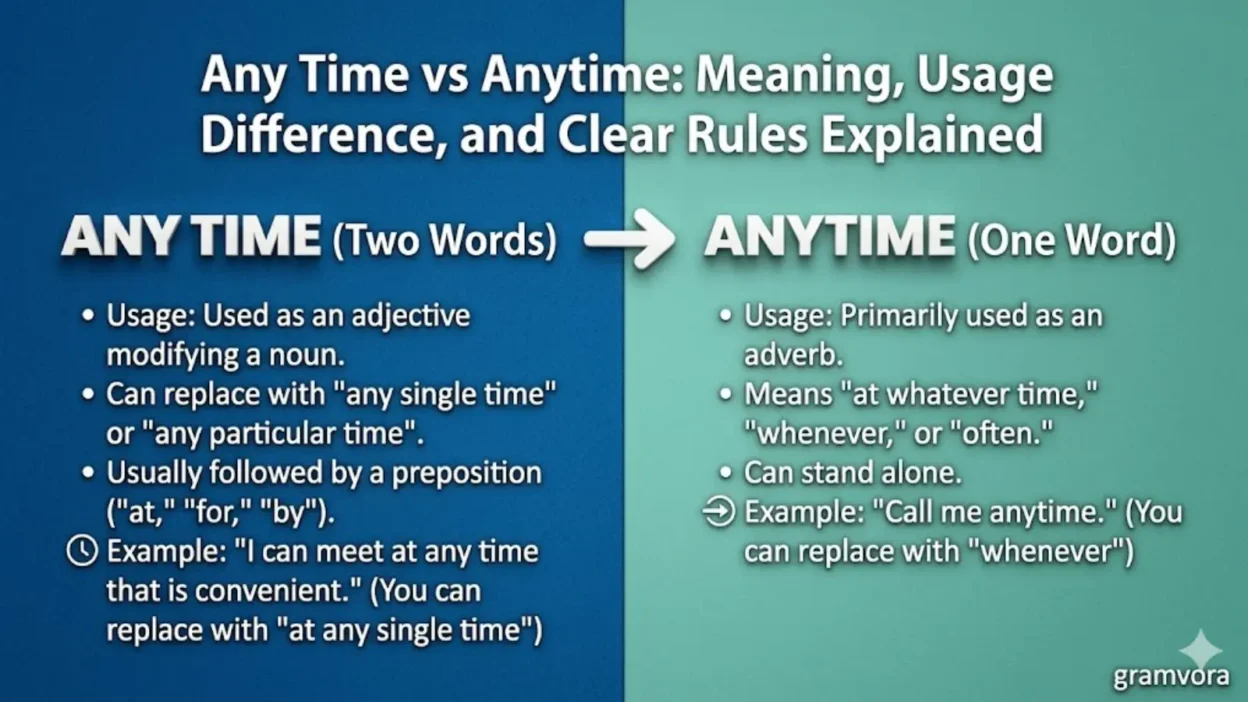
The difference between “any time” and “anytime” looks small, but it often causes confusion in writing. Many people use them interchangeably, especially in texting and casual speech. However, in standard English, they are not always used the same way.
Understanding when to separate the words and when to combine them helps your writing sound more natural, correct, and clear. This guide explains the difference in simple terms with real examples you can actually use.
Quick Answer
“Any time” is a two-word phrase used when referring to time in a more literal or structured way.
“Anytime” is a single word that usually works as an adverb meaning “whenever” in casual or conversational English.
Why People Confuse Them
The confusion happens for a few simple reasons.
First, both forms sound exactly the same when spoken. There is no pause or stress difference, so it is easy to miss the spelling distinction.
Second, modern texting and online writing often prefer shorter forms. Because of that, “anytime” appears very frequently in casual communication, which makes it feel like the default.
Third, both versions are grammatically accepted in different contexts, so people assume they are fully interchangeable. They are close in meaning, but their structure and usage are not identical in all situations.
Key Differences At A Glance
| Feature | any time | anytime |
|---|---|---|
| Structure | two words | one word |
| Role | noun phrase | adverb |
| Meaning focus | literal time reference | “whenever” meaning |
| Style | more formal | more casual |
Meaning and Usage Difference
The core difference comes down to how each form functions in a sentence.
“Any time” is used when you are talking about time as a measurable or identifiable concept. It often answers questions like “when?” in a direct way.
Example:
- Do you have any time this afternoon to review this?
Here, “any time” refers to actual availability of time.
On the other hand, “anytime” is used when you mean “whenever” or “at any point.”
Example:
- You can message me anytime.
Here, it does not refer to a specific amount of time. It simply means the action is allowed at any moment.
A simple way to understand it:
- If you can replace it with “some time,” “any time” often fits better.
- If you can replace it with “whenever,” “anytime” usually works.
Tone, Context, and Formality
Tone plays a big role in choosing between these two forms.
“Any time” tends to appear more in structured or formal writing. You will often see it in school writing, work communication, and clear informational sentences where precision matters.
- Emails
- Reports
- Instructions
- Formal requests
Example:
- If you need help, contact us any time during office hours.
“Anytime,” however, feels more relaxed and conversational. It is very common in texting, social media, and everyday speech.
Example contexts:
- Text messages
- Friendly conversations
- Casual writing
Example:
- Call me anytime you’re free.
Quick Comparison Table
Context | Best Choice | Why
Work email | any time | clearer and more formal tone
Text to friend | anytime | natural and casual
Customer support note | any time | structured clarity
Social post | anytime | conversational flow
Which One Should You Use?
Choosing between them becomes easy once you understand the situation.
Use “any time” when:
- You are referring to actual time availability
- The sentence feels formal or structured
- You want clarity in professional writing
Use “anytime” when:
- You mean “whenever”
- The tone is casual
- You are speaking or texting naturally
A helpful habit is to quickly test the sentence:
- If “at any point in time” fits → use any time
- If “whenever” fits → use anytime
This simple check avoids most mistakes.
When One Choice Sounds Wrong
Sometimes using the wrong form can make a sentence feel slightly off.
Example:
- Please visit us anytime during business hours.
This can sound too casual in formal customer instructions. A more appropriate version would be:
- Please visit us any time during business hours.
On the other hand, in casual speech, “any time” can sound overly stiff.
Example:
- Text me any time you want. (correct but formal tone)
- Text me anytime you want. (more natural in casual use)
The difference is not about correctness alone—it is also about tone.
Common Mistakes (and Quick Fixes)
Mistake 1: Mixing tone
- Wrong: Please call me anytime during office procedures
- Better: Please call me any time during office procedures
Mistake 2: Overusing “anytime” in formal writing
- Wrong: You may submit the form anytime before the deadline
- Better: You may submit the form any time before the deadline
Mistake 3: Treating both forms as always identical
- Wrong assumption: They are always interchangeable
- Reality: They depend on sentence structure and tone
Mistake 4: Using “any time” in very casual messaging
- It’s not wrong, but it can sound overly formal in friendly chat
Everyday Examples
Here are simple, real-world sentences showing both forms in action.
- You can arrive any time after 5 PM.
- You can call me anytime you need help.
- I don’t have any time to finish this task today.
- We can meet anytime this weekend.
- If you have any time, please review this document.
- You’re welcome to stop by anytime.
- Do you have any time before the meeting?
- Let’s hang out anytime next week.
These examples show how context naturally changes the choice.
Dictionary-Style Word Details
Verb
- any time: Not used as a verb in standard English.
- anytime: Not used as a verb.
Noun
- any time: Works as a noun phrase referring to time availability or duration.
- anytime: Not used as a noun in standard grammar.
Synonyms
- any time: at any moment, at any point, whenever (context-based)
- anytime: whenever, freely, at any point (closest plain alternatives)
Antonyms are not direct, but context opposites may include:
- specific time, scheduled time, fixed time
Example Sentences
- any time: You can take a break any time you feel tired.
- anytime: You can take a break anytime you feel tired.
- any time: Do you have any time to help me move this weekend?
- anytime: Call me anytime you arrive safely.
Word History
The two-word form “any time” has been used in English for a long time as a clear time-related phrase. Over time, especially in informal writing, the single-word form “anytime” became widely accepted in conversational use.
The shift reflects a general pattern in English where frequently used phrases often become single words in casual communication. However, both forms continue to exist side by side depending on context.
Phrases Containing
- at any time
- any time soon
- any time of day
- anytime you want
- anytime soon
- any time at all
FAQs
Is “anytime” one word or two words?
Both are correct, but they are used differently. “Anytime” is one word, while “any time” is two words used in more formal or structural sentences.
When should I use “any time”?
Use “any time” when you mean “at any point in time” or when it acts like a noun phrase. It’s common in formal writing and clear time references.
Example:
- Do you have any time to meet today?
When is “anytime” correct?
“Anytime” is correct when you mean “whenever” in casual or conversational English.
Example:
- You can call me anytime.
Can I always use “anytime” instead of “any time”?
No. In informal writing, “anytime” often works, but in formal or precise sentences, “any time” is preferred. They are not always interchangeable.
Is “at anytime” correct?
It is usually better to write “at any time.” The two-word form is more standard in formal English.
Is “anytime soon” correct?
Yes, “anytime soon” is commonly used in casual English.
Example:
- I’m not moving anytime soon.
Which one is more formal?
“Any time” is more formal. “Anytime” is more relaxed and conversational.
Do native speakers use both forms?
Yes. Native speakers use both depending on context, tone, and formality.
What is the easiest rule to remember?
If you mean “whenever,” use anytime. If you mean “at any point in time,” use any time.
Are “anytime” and “any time” pronounced differently?
No, they are pronounced the same. The difference is only in writing, not in speech.
Conclusion
The difference between “any time” and “anytime” is small but important. “Any time” is more structured and often used in formal or literal time references. “Anytime” is more casual and works well when you mean “whenever.”
Choosing the right form depends on tone, context, and clarity. Once you understand this simple distinction, your writing becomes more natural and confident in both formal and informal situations.
[…] loose rule sounds relaxed.To lose a rule would mean the rule is removed, forgotten, or no longer […]