
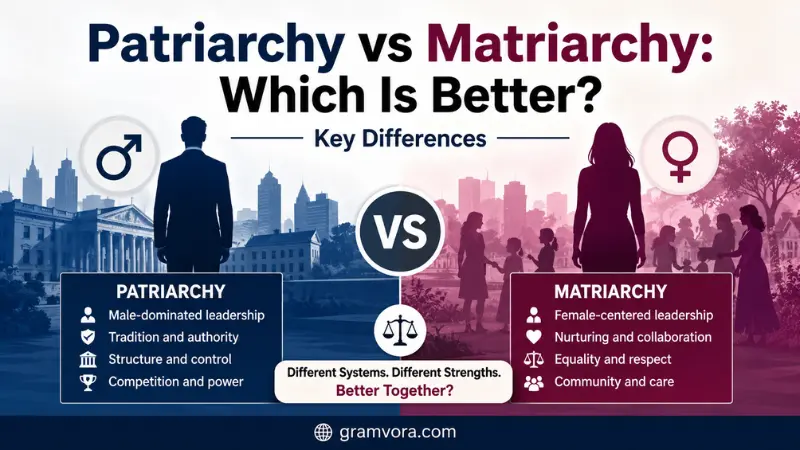
Patriarchy and matriarchy are both correct English words, but they describe different ways authority may be organized around gender.
The bigger question in patriarchy vs matriarchy which is better has no simple winner. If the question is about which social arrangement is preferable, neither gender-dominant model is automatically better simply because men or women hold the dominant position.
For word choice, however, the distinction is clear: use patriarchy for a social structure centered on male authority and matriarchy for one centered on female authority.
Quick Answer
Patriarchy means a social organization in which men or male authority hold a dominant share of power.
Matriarchy means a social organization in which women or female authority hold a dominant or leading position.
So:
- Patriarchy → male-centered authority
- Matriarchy → female-centered authority
If you are asking which is better as a model for society, neither word itself represents a value judgment. A system should be judged by how fairly authority, rights, responsibilities, and opportunities are distributed rather than simply by whether men or women hold more power.
Why People Confuse Them
The two words look like direct opposites.
The first is associated with fathers or men, while the second is associated with mothers or women. That makes it tempting to treat them as exact mirror images.
But social structures are more complicated than the gender of one person in charge.
For example, a family may have a grandmother who makes most household decisions. That does not necessarily mean the larger society is a matriarchy.
Likewise, a man serving as the head of a company does not automatically make the entire company a patriarchy.
The important question is how authority is organized across the relevant family, institution, or society.
Key Differences At A Glance
| Context | Best Choice | Why |
|---|---|---|
| Male-centered social authority | Patriarchy | The term identifies a system in which male authority is dominant. |
| Female-centered social authority | Matriarchy | The term identifies a system in which female authority is dominant or central. |
| Male leader of one group | Usually neither | One man’s leadership does not automatically establish a patriarchal structure. |
| Female leader of one group | Usually neither | One woman’s leadership does not automatically establish a matriarchal structure. |
| Descent through the mother’s side | Not necessarily matriarchy | Female-line descent is a kinship pattern, not automatically female rule. |
| Descent through the father’s side | Not necessarily patriarchy | Male-line descent alone does not describe every aspect of authority. |
Meaning and Usage Difference
Patriarchy is a noun used for a social organization or institution in which fathers, men, or male authority have a dominant share of power. Merriam-Webster also gives a broader sense involving men holding a disproportionately large share of power.
Matriarchy is a noun used for a family, group, or state governed by a matriarch, or for a social system in which descent and inheritance are traced through the female line.
That second definition is important because matriarchy can involve more than one idea depending on context. A discussion of family inheritance may focus on female-line descent, while a discussion of social authority may focus on women exercising power.
Do not automatically equate matrilineal with matriarchal. A matrilineal system traces descent or inheritance through the mother’s side, but that does not necessarily mean women hold the main political or family authority.
The same basic caution applies to patrilineal and patriarchal. They are related concepts, but they are not interchangeable.
Tone, Context, and Formality
Both patriarchy and matriarchy are standard nouns and can appear in formal American English.
You may encounter them in discussions of:
- sociology
- anthropology
- history
- family structures
- politics
- culture
- literature
- gender and social organization
Patriarchy often appears in critical discussions of unequal gender power. That common context can give the word a negative tone, but the noun itself primarily identifies a social structure.
Matriarchy can sound more specialized because the term is used in different ways and because scholars do not always apply it to the same types of societies.
The related adjectives are patriarchal and matriarchal.
For example:
- “The author examines patriarchal family structures.”
- “The documentary explores a matriarchal community.”
Which One Should You Use?
Use patriarchy when the subject is a structure in which male authority is dominant.
The book examines how patriarchy shaped family decision-making.
Use matriarchy when the subject is a structure in which female authority is dominant or central.
The novel imagines a matriarchy led by senior women.
But if you only mean that one man or woman is a leader, be more specific.
The company has a female CEO.
That sentence does not need matriarchy.
Similarly:
The grandfather makes most of the household decisions.
That does not automatically mean the family belongs to a patriarchy.
A useful comparison
- Patriarchy: describes a broader male-centered structure.
- Matriarchy: describes a broader female-centered structure.
- Individual leadership: may describe neither.
When the evidence is limited, choose the narrower description rather than making a larger claim.
When One Choice Sounds Wrong
Matriarchy can sound wrong when a writer uses it only because women are prominent in a group.
For example:
Incorrect or misleading: “The company is a matriarchy because its CEO is a woman.”
A female CEO alone does not establish a female-centered social system.
Likewise:
Incorrect or misleading: “The school is a patriarchy because the principal is a man.”
A single male leader does not automatically establish patriarchy.
Another common problem is confusing inheritance with authority.
A community can trace descent through women without women holding all major decision-making power. Calling every such society a matriarchy can therefore be inaccurate.
Common Mistakes (and Quick Fixes)
Mistake 1: Treating the words as simple gender labels
A man-led group is not automatically a patriarchy, and a woman-led group is not automatically a matriarchy.
Fix: Look at the broader structure of authority.
Mistake 2: Using matriarchy to mean matrilineal
These terms are related but not identical.
Fix: Use matrilineal when the specific issue is descent or inheritance through the mother’s line.
Mistake 3: Assuming one system must be better
The words describe social arrangements. They do not, by themselves, prove that one arrangement produces better outcomes.
Fix: Judge the actual distribution of authority and opportunities rather than the label.
Mistake 4: Using patriarchal and patriarchy interchangeably
They are related but have different grammatical roles.
Fix: Use patriarchy as the noun and patriarchal as the adjective.
Everyday Examples
Here are natural examples showing the difference:
Patriarchy
- “The history course examines patriarchy and its effect on family roles.”
- “The writer argues that the institution retained patriarchal traditions.”
- “The novel portrays a family organized around a strict patriarchal hierarchy.”
Matriarchy
- “The science-fiction story imagines a future matriarchy.”
- “The documentary explores a community described as matriarchal.”
- “The fictional kingdom operates as a matriarchy led by senior women.”
Notice that the words describe an overall structure rather than simply identifying the gender of one individual.
Dictionary-Style Word Details
Verb
- Patriarchy: Not commonly used as a verb in standard US English.
- Matriarchy: Not commonly used as a verb in standard US English.
Both are primarily nouns.
Their related adjectives are patriarchal and matriarchal.
Noun
- Patriarchy: A social organization, institution, or society characterized by dominant male authority.
- Matriarchy: A family, group, state, or social organization characterized by female authority or, in some definitions, female-line descent and inheritance.
Both can refer to social organization, but the exact application depends on context.
Synonyms
Exact synonyms are limited because both words describe specific social arrangements.
- Patriarchy: Closest plain alternatives include male-dominated social system and male-centered power structure, depending on context.
- Matriarchy: Closest plain alternatives include female-dominated social system and female-centered power structure, when those descriptions accurately match the situation.
These alternatives are descriptive rather than perfect replacements in every sentence.
Example Sentences
Patriarchy:
- “The article discusses how patriarchy can shape expectations about family leadership.”
- “The researcher studied patriarchal patterns in the institution.”
Matriarchy:
- “The fictional society is organized as a matriarchy.”
- “The story presents a matriarchal community in which senior women hold major authority.”
Word History
Patriarchy has been recorded in English since at least 1632, according to Merriam-Webster.
Matriarchy has been recorded since at least 1885, according to Merriam-Webster.
The words are built around ideas associated with fathers or mothers and rule, but their modern meanings concern social organization and authority rather than simply the identity of a parent.
Phrases Containing
Common expressions include:
- patriarchal society
- patriarchal system
- patriarchal structure
- patriarchal culture
- matriarchal society
- matriarchal system
- matriarchal structure
- matriarchal culture
The adjective forms are especially useful when the word describes a noun directly.
FAQs
1. What is the main difference between patriarchy and matriarchy?
Patriarchy describes a social system in which men or male authority hold dominant power. Matriarchy describes a social system in which women or female authority hold dominant or central power.
2. Which is better, patriarchy or matriarchy?
Neither is automatically better simply because one gender holds more authority. A better system is generally one that provides fair opportunities, rights, and participation rather than concentrating power based solely on gender.
3. Is matriarchy the opposite of patriarchy?
In a basic sense, the terms describe contrasting forms of gender-centered authority. However, they should not always be treated as perfect mirror images because real societies can have complex systems of power, family organization, and inheritance.
4. Is patriarchy the same as male dominance?
They are closely related, but patriarchy refers to a broader social or institutional structure in which male authority is dominant. One man’s leadership does not automatically mean a group or society is patriarchal.
5. Is matriarchy the same as female dominance?
Not necessarily. Matriarchy generally refers to a broader social structure centered on female authority. Having a woman as a leader does not by itself make an organization or society a matriarchy.
6. Is matriarchal the same as matrilineal?
No. Matrilineal refers to tracing descent or inheritance through the mother’s side. Matriarchal refers to female-centered authority or organization. A matrilineal society is not automatically matriarchal.
7. Is patriarchal the same as patriarchy?
They are related but have different grammatical functions. Patriarchy is a noun, while patriarchal is an adjective.
- The patriarchy influenced the institution.
- The institution had a patriarchal structure.
8. Can a family be patriarchal or matriarchal?
Yes. These words can describe family structures when authority is consistently organized around male or female leadership. However, one family member making most decisions does not necessarily establish a broader patriarchal or matriarchal system.
9. Is a woman-led family automatically a matriarchy?
No. A woman can be the head of a household without the family representing a matriarchal social system. Matriarchy describes a broader pattern of female-centered authority.
10. Is a man-led family automatically patriarchal?
No. Having a male head of household does not by itself prove that the family operates according to a patriarchal system. The broader distribution of authority matters.
Conclusion
In patriarchy vs matriarchy which is better, neither term is automatically the better choice. They describe different arrangements of social authority.
Use patriarchy for a system in which male authority is dominant. Use matriarchy for a system in which female authority is dominant or central.
The most important distinction is between individual leadership and a broader social structure. One powerful man does not automatically create a patriarchy, and one powerful woman does not automatically create a matriarchy.
Also remember that matrilineal and matriarchal are not interchangeable. Descent through the mother’s side does not necessarily mean women control the society.
If the question is which type of social organization is preferable, the gender of the dominant group alone is not a sufficient measure. The more useful standard is whether authority and opportunities are distributed fairly rather than simply transferred from one gender to another.


