
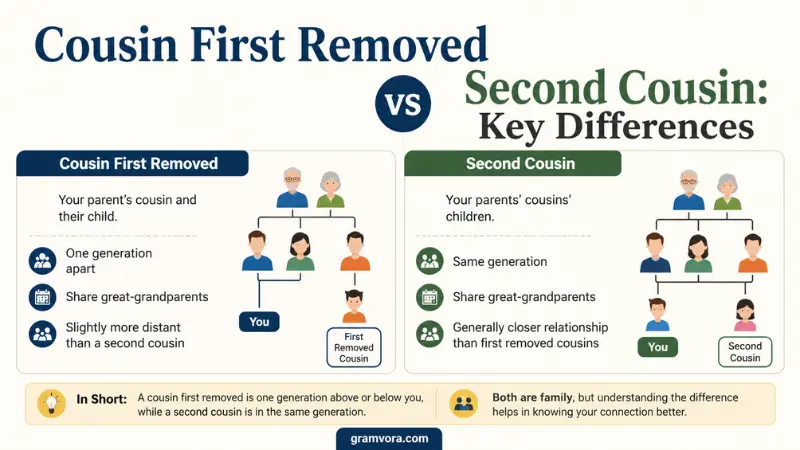
If you are comparing cousin first removed vs second cousin, the main issue is that the first phrase is not the standard way to name the relationship.
In standard US genealogy usage, the established expression is first cousin once removed. A second cousin is a different relationship.
The difference comes down to two things: the cousin level and the generation gap.
Quick Answer
Second cousin is correct when two people are in the same generation and share great-grandparents.
Cousin first removed is not the standard form. If you mean a cousin relationship separated by one generation, the standard expression is first cousin once removed.
For example, your first cousin’s child is your first cousin once removed. That child is not your second cousin.
Your child and your first cousin’s child, however, are second cousins.
Why People Confuse Them
The confusion comes from the word removed.
It is easy to assume that moving from a first cousin to the next generation automatically creates a second cousin. But that is not how the terminology works.
The word first identifies the cousin level. The words once removed identify a one-generation difference.
A second cousin has no generation difference between the two people. Both people are descendants of the same great-grandparents and occupy the same generation in the usual relationship pattern.
Key Differences At A Glance
| Context | Best Choice | Why |
|---|---|---|
| Your first cousin’s child | First cousin once removed | The child is one generation below you |
| Your parent’s first cousin | First cousin once removed | That person is one generation above you |
| Your parent’s first cousin’s child | Second cousin | You and that person are in the same generation |
| Two people who share great-grandparents | Second cousin | They are normally in the same generation |
| “Cousin first removed” as a standard label | Avoid it | It is not the usual standard form |
A simple way to remember the distinction is:
Cousin number = family-line distance.
Removed = generation difference.
Feature Comparison
| Feature | Cousin first removed | Second cousin |
| Standard US form | Not standard | Standard |
| Standard related expression | First cousin once removed | Second cousin |
| Generation relationship | One generation apart | Usually same generation |
| Typical example | Your first cousin’s child | Your parent’s first cousin’s child |
| Main clue | “Once removed” | “Second cousin” |
Meaning and Usage Difference
Cousin first removed is understandable, but it is not the normal standard expression used to describe this relationship. In careful family-tree writing, first cousin once removed is the clearer choice.
A first cousin once removed can be one generation above or below you.
For example, your mother’s first cousin is your first cousin once removed. Your first cousin’s daughter is also your first cousin once removed.
A second cousin is different. You and your second cousin normally share a set of great-grandparents.
For example, suppose your grandfather and another person’s grandfather were brothers. Their children are first cousins, and you and the other person’s child are second cousins.
The key point is that second does not mean “one generation removed.” It identifies a different cousin level.
Tone, Context, and Formality
Neither relationship is especially formal or informal. The terminology is mainly used when people need to describe a family connection accurately.
In everyday conversation, people may simply say cousin, especially when the exact relationship does not matter.
More precise wording becomes useful when building a family tree, discussing genealogy, describing relatives, or explaining a family connection.
In those situations, first cousin once removed and second cousin are much clearer than an informal phrase such as cousin first removed.
Which One Should You Use?
Use second cousin when the two people are at the same generation level and share great-grandparents.
Use first cousin once removed when the relationship is based on first cousins but the two people are one generation apart.
Do not use cousin first removed as your preferred standard wording in US English.
A useful example is:
My cousin’s son is my first cousin once removed.
But:
My cousin’s son is my second cousin.
That second sentence is incorrect when you are describing your relationship to your cousin’s son.
When One Choice Sounds Wrong
Cousin first removed sounds unusual because the normal construction places the cousin level first and then gives the removal: first cousin once removed.
Another common mistake is calling a first cousin’s child a second cousin.
The relationship changes only when you compare the child with another person in the next generation.
So:
- You → your first cousin’s child: first cousin once removed.
- Your child → your first cousin’s child: second cousins.
This distinction keeps the family-tree labels consistent.
Common Mistakes (and Quick Fixes)
Mistake: My first cousin’s daughter is my second cousin.
Fix: She is your first cousin once removed.
Mistake: “Cousin first removed” is the standard term.
Fix: Use first cousin once removed in standard US English.
Mistake: “Once removed” means the relationship is a second cousin.
Fix: “Once removed” means the two people are separated by one generation.
Mistake: Second cousins are always one generation apart.
Fix: Second cousins normally occupy the same generation and share great-grandparents.
Everyday Examples
Example 1: Your cousin’s child
Your first cousin has a son named Ryan. Ryan is one generation below you.
Ryan is your first cousin once removed.
Example 2: Your parent’s cousin
Your mother has a first cousin named Lisa. Lisa is in your mother’s generation.
Lisa is your first cousin once removed.
Example 3: Your second cousin
Your great-grandparents had two children. One child was your grandparent, and the other was the grandparent of another person.
You and that person are second cousins.
Example 4: The next generation
Your first cousin has a daughter, and you also have a daughter.
Your daughters are second cousins to each other.
This is why the same family branch can contain both a first cousin once removed relationship and a second cousin relationship.
Dictionary-Style Word Details
Verb
- Cousin first removed: Not used as a standard verb. “Cousin” is a noun, while “removed” describes a relationship by generation.
- Second cousin: Not used as a verb. It is a noun phrase naming a family relationship.
Noun
- Cousin first removed: This is not the standard noun phrase for the relationship. The standard expression is first cousin once removed.
- Second cousin: A noun phrase for a cousin who shares great-grandparents with you in the usual same-generation relationship.
Synonyms
- Cousin first removed: There is no exact standard synonym for the phrase as written. The closest standard expression is first cousin once removed.
- Second cousin: There is no exact everyday synonym that preserves the same precise relationship.
Antonyms: Neither term has a direct antonym. These are relationship labels rather than opposing concepts.
Example Sentences
- Cousin first removed: “Cousin first removed” is not the wording I would use in a family tree.
- Standard relationship: “My first cousin’s daughter is my first cousin once removed.”
- Second cousin: “My second cousin and I share great-grandparents.”
- Second cousin: “Her second cousin lives in another state.”
Word History
The important distinction is grammatical and genealogical rather than a matter of two competing modern spellings.
Cousin first removed does appear occasionally in informal or older material, but it is not the standard expression used in modern US genealogy references.
Second cousin is an established family-relationship term. The exact historical development of every form is not necessary to determine the modern usage distinction.
Phrases Containing
- Cousin first removed: The phrase is not normally used as a fixed standard relationship label.
- First cousin once removed: Used for the child of a first cousin or the first cousin of a parent.
- Second cousin: Used for a same-generation cousin relationship involving shared great-grandparents.
- Second cousin once removed: Adds a one-generation difference to a second-cousin relationship.
FAQs
1. Is “cousin first removed” correct?
Not usually. The standard expression is first cousin once removed. “Cousin first removed” is understandable, but it is not the normal way to name the relationship.
2. Is a first cousin once removed the same as a second cousin?
No. They describe different relationships. A first cousin once removed is one generation above or below you, while a second cousin is normally in your same generation.
3. Is my first cousin’s child my second cousin?
No. Your first cousin’s child is your first cousin once removed.
4. What is a second cousin?
A second cousin is someone who shares your great-grandparents with you. You are normally in the same generation.
5. What does “once removed” mean?
Once removed means there is a one-generation difference between two relatives. It does not mean that the person is a second cousin.
6. Is my parent’s first cousin my first cousin once removed?
Yes. Your parent’s first cousin is generally your first cousin once removed because that person is one generation above you.
7. What is the difference between a first cousin and a second cousin?
First cousins share grandparents. Second cousins share great-grandparents. In the usual family-tree structure, second cousins are one relationship level farther apart.
8. Are my first cousin’s children my second cousins?
No. Your first cousin’s children are your first cousins once removed. Your children and your first cousin’s children are generally second cousins.
9. Which is correct: “cousin first removed” or “first cousin once removed”?
First cousin once removed is the standard choice. Use it when describing a first-cousin relationship with a one-generation difference.
10. How can I remember the difference between second cousin and once removed?
Remember this simple distinction: the cousin number describes the relationship level, while “removed” describes the generation gap. A second cousin and a first cousin once removed are therefore not the same relationship.
Conclusion
For cousin first removed vs second cousin, the two expressions should not be treated as interchangeable.
Cousin first removed is not the standard US form. If you mean a first-cousin relationship with a one-generation gap, use first cousin once removed.
Use second cousin when the relationship is at the second-cousin level, normally with both people in the same generation and sharing great-grandparents.
The easiest rule is simple: “once removed” describes a generation gap; “second cousin” describes the cousin level.


