
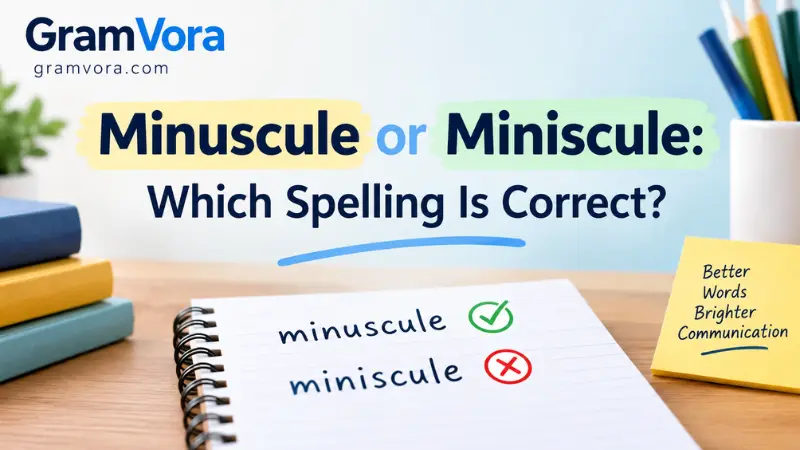
Minuscule and miniscule look almost identical, and they usually sound very similar when spoken. That makes the spelling easy to mix up.
The confusion becomes understandable when you think about words such as miniature, minimum, and miniskirt. The spelling miniscule may seem natural because the beginning looks like the familiar word pattern mini-.
There is an important difference, however. Minuscule is the established spelling to use when you mean “extremely small.” Miniscule is also found in dictionaries and published writing, but its status is less settled. Some references treat it as a variant, while learner-focused references may identify it as an incorrect spelling.
For ordinary US writing, minuscule is the safest choice.
Quick Answer
Use minuscule when you want the standard spelling.
Minuscule means “extremely small,” “tiny,” or very small in size or amount. It can also have a specialized noun meaning connected with lowercase letters or historical writing.
Miniscule normally has the same intended meaning, but it is a disputed or nonstandard variant in many usage contexts. It appears often enough that readers will understand it, but it may be treated as a spelling error in edited or formal writing.
The practical rule is simple:
Use minuscule in standard US English.
For example:
- The difference was minuscule.
- We noticed a minuscule crack in the screen.
- The amount of waste was minuscule.
- The print was so minuscule that I could barely read it.
Why People Confuse Them
The main reason is that minuscule does not look exactly like the word many people expect.
When someone hears the word, the first part can sound like mini. English has many familiar words beginning with that pattern, so writers may naturally produce miniscule.
The spelling also does not immediately reveal the word’s history. Someone who knows that mini relates to small size may assume that miniscule was built from the same idea.
That assumption is understandable, but it does not give the standard spelling.
Pronunciation contributes to the problem as well. In American English, minuscule can be pronounced roughly like MIN-uh-skyo͞ol or mih-NUSS-kyo͞ol. Because the middle vowel is not strongly emphasized, the spelling can be difficult to reconstruct from sound alone.
The result is a classic spelling trap: the incorrect version looks logical, sounds close, and has become common in real-world writing.
Key Differences At A Glance
The two forms generally point to the same intended meaning. The important difference is their status in standard written English.
| Feature | Minuscule | Miniscule |
|---|---|---|
| Standard spelling | Yes | Disputed or nonstandard variant |
| Main meaning | Extremely small | Usually intended to mean extremely small |
| Common grammatical role | Adjective; also noun in specialized uses | Mainly adjective |
| Formal writing | Recommended | Better avoided |
| Meaning difference | No separate everyday meaning | Usually no separate meaning |
| Main issue | Standard form | Spelling variation |
The distinction is therefore not like affect vs. effect, where the two words have different meanings and grammatical functions. Minuscule and miniscule are usually competing spellings of the same intended word.
That makes spelling choice the central issue.
Meaning and Usage Difference
Minuscule is primarily an adjective meaning extremely small.
It can describe a physical object:
A minuscule insect landed on the windowsill.
It can describe an amount:
Only a minuscule amount of paint was left.
The two measurements showed a minuscule difference.
The change had a minuscule impact on the final cost.
The word is flexible because “small” can refer to physical size, quantity, degree, or extent.
Miniscule, when used as an adjective, generally intends the same meaning. A sentence such as “The difference was miniscule” is normally understood immediately.
The problem is not that readers cannot understand the sentence. The problem is that many readers, editors, teachers, and style-conscious writers may recognize miniscule as the less accepted spelling.
That is why replacing it with minuscule is usually the better editing decision.
Does the meaning change?
Usually, no.
Compare:
- The room was minuscule.
- The room was miniscule.
The writer normally intends exactly the same idea: the room was extremely small.
The difference is primarily the spelling and the level of acceptance attached to each form.
Is minuscule only about physical size?
No. It can describe quantities, differences, changes, risks, effects, and other things that can be extremely small in degree.
For example:
- a minuscule amount
- a minuscule difference
- a minuscule increase
- a minuscule risk
- a minuscule improvement
This broader use is common in ordinary English.
Tone, Context, and Formality
Minuscule works comfortably in both everyday and formal English.
You can use it in a casual conversation:
The scratch is minuscule. I wouldn’t worry about it.
It also fits professional writing:
The company reported a minuscule increase in operating costs.
Academic writing can use it naturally:
The study found only a minuscule difference between the two measurements.
The word is slightly more precise and emphatic than simply saying small, but it is not limited to highly formal writing.
Miniscule has a different practical problem. Because many readers know minuscule as the standard spelling, the variant can attract attention in edited writing.
For a text message between friends, that may not matter. In a résumé, school paper, business report, application, article, or other polished document, using minuscule avoids unnecessary doubt.
The distinction is therefore about written convention rather than a major difference in tone.
Pronunciation
The pronunciations are close enough to contribute to the spelling confusion.
A practical American-English guide is:
minuscule: MIN-uh-skyo͞ol
Some speakers use a pronunciation closer to:
mih-NUSS-kyo͞ol
The variant miniscule is also pronounced differently by some speakers, with the spelling influencing the sound. In ordinary conversation, however, the similarity is strong enough that pronunciation usually does not help listeners identify the spelling.
Which One Should You Use?
Choose minuscule in almost all standard writing.
That recommendation applies to:
- School assignments
- College papers
- Business emails
- Reports
- Articles
- Professional documents
- Applications
- Published writing
- General everyday writing
There is little practical advantage to choosing miniscule when minuscule is available and widely recognized as the standard form.
If you encounter miniscule in someone else’s writing, the intended meaning is usually obvious. You do not need to interpret it as a different word.
When editing your own work, though, changing miniscule to minuscule is a simple way to follow the more conventional spelling.
A simple rule
Remember:
MINUSCULE = standard choice
MINISCULE = common variant to avoid in careful writing
This rule is especially useful when writing for an audience that expects conventional American English.
When One Choice Sounds Wrong
Because miniscule is familiar to many readers, it does not usually make a sentence sound meaningless.
Instead, it can look wrong on the page.
Consider:
The difference between the prices was miniscule.
Most readers will understand the sentence instantly. However, the spelling may cause a reader to pause.
Now compare:
The difference between the prices was minuscule.
The second version follows the standard spelling and creates no such distraction.
This is why miniscule can be described as a common variant while still being a poor choice for careful writing. Dictionary treatment is not completely uniform, but the safest conventional form remains minuscule.
The same point applies regardless of what the word describes:
- minuscule amount
- minuscule error
- minuscule room
- minuscule change
- minuscule chance
- minuscule detail
Replacing the spelling with miniscule does not normally create a new meaning. It simply creates a less standard-looking written form.
Common Mistakes (and Quick Fixes)
Mistake 1: Writing “miniscule” because of “mini”
The most common error is assuming that the word begins with the familiar mini- pattern.
Fix: Remember the spelling minuscule.
Mistake 2: Treating the two forms as completely different words
They are not normally different words with different everyday meanings.
Fix: Think of the issue as a spelling-choice problem.
Mistake 3: Assuming dictionary recognition means universal approval
A form can appear in a dictionary without being equally preferred in every type of writing.
Fix: When you need conventional written English, choose minuscule.
Mistake 4: Using the spelling based only on pronunciation
The sound does not reliably tell you whether the middle letters should be -us- or -is-.
Fix: Remember the written form rather than trying to spell it from sound.
Mistake 5: Forgetting the noun sense
Most people know minuscule only as an adjective meaning “very small.”
Fix: Remember that minuscule can also refer to a lowercase letter or a historical style of writing.
Everyday Examples
Here are natural examples using the standard spelling.
Describing physical size
The insect was so minuscule that I almost missed it.
A minuscule crack appeared near the edge of the screen.
The apartment’s kitchen was minuscule but surprisingly functional.
Describing an amount
Only a minuscule amount of sugar was needed.
The recipe calls for a minuscule quantity of salt.
The remaining balance was minuscule compared with the original amount.
There was a minuscule difference between the two measurements.
The updated version offers only a minuscule improvement.
The price difference was minuscule.
The policy had a minuscule effect on the final result.
The temperature change was minuscule.
Her adjustment produced a minuscule improvement in the final score.
Correcting the common spelling
Incorrect:
The difference was miniscule.
Standard:
The difference was minuscule.
Incorrect:
We found a miniscule amount of dust.
Standard:
We found a minuscule amount of dust.
Incorrect:
The increase was miniscule.
Standard:
The increase was minuscule.
The meaning remains clear in the incorrect examples, but the standard spelling is preferable.
Dictionary-Style Word Details
Verb
Minuscule: Not commonly used as a verb in standard US English.
Miniscule: Not commonly used as a verb in standard US English.
Neither form functions as an ordinary verb meaning “to make smaller.” The word is primarily used as an adjective, with minuscule also having specialized noun uses.
Noun
Minuscule: Can function as a noun in specialized contexts. It can refer to a lowercase letter or a small cursive style of writing used in historical manuscripts.
Example:
The manuscript was written in a form of minuscule.
It can also refer to a lowercase letter:
The editor identified the minuscule used in the manuscript.
Miniscule: When this spelling is used, it normally represents the adjective intended by minuscule. It is not the preferred form for the specialized noun senses.
For ordinary writing about something being extremely small, use the adjective minuscule.
Synonyms
Minuscule: Closest plain alternatives include tiny, very small, minute, little, and diminutive, depending on context.
Examples:
- a minuscule amount → a tiny amount
- a minuscule room → a very small room
- a minuscule difference → a tiny difference
- a minuscule detail → a very small detail
These alternatives are not identical in every sentence. Tiny is usually more conversational, while minuscule can sound more precise or emphatic.
Miniscule: Because it is normally used as a variant of minuscule, its synonyms are effectively the same intended alternatives: tiny, very small, minute, and similar words.
Antonyms for the size sense include large, huge, enormous, and massive, depending on the sentence.
Example Sentences
Minuscule:
- The print was minuscule.
- A minuscule amount of water remained.
- The error was minuscule.
- She noticed a minuscule scratch on the table.
- The difference between the two results was minuscule.
- The company recorded a minuscule increase in sales.
Miniscule:
- The word miniscule is commonly used when the writer intends minuscule.
- In careful writing, replace miniscule with minuscule.
- The intended meaning of miniscule is usually clear from context.
The examples show that the two forms normally do not create a meaningful difference in interpretation.
Word History
Minuscule: The word comes through French from Latin minusculus, meaning “rather small” or “somewhat smaller.” Its history is connected with the idea of something being small.
The word originally had a more specialized connection with small-letter writing. Its modern everyday sense expanded to describe anything extremely small.
Miniscule: The alternative spelling developed through the influence of familiar mini- words. Because mini- is strongly associated with small size, the spelling miniscule can feel more intuitive to modern writers.
That explains why the variant is so common. It does not mean that the two spellings developed as separate words with separate everyday meanings.
Phrases Containing
Minuscule commonly appears in phrases such as:
- a minuscule amount
- a minuscule difference
- a minuscule change
- a minuscule increase
- a minuscule detail
- a minuscule risk
- a minuscule chance
- a minuscule portion
- minuscule handwriting
- minuscule letters
The exact phrase depends on what is being described, but the central idea remains extreme smallness.
Miniscule can occur in the same kinds of sentences when writers use the variant spelling. For standard US writing, replace it with minuscule.
FAQs
Is it minuscule or miniscule?
Minuscule is the standard spelling in careful English writing. Miniscule is a common variant that appears in dictionaries and everyday writing, but it is generally safer to use minuscule in formal, academic, and professional contexts.
What does minuscule mean?
Minuscule means extremely small or tiny. It can describe a physical object, amount, difference, change, or effect.
Example:
The difference between the two prices was minuscule.
Is miniscule a misspelling of minuscule?
Miniscule is commonly treated as a variant or disputed spelling of minuscule. The intended meaning is usually clear, but minuscule is the safer standard form for careful writing.
Why do people spell minuscule as miniscule?
The spelling miniscule is probably influenced by familiar words beginning with mini-, such as miniature and minimum. Because the word means “extremely small,” the mini- spelling can seem natural.
Does minuscule mean very small?
Yes. Minuscule means extremely small, tiny, or very little in size or amount.
Example:
She noticed a minuscule crack in the screen.
Is minuscule a formal word?
Minuscule can be used in both everyday and formal English. It is appropriate in professional, academic, and general writing when you want to emphasize that something is extremely small.
Can minuscule describe an amount?
Yes. Minuscule can describe a very small amount or quantity.
Example:
Only a minuscule amount of paint was left.
Can minuscule be used as a noun?
Yes. In specialized contexts, minuscule can be a noun referring to lowercase letters or a historical style of small-letter writing. The adjective meaning “extremely small” is much more common in everyday English.
Is minuscule or miniscule preferred in American English?
Minuscule is the safer choice for standard American English writing. Although miniscule is recognizable and appears in some dictionary references, using minuscule avoids questions about spelling.
What is the easiest way to remember the spelling of minuscule?
Remember that the standard spelling is minuscule, with -usc- in the middle:
Conclusion
The practical choice between minuscule and miniscule is straightforward.
Minuscule is the standard spelling to use when you mean “extremely small.” It works as an adjective in everyday, professional, academic, and published writing. It also has specialized noun uses related to lowercase letters and historical writing.
Miniscule is widely recognizable and appears in dictionaries and real-world writing, but its status is less secure. Some references treat it as a variant, while others present it as an incorrect spelling. Because of that variation, it is not the safest choice when you want conventional written English.
If you need one spelling to remember, choose minuscule.
Minuscule = standard spelling.
Miniscule = common variant that is better avoided in careful writing.


