
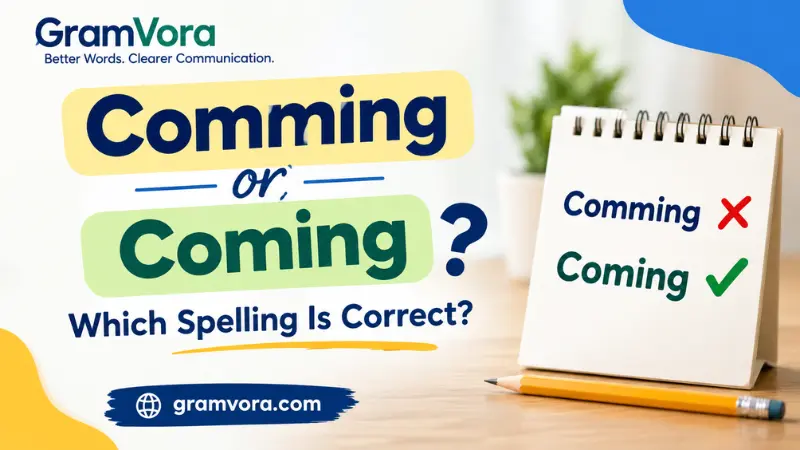
If you are unsure whether to write comming or coming, the correct spelling is coming.
Coming is the -ing form of the verb “come.” The spelling changes from come to coming by removing the final silent e before adding -ing.
The correct form is:
come → coming
The spelling comming is incorrect in standard modern English.
This mistake is understandable because English has many verbs that double their final consonant before -ing. For example:
- run → running
- sit → sitting
- stop → stopping
- swim → swimming
However, come does not follow that pattern. Its final e is simply dropped:
come → coming
Knowing this small spelling pattern can help you avoid one of the most common mistakes involving this word.
Quick Answer
Coming is correct. Comming is incorrect.
Use coming whenever you need the -ing form of come.
Examples:
- She is coming home.
- Are you coming with us?
- The bus is coming now.
- Thank you for coming to the meeting.
- The coming months will be busy.
Do not write:
- She is comming home.
- Are you comming with us?
- Thank you for comming to the meeting.
The correct spelling always has one m:
coming ✅
comming ❌
Why People Confuse Them
The spelling comming usually results from confusion about how English forms -ing words.
When some short verbs end in a consonant, that consonant is doubled before -ing.
For example:
- run → running
- sit → sitting
- get → getting
- stop → stopping
- plan → planning
Because of these examples, someone may incorrectly assume that:
come → comming
But come follows a different spelling pattern.
The word come ends in a silent e. When -ing is added, that final e is removed.
Therefore:
come − e + ing = coming
There is no second m.
Another possible mistake is comeing, which incorrectly keeps the final e.
The three forms can therefore be compared like this:
- coming ✅ correct
- comming ❌ incorrect
- comeing ❌ incorrect
The easiest form to remember is simply:
come → coming
Key Differences at a Glance
| Feature | Coming | Comming |
|---|---|---|
| Standard spelling | Correct | Incorrect |
| Form of come | Yes | No |
| Used in modern English | Yes | No |
| Appropriate in formal writing | Yes | No |
| Appropriate in casual writing | Yes | No |
| Number of m’s | One | Two |
There is no modern standard-English situation in which comming should replace coming when you mean the -ing form of come.
Meaning and Usage Difference
Coming and comming do not have different meanings.
Instead, coming is the correct spelling, while comming is a spelling mistake.
What Does “Coming” Mean?
Coming is the present participle of come. It commonly describes movement toward a person, place, or destination.
For example:
I am coming home.
Here, coming describes movement toward home.
It can also refer to someone’s arrival:
Our guests are coming at six.
In this sentence, coming means that the guests are expected to arrive at six.
The word can also describe something that is approaching in time:
The coming year will be busy.
Here, coming means the year that is approaching.
Coming in Continuous Verb Forms
Coming is commonly used with forms of be to describe an ongoing or expected action.
Examples include:
- I am coming.
- She is coming.
- They are coming.
- We were coming.
- He will be coming later.
For example:
We are coming to the party tonight.
The word coming describes the action associated with the verb come.
Coming as a Gerund
The -ing form of a verb can sometimes function as a noun. When this happens, it is called a gerund.
For example:
Thank you for coming.
Here, coming refers to the act of attending or arriving.
Another example is:
Coming early helped us get good seats.
In this sentence, coming early functions as the subject.
Coming as an Adjective
Coming can also be used as an adjective when it describes something that is approaching or expected soon.
Examples include:
- the coming week
- the coming year
- the coming months
- the coming season
For example:
We need to prepare for the coming winter.
Here, coming describes the approaching winter.
Tone, Context, and Formality
There is no difference in tone or formality between coming and comming because comming is not the standard spelling.
Coming works in virtually any context.
Casual Conversation
Are you coming with us?
Text Messages
I’m coming now.
Professional Writing
Thank you for coming to today’s meeting.
Academic Writing
The coming decades may bring significant changes.
The spelling stays the same in every context:
coming
You do not need a different spelling for formal or informal writing.
American English
In American English, the standard spelling is coming.
This is not a normal American-versus-British spelling difference. Writers using standard English should use coming.
Which One Should You Use?
Use coming whenever you need the -ing form of come.
For example:
Correct:
She is coming tomorrow.
Incorrect:
She is comming tomorrow.
Another example:
Correct:
Are you coming to dinner?
Incorrect:
Are you comming to dinner?
And:
Correct:
The train is coming.
Incorrect:
The train is comming.
The spelling rule is simple:
come → remove e → add -ing → coming
Remembering this pattern will prevent both comming and comeing.
When One Choice Sounds Wrong
Because comming is not the standard spelling, it looks incorrect in ordinary modern English writing.
Consider this sentence:
We are comming over after work.
The meaning is clear, but the spelling is wrong.
The corrected sentence is:
We are coming over after work.
The same issue can occur in professional communication:
Thank you for comming to our event.
Correct:
Thank you for coming to our event.
The problem is not the meaning or sentence structure. It is simply the spelling of the -ing form.
Here are several common phrases:
- Coming soon ✅
- Comming soon ❌
- Coming home ✅
- Comming home ❌
- Coming tomorrow ✅
- Comming tomorrow ❌
- Coming back ✅
- Comming back ❌
Whenever the word comes from come + -ing, use coming.
Common Mistakes (and Quick Fixes)
Mistake 1: Writing “Comming”
Incorrect:
She is comming home.
Correct:
She is coming home.
The extra m should not be added.
Mistake 2: Treating “Come” Like “Run”
A writer may remember:
run → running
and apply the same pattern to come:
come → comming
That is incorrect.
The correct form is:
come → coming
Mistake 3: Keeping the Final “e”
Another common mistake is:
comeing
The final e should be removed before -ing is added.
Correct:
coming
Mistake 4: Adding an Extra Consonant
The correct word contains only one m:
coming
Not:
comming
A quick visual check can help:
c o m i n g
There is only one m.
Quick Fix
Use this simple formula:
COME → COMING
Remove the final e.
Keep the single m.
Add -ing.
Everyday Examples
The following examples show how coming is naturally used in American English.
I’m coming to your office now.
She is coming home after work.
Are you coming with us?
They are coming from Chicago tomorrow.
The delivery is coming this afternoon.
Our guests are coming at six.
The bus is coming down the street.
Your order is coming soon.
Talking About the Future
The coming months will be busy.
We are preparing for the coming season.
The coming year will bring several changes.
I have a lot planned for the coming weekend.
Talking About Participation
Thanks for coming to my birthday party.
I appreciate you coming to the meeting.
Are you coming to the concert?
I’m glad you are coming.
Texting and Casual Conversation
Are you coming?
I’m coming now.
We’re coming over later.
I’ll be coming after work.
The spelling does not change because the context is informal.
Dictionary-Style Word Details
Verb
Coming is the present participle of the verb come.
The main forms of the verb include:
- come
- comes
- came
- coming
Examples:
I am coming home.
She is coming with us.
They were coming toward the entrance.
The spelling comming is not the standard present participle of come.
Noun
Coming can function as a gerund when the -ing form acts as a noun.
For example:
Thank you for coming.
Here, coming refers to the act of attending or arriving.
Another example:
Coming early gave us more time to prepare.
The phrase coming early acts as the subject of the sentence.
Comming does not function as a standard noun in modern English.
Synonyms
The closest plain alternatives for coming depend on its meaning.
When coming refers to movement, possible alternatives include:
- approaching
- arriving
- traveling toward
For example:
The train is coming.
Depending on the context, this could be expressed as:
The train is approaching.
When coming refers to something that will happen soon, possible alternatives include:
- upcoming
- approaching
- forthcoming
For example:
The coming year will be busy.
A possible alternative is:
The upcoming year will be busy.
These alternatives are not interchangeable in every sentence, so context still matters.
Comming does not have standard synonyms because it is not the standard spelling of a modern English word.
Example Sentences
Here are several correct examples:
- Are you coming to the meeting?
- She is coming home tonight.
- The bus is coming now.
- Thanks for coming to dinner.
- Winter is coming soon.
- The coming weeks will be busy.
- We are coming from the airport.
- He will be coming later.
- I appreciate you coming to help.
- The coming year should be interesting.
In all of these examples, coming is spelled with one m.
Word History
For modern English, the important spelling pattern is:
come → coming
The final silent e is removed before the -ing ending is added.
There is no need to add a second m.
For contemporary American English writing, coming is the standard spelling.
Phrases Containing
Coming appears in many common English phrases, including:
- coming home
- coming back
- coming soon
- coming up
- coming over
- coming along
- coming together
- coming down
- coming in
- coming out
- coming of age
- the coming year
- the coming months
- the coming weekend
Examples:
The new restaurant is coming soon.
Are you coming over tonight?
She is coming back tomorrow.
The coming months will require careful planning.
In every one of these examples, the correct spelling is coming with one m
FAQs
Is it “comming” or “coming”?
Coming is the correct spelling. Comming is an incorrect spelling in standard modern English.
Why is “coming” spelled with one m?
The word comes from come. When -ing is added, the final silent e is removed:
come → coming
The m is not doubled.
Is “comming” a real word?
Comming is not the standard modern spelling of the -ing form of come. In normal English writing, use coming.
Is “coming” correct in American English?
Yes. Coming is the standard spelling used in American English.
Why do people spell “coming” as “comming”?
The mistake often happens because some verbs double their final consonant before -ing, such as run → running and sit → sitting. However, come does not follow this pattern.
Is “comeing” also wrong?
Yes. Comeing is incorrect. The final e in come is removed before -ing is added, giving coming.
What is the spelling rule for “coming”?
The simple pattern is:
come − e + ing = coming
So the correct spelling has one m and no e before -ing.
Is “coming soon” correct?
Yes. Coming soon is the correct phrase.
Example:
The new store is coming soon.
Is “coming home” correct?
Yes. Coming home is completely correct.
Example:
I am coming home after work.
Can “coming” be used in a sentence?
Yes. Coming is commonly used as the -ing form of come.
Example:
Are you coming with us?
Can “coming” be used as a noun?
Yes. Coming can function as a gerund, which means the -ing form acts like a noun.
Example:
Thank you for coming.
Can “coming” be used as an adjective?
Yes. Coming can describe something that is approaching or expected soon.
Example:
We are preparing for the coming year.
What is the easiest way to remember “coming”?
Remember the pattern:
COME → COMING
Remove the final e, keep one m, and add -ing.
Which is correct: “I am comming” or “I am coming”?
I am coming is correct.
Incorrect:
I am comming.
Correct:
I am coming.
Which is correct: “Thanks for comming” or “Thanks for coming”?
Thanks for coming is correct.
The spelling comming should not be used in standard modern English.
Is “coming” formal or informal?
Coming is appropriate in both formal and informal English. You can use it in conversations, text messages, emails, academic writing, and professional documents.
What is the difference between “coming” and “comming”?
There is no standard meaning difference. Coming is the correct spelling, while comming is a spelling error when referring to the -ing form of come.
Conclusion
When choosing between comming and coming, use coming.
Coming is the standard -ing form of come. It can describe movement, arrival, participation, or something approaching in time.
The most common reason people write comming is confusion with verbs that double their final consonant before -ing. However, come does not follow that pattern.
The correct formation is:
come → coming
The final silent e is removed, while the m remains single.
So the rule is easy to remember:
Coming = correct
Comming = incorrect
Whether you are writing a text message, email, school assignment, business document, or article, coming is the spelling you should use.


