
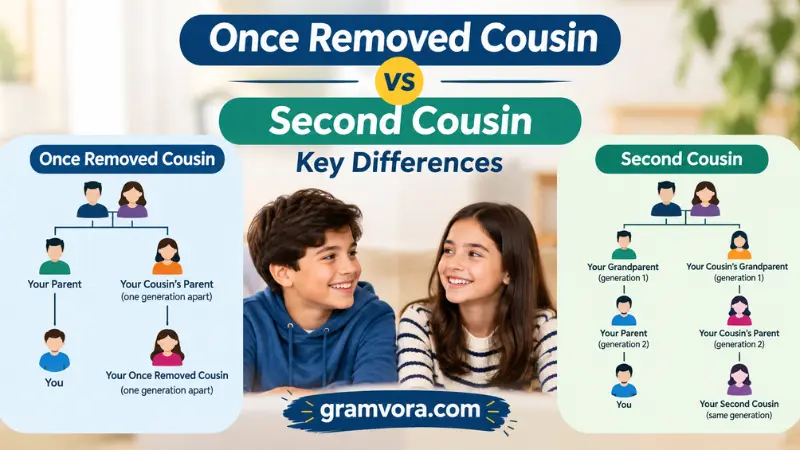
The terms once removed cousin and second cousin can sound like two competing names for the same family relationship. They are not.
There is also an important wording issue. In standard English, the usual expression is “cousin once removed,” not “once removed cousin.” The phrase “once removed” describes the relationship between two people rather than acting as the normal adjective before “cousin.”
A second cousin identifies a specific cousin level. A cousin once removed identifies a one-generation difference. These labels therefore describe different parts of a family relationship.
Understanding that distinction makes family trees much easier to read.
Quick Answer
If you mean the standard genealogical wording, use “cousin once removed,” not “once removed cousin.”
A second cousin is a specific relationship. You and that person share great-grandparents and are generally in the same generation.
A cousin once removed means there is a one-generation difference between you and the cousin relationship being described.
For example:
- Your second cousin is your second cousin.
- Your second cousin’s child is your second cousin once removed.
- Your parent’s second cousin is also your second cousin once removed.
- If you know only that a cousin is one generation above or below you, cousin once removed can be used more generally.
The easiest distinction is:
Second cousin = cousin degree.
Once removed = generation difference.
Why People Confuse Them
The confusion comes from treating the words second and once removed as though they measure the same thing.
They do not.
The number in second cousin identifies the cousin level. A second cousin shares great-grandparents with you.
The phrase once removed describes how far apart two people are by generation. One generation of difference means “once removed.”
That means a person can be a first cousin once removed, second cousin once removed, or third cousin once removed.
So “once removed” does not automatically mean “second cousin.”
Another source of confusion is the wording itself. People sometimes say “once removed cousin,” but the conventional expression is “cousin once removed.”
Key Differences At A Glance
| Context | Best Choice | Why |
|---|---|---|
| Same generation and shared great-grandparents | second cousin | It identifies a specific cousin relationship. |
| One generation apart in a second-cousin relationship | second cousin once removed | It gives both the cousin degree and generation difference. |
| One generation apart, but exact cousin degree is not stated | cousin once removed | It describes the generational difference without naming the degree. |
| Referring to the standard phrase | cousin once removed | This is the usual word order. |
| Referring to a specific family relationship | second cousin | The term gives a clear cousin degree. |
Compact comparison
- Once removed: describes a generation difference.
- Second cousin: describes a particular cousin degree.
- Second cousin once removed: combines both pieces of information.
Meaning and Usage Difference
What “second cousin” means
A second cousin is a person who shares your great-grandparents but not your grandparents.
For example, imagine that your grandfather and another person’s grandfather were siblings. Their children are first cousins. Their grandchildren are second cousins.
That means you and the other person’s child can be second cousins when you both descend from the same great-grandparents.
The important point is that second cousins are normally at the same generational level in the family tree.
What “cousin once removed” means
“Once removed” means that two people are separated by one generation.
The relationship can move in either direction.
Your second cousin’s child is your second cousin once removed. That person is one generation below you.
Your parent’s second cousin is also your second cousin once removed. That person is one generation above you.
The phrase therefore does not mean “a more distant second cousin.” It specifically describes the generation difference.
The exact wording matters
If you are writing about genealogy, “cousin once removed” is the natural phrase.
For greater precision, include the cousin number:
- first cousin once removed
- second cousin once removed
- third cousin once removed
This makes the relationship much easier to understand.
Tone, Context, and Formality
Neither second cousin nor cousin once removed is unusually formal or informal.
Both are standard expressions for family relationships.
The main difference is precision, not tone.
In everyday conversation, someone might simply say, “He’s my cousin once removed.” That can be perfectly understandable if everyone already knows which cousin relationship is being discussed.
In a family-tree discussion, however, a more exact label is often better.
For example:
“She’s my second cousin.”
is more specific than:
“She’s my cousin.”
Likewise:
“He’s my second cousin once removed.”
gives more information than:
“He’s my cousin once removed.”
The longer form tells the reader both the cousin level and the generation difference.
Which One Should You Use?
Use second cousin when the person is your second cousin in the same generation.
Use cousin once removed when you are describing a cousin relationship that has a one-generation difference.
If you know the exact cousin degree, the clearest choice is to include it.
For example, instead of saying:
“She’s my once removed cousin.”
say:
“She’s my first cousin once removed.”
or:
“She’s my second cousin once removed.”
The exact wording prevents confusion.
Remember that “once removed” does not replace the cousin number. It adds information about generations.
When One Choice Sounds Wrong
The phrase “once removed cousin” may sound understandable, but it is not the normal order used for this relationship.
A more natural expression is:
“cousin once removed”
The same pattern appears in more specific relationships:
“first cousin once removed”
“second cousin once removed”
“third cousin once removed”
By contrast, second cousin is already a complete and standard relationship label.
Another common mistake is using “second cousin” for someone who is actually a cousin once removed. A second cousin and a second cousin once removed are not identical relationships.
The difference is the generation gap.
Common Mistakes (and Quick Fixes)
Mistake 1: “Once removed” means second cousin.
Fix: “Once removed” means one generation apart. It can apply to first, second, third, and other cousin levels.
Mistake 2: “Once removed cousin” is the standard phrase.
Fix: Use “cousin once removed.”
Mistake 3: Your second cousin’s child is your third cousin.
Fix: Your second cousin’s child is your second cousin once removed.
Mistake 4: Your parent’s second cousin is simply your second cousin.
Fix: That person is your second cousin once removed because your parent and that relative belong to different generations from you.
Mistake 5: “Removed” means the person is less related.
Fix: “Removed” describes the generation difference. It does not simply mean “more distant.”
Everyday Examples
Consider a simple family tree.
Your great-grandparents have two children. One becomes your grandparent, while the other becomes the grandparent of another family branch.
You and someone from that other branch can be second cousins because you share great-grandparents and occupy the same general generation.
Now suppose your second cousin has a child.
That child is one generation below you. The correct relationship is second cousin once removed.
The same idea works upward.
Suppose your parent has a second cousin. That person is one generation above you. That relative is also your second cousin once removed.
Here are a few natural sentences:
- “I met my second cousin at the family reunion.”
- “Her daughter is my second cousin once removed.”
- “My dad’s second cousin lives in Texas.”
- “My dad’s second cousin is my second cousin once removed.”
- “I had to check the family tree to figure out that relationship.”
- “He’s not my second cousin; he’s my second cousin once removed.”
These examples show why the two labels should not be treated as interchangeable.
Dictionary-Style Word Details
Verb
- Once removed cousin: Not a standard verb expression. “Removed” is part of a family-relationship phrase rather than a verb in this construction.
- Second cousin: Not a verb. The expression functions as a noun phrase identifying a family relationship.
The verb remove has other ordinary meanings, but that does not make “once removed cousin” a standard verb-based expression.
Noun
- Once removed cousin: The exact word order is not the usual standard noun phrase. The conventional form is cousin once removed, with the phrase describing a one-generation difference.
- Second cousin: A noun phrase naming a specific cousin relationship. A second cousin shares great-grandparents with you and is generally in your generation.
The noun cousin can be modified by terms such as first, second, or third, while once removed adds information about generation.
Synonyms
- Once removed cousin: There is no exact synonym that preserves the full meaning. The closest plain alternative is cousin one generation apart, although the standard genealogical expression remains cousin once removed.
- Second cousin: There is no exact everyday synonym that gives the same precise relationship. Relative is broader and therefore should not be treated as an exact equivalent.
These terms are relationship labels, so replacing them with broad words such as “relative” loses useful information.
Example Sentences
- Once removed cousin: “She is my cousin once removed, although I had to check the family tree to confirm the exact relationship.”
- Second cousin: “My second cousin and I share the same great-grandparents.”
- Second cousin once removed: “My second cousin’s son is my second cousin once removed.”
- Second cousin once removed: “My mother’s second cousin is my second cousin once removed.”
These examples also demonstrate why the standard order is cousin once removed, not once removed cousin.
Word History
The modern family terminology uses cousin together with numbered degrees such as first, second, and third. The expression once removed developed as a way to describe a generational difference within these relationships.
The exact historical development of every variation is more complicated than the basic modern rule. For practical US English, the important point is that cousin once removed is the established expression, while second cousin is the standard label for that particular cousin degree.
Phrases Containing
Common relationship phrases include:
- cousin once removed
- first cousin once removed
- second cousin once removed
- third cousin once removed
- second cousin
- first cousin
- third cousin
The pattern is useful because the cousin number and the removal number communicate different information.
FAQs
Is a once removed cousin the same as a second cousin?
No. A second cousin and a cousin once removed describe different parts of a family relationship. A second cousin identifies the cousin level, while “once removed” indicates that the two people are one generation apart.
What is the correct phrase: once removed cousin or cousin once removed?
The standard expression is “cousin once removed.” For example, you would normally say, “She is my second cousin once removed,” rather than “She is my once removed cousin.”
What does “once removed” mean in a family relationship?
“Once removed” means that two relatives are separated by one generation. The difference can be upward or downward in a family tree.
What is a second cousin?
A second cousin is generally someone who shares your great-grandparents with you. Unlike a second cousin once removed, a second cousin is normally in the same generation as you.
Is my second cousin’s child my second cousin?
Your second cousin’s child is your second cousin once removed. The child is one generation below you, so “once removed” describes that generational difference.
Is my parent’s second cousin my second cousin?
No. Your parent’s second cousin is generally your second cousin once removed because that person is one generation above you.
Does “once removed” mean that someone is less closely related?
Not necessarily. “Once removed” describes a generation difference, not simply how distant the relationship is. The exact relationship also depends on the cousin degree.
Can someone be a first cousin once removed and a second cousin?
No, these labels describe different relationships. A first cousin once removed has a first-cousin relationship with a one-generation difference, while a second cousin describes a different cousin level.
How can I remember the difference between second cousin and once removed?
Think of the terms as measuring two different things. “Second” identifies the cousin level, while “once removed” identifies a one-generation difference.
What is the difference between a second cousin and a second cousin once removed?
A second cousin is generally in the same generation and shares great-grandparents with you. A second cousin once removed has the same second-cousin connection but is one generation above or below you.
Conclusion
Once removed cousin and second cousin do not mean the same thing.
For standard wording, say “cousin once removed,” rather than “once removed cousin.” The phrase once removed describes a one-generation difference between two people.
A second cousin, on the other hand, is a specific cousin relationship involving shared great-grandparents and generally the same generation.
When both pieces of information matter, combine them:
second cousin once removed
The simplest way to remember the difference is this: the cousin number identifies the relationship level, while “once removed” identifies the generation difference.


