
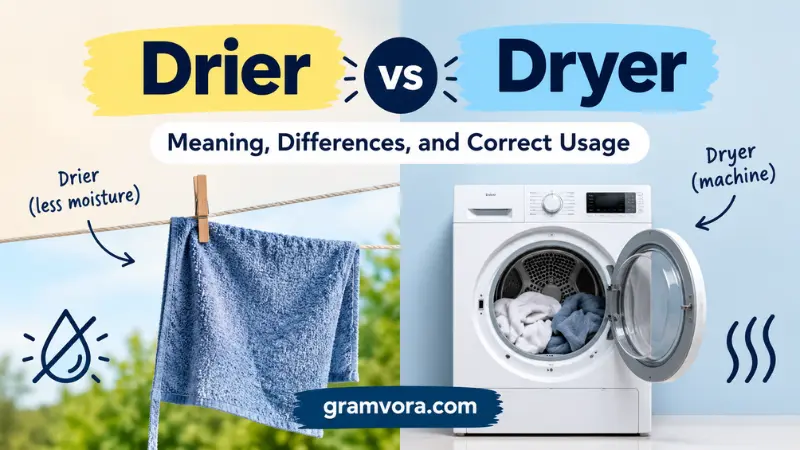
Drier and dryer are both correct English words, but they usually do different jobs.
The main distinction is simple: drier is normally the comparative form of dry, while dryer is commonly a noun for a machine or device that dries something.
For example, you can say, “The towel is drier now,” but “Put the towel in the dryer.”
There is one important detail. Dictionaries also recognize drier as a noun for a drying device, so the two spellings can overlap in some contexts. For clear everyday American English, however, the distinction above is the easiest and most useful choice.
Quick Answer
Use drier when you mean more dry, less wet, or having less moisture.
Use dryer when you mean a machine or device that dries something.
| Context | Best Choice | Why |
|---|---|---|
| Comparing moisture | drier | It is the comparative form of dry. |
| Talking about weather | drier | It describes conditions with less moisture. |
| Describing skin or soil | drier | It describes a change or comparison. |
| Naming a clothes appliance | dryer | It is a noun for a drying machine. |
| Naming a hair appliance | dryer | Hair dryer is the common American form. |
| Naming a hand-drying machine | dryer | It refers to the device. |
Quick rule: Drier describes. Dryer dries.
Why People Confuse Them
The confusion is easy to understand because the two words look almost identical.
They also sound the same or very similar in ordinary English. That means a listener may not know which spelling you mean until the surrounding sentence makes the meaning clear.
Both words are also connected to dry. However, they developed different common grammatical roles.
Consider these sentences:
- The air is drier today.
- The clothes are in the dryer.
In the first sentence, drier describes the air.
In the second, dryer names an object.
That difference in meaning is more useful than trying to decide from pronunciation alone.
Key Differences At A Glance
| Feature | Drier | Dryer |
|---|---|---|
| Usual role | Comparative adjective | Noun |
| Main meaning | More dry; less moist | A machine or device that dries |
| Common use | Weather, skin, soil, towels, food | Clothes, hair, hands, crops, materials |
| Example | The air is drier today. | The dryer is running. |
| Comparison with “than” | Yes | Not when it means “more dry” |
There is also an overlap worth remembering: drier can be used as a noun meaning a drying device.
So the table describes the usual distinction, not an absolute rule covering every dictionary entry.
Meaning and Usage Difference
What Does Drier Mean?
Drier is normally the comparative form of the adjective dry.
The pattern is:
dry → drier → driest
Use drier when something has less moisture than something else or has become less wet.
Examples include:
- The towel is drier than the other one.
- The air feels drier today.
- My skin gets drier in winter.
- This soil is drier than the soil near the river.
- The bread became drier after sitting out overnight.
The comparison does not always need to be stated directly. In “The weather will be drier tomorrow,” the comparison may simply be understood from the situation.
What Does Dryer Mean?
Dryer is commonly a noun for a machine or device that removes moisture.
Common examples include:
- clothes dryer
- hair dryer
- hand dryer
- grain dryer
For example:
- The dryer stopped working.
- I put the towels in the dryer.
- She packed a small hair dryer.
- The bathroom hand dryer is broken.
In each sentence, dryer names a thing.
A Useful Spelling Pattern
The comparative form of dry is drier, not normally dryer when you mean “more dry.”
Compare:
- dry → drier → driest
- happy → happier → happiest
- easy → easier → easiest
The final y changes to i in the comparative form.
That is why “The weather is drier today” is the clearest standard choice.
Tone, Context, and Formality
Neither word is especially formal or informal. The choice depends mainly on meaning.
Drier works naturally in everyday conversation, school writing, workplace writing, weather reports, and descriptions of physical conditions.
For example:
The climate is drier than it was last year.
Dryer is equally normal when naming equipment.
The new dryer is quieter than our old one.
For American readers, dryer is the clearest choice for an appliance such as a clothes dryer or hair dryer.
At the same time, drier is not automatically wrong when used as a noun. Major dictionaries recognize it as an alternative noun spelling. That means context matters.
Pronunciation does not provide much help. The two words are normally pronounced alike or nearly alike, so writers should rely on meaning and sentence structure.
Which One Should You Use?
For most American English writing, use this practical guide:
Choose drier when:
- you mean “more dry”
- you are comparing moisture levels
- you are describing weather or climate
- you are describing skin, hair, soil, food, paint, or another condition
- the word functions as a comparative adjective
Choose dryer when:
- you mean a machine
- you mean an appliance
- you are naming equipment that dries something
- you are writing common terms such as clothes dryer or hair dryer
One sentence makes the distinction easy to remember:
The dryer makes the clothes drier.
The first word names the machine. The second describes the condition of the clothes.
When One Choice Sounds Wrong
Some sentences become awkward or unclear when the wrong form is chosen.
For example:
The desert air is dryer than the coastal air.
If the intended meaning is “more dry,” drier is the clearer standard choice:
The desert air is drier than the coastal air.
Now consider:
I bought a new drier for my laundry room.
This can be understood because drier is also recorded as a noun for a drying device. However, dryer is the clearer and more familiar American choice:
I bought a new dryer for my laundry room.
So the issue is not always “right versus wrong.” Sometimes it is about choosing the form that makes the intended meaning easiest to recognize.
Common Mistakes (and Quick Fixes)
Mistake 1: Writing “dryer than”
When you mean “more dry,” use drier than.
- Less clear: The air is dryer than yesterday.
- Better: The air is drier than yesterday.
Mistake 2: Using “dryer” for every comparison
Because dryer is a real word, spell-checking may not catch the problem.
- Less clear: My skin is dryer in winter.
- Better: My skin is drier in winter.
Mistake 3: Using “drier” for an appliance
The noun drier exists, but dryer is the clearer everyday American choice for a household appliance.
- Less familiar: Put the clothes in the drier.
- Clearer: Put the clothes in the dryer.
Mistake 4: Choosing by sound
The pronunciation will not reliably tell you which spelling to use.
Instead, ask:
Does it mean “more dry”? → drier
Does it name a drying machine? → dryer
Everyday Examples
Here are realistic examples showing how the two forms work.
- Weather: The forecast says tomorrow will be drier than today.
- Climate: The western part of the state has a drier climate.
- Laundry: The towels are still in the dryer.
- Hair: I need to replace my old hair dryer.
- Skin: My hands feel drier during the colder months.
- Soil: The soil near the window is drier than the soil outside.
- Food: This loaf is drier than the one we made yesterday.
- Public restroom: The hand dryer is not working.
- Paint: The second coat is drier now, so we can continue.
- Laundry comparison: These shirts are drier than the ones in the other basket.
- Home appliance: The new dryer has a larger drum.
- Both in one sentence: The dryer made the towels drier.
That last example is an especially useful memory aid because both words appear naturally together.
Dictionary-Style Word Details
Verb
- Drier: Not a verb. The word is normally the comparative adjective drier or a noun in certain uses.
- Dryer: Not normally used as a verb. The related verb is dry, as in “Please dry the dishes.”
Noun
- Drier: Can be a noun for a person or thing that dries something. Dictionaries also recognize it as an alternative spelling of dryer. In technical contexts, it can refer to a substance or apparatus involved in drying.
- Dryer: Commonly a countable noun for a machine or device that dries something, such as a clothes dryer or hair dryer.
Synonyms
- Drier: Closest plain alternatives include less wet, less moist, or, in suitable contexts, more arid. These are not exact replacements in every sentence.
- Dryer: Closest plain alternatives include drying machine and drying device when referring to equipment.
A clear antonym for drier in the moisture sense is wetter. Dryer does not have a simple everyday antonym when it means a machine.
Example Sentences
Drier:
- The towels are drier now.
- This room feels drier than the basement.
- The air becomes drier during winter.
- The soil is drier after several sunny days.
Dryer:
- The dryer is running.
- Put the sheets in the dryer.
- Her hair dryer is in the bathroom.
- The public hand dryer needs repair.
Word History
Both forms are connected to dry, but their grammatical roles are different.
Drier functions as the regular comparative form of the adjective dry. The spelling follows the common pattern in which a final y changes to i before the comparative ending.
Dryer developed as a noun from dry plus -er, an ending that can form a word for something that performs an action. Oxford records the noun historically in the sense of a person who dries and traces it to dry + -er.
Modern dictionaries also record overlap between drier and dryer in noun use.
Phrases Containing
Drier:
- drier weather
- drier climate
- drier air
- drier soil
- drier skin
- drier conditions
- drier than before
Dryer:
- clothes dryer
- hair dryer
- hand dryer
- grain dryer
- tumble dryer
- dryer vent
- dryer cycle
These phrases show the most useful modern distinction: drier commonly describes a condition, while dryer commonly names drying equipment.
FAQs
What is the difference between drier and dryer?
Drier usually means “more dry” or “less moist,” while dryer usually refers to a machine or device that dries something. For example, “The air is drier today” and “The clothes are in the dryer.”
Is it drier or dryer?
Both drier and dryer are correct words, but they are usually used differently. Use drier for the comparative form of dry and dryer for a drying machine or device.
Is drier the comparative form of dry?
Yes. Drier is the standard comparative form of dry. The usual forms are dry, drier, driest.
Should I say drier than or dryer than?
Use drier than when you mean “more dry.” For example, “This room is drier than the basement.” Dryer is normally used as a noun for a machine, not as the comparative form.
5. Is it clothes dryer or clothes drier?
Clothes dryer is the common and clearer choice in American English. It refers to a machine that dries clothes.
Is it hair dryer or hair drier?
Hair dryer is the standard and familiar form in American English. It refers to an appliance used to dry hair.
Can drier be used as a noun?
Yes. Drier can be used as a noun for something that dries, and dictionaries recognize it as a variant in some noun uses. However, dryer is the more familiar spelling for household drying appliances.
Are drier and dryer pronounced the same?
They are normally pronounced the same or very similarly in standard English. Because the pronunciation does not clearly distinguish them, the intended meaning and context determine the spelling.
Is “the weather is dryer” correct?
When you mean that the weather is more dry, drier is the clearer standard choice: “The weather is drier this week.” Dryer is generally used for a drying device.
What is an easy way to remember drier vs dryer?
Remember: drier describes something that is more dry, while a dryer is something that dries. For example, “The dryer made the clothes drier.”
Conclusion
The difference between drier vs dryer is mostly about meaning and grammatical role.
Use drier when you mean more dry or less moist. It is the normal comparative form of dry:
dry → drier → driest
Use dryer when you mean a machine or device that dries something, especially in familiar American expressions such as clothes dryer and hair dryer.
There is some overlap because dictionaries also recognize drier as a noun for a drying device. Still, for clear everyday American English, this rule works well:
Drier = more dry.
Dryer = the machine.
And the easiest memory sentence is:
The dryer makes things drier.


