
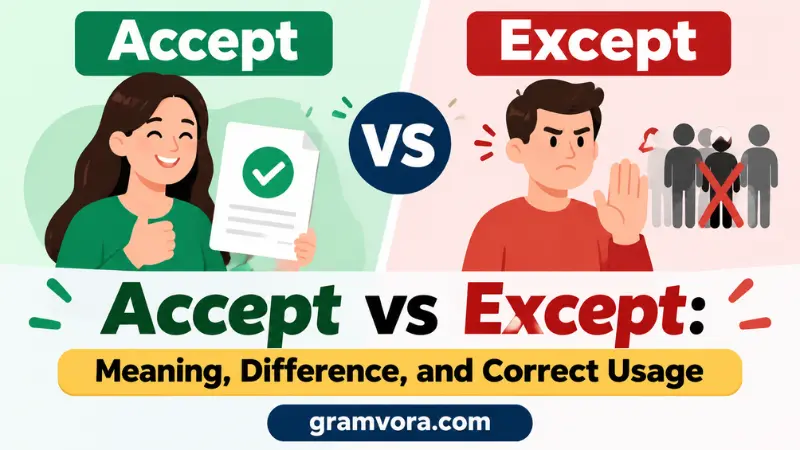
Accept and except are two commonly confused English words. They look similar, sound similar, and differ by only one letter, but they have different meanings and grammatical functions.
The easiest way to separate them is to focus on the action or idea in the sentence. Accept usually means to receive, agree to, approve, or recognize something. Except usually means excluding someone or something from a group, statement, or situation.
For example, you can accept an invitation, but you might say that everyone attended except Sarah. The first word describes receiving or agreeing to something; the second identifies an exception.
Quick Answer
Use accept when you mean receive, agree to, approve, or recognize something.
Use except when you mean excluding, apart from, or with the exception of someone or something.
Compare:
- I accept your apology.
- Everyone came except Jake.
In the first sentence, the speaker receives or acknowledges an apology. In the second, Jake is the person who is not included.
Why People Confuse Them
The confusion mainly comes from their similar spelling and pronunciation.
Both words contain the same -cept ending, and their overall sounds are close. However, their meanings are very different.
Their grammatical roles also help distinguish them. Accept is normally a verb. Except is most commonly used as a preposition or conjunction.
Consider these examples:
- She accepted the invitation.
- Everyone except Mia accepted the invitation.
The first accepted means that Mia or another person agreed to the invitation. The second except identifies someone who is being left out of the general statement.
A useful memory aid is to connect except with exclude. Both relate to leaving something out.
Key Differences At A Glance
| Feature | Accept | Except |
|---|---|---|
| Main grammatical role | Verb | Usually preposition or conjunction |
| Basic idea | Receive, agree to, approve, or recognize | Exclude, leave out, or identify an exception |
| Example | I accept the offer. | Everyone came except Mark. |
| Common alternatives | receive, agree to, approve | excluding, apart from, other than |
| Main clue | Something is being received or agreed to | Someone or something is being left out |
Quick memory aid:
- Accept = take or agree to something
- Except = leave something out
Meaning and Usage Difference
Accept is a verb with several common meanings.
One common use is to receive something willingly:
She accepted the package from the delivery driver.
Another meaning is to agree to something that has been offered or proposed:
Daniel accepted the job offer.
The word can also mean to approve or agree to something:
The committee accepted the proposal.
In other contexts, accept means to recognize something as true, valid, or unavoidable:
She accepted that the schedule had changed.
The word may also describe acknowledging a situation emotionally or practically:
It took him some time to accept the decision.
Businesses and organizations can use accept to show that they are willing to receive a particular form of payment:
The store accepts credit cards.
Overall, accept commonly expresses the ideas of receiving, agreeing, approving, or recognizing something.
Except
Except generally introduces an exception or identifies something that is not included.
Everyone attended except Olivia.
Olivia is the exception to the statement that everyone attended.
Except can also mean apart from:
I like all the desserts except cheesecake.
It commonly appears in the phrase except for:
Except for one small mistake, the report was complete.
It can also introduce a clause:
I would come with you, except I have to work.
Here, except introduces the reason the speaker cannot come.
In less common usage, except can function as a verb meaning to exclude:
The rule excepts certain employees from the requirement.
This use is grammatical, but it is much less common in everyday American English than the preposition and conjunction uses.
Pronunciation
Pronunciation can contribute to the confusion because the words sound very similar.
In standard American English, accept and except have different initial vowel sounds:
- accept: roughly uhk-SEPT
- except: roughly ik-SEPT
The difference is small, especially in fast speech, so context is often the easiest way to identify the intended word.
Tone, Context, and Formality
Neither accept nor except is inherently more formal than the other.
Both appear naturally in everyday conversation, school writing, workplace communication, and formal writing.
For example:
We are happy to accept your application.
and:
The office is closed every day except Friday.
Both sentences are ordinary and natural.
The important difference is meaning and grammatical function, not formality.
Use accept when something is received, approved, agreed to, or recognized.
Use except when something or someone is excluded from a broader statement.
The less common verb use of except may sound more formal or specialized because everyday writers often use exclude instead.
Which One Should You Use?
Choose accept when you mean:
- receive something
- agree to something
- approve something
- recognize something
- acknowledge something
- take responsibility for something
Examples:
- I accept your apology.
- She accepted the invitation.
- The company accepted our proposal.
- He accepted responsibility for the mistake.
- The store accepts credit cards.
Choose except when you mean:
- excluding
- apart from
- other than
- with the exception of
- but, in certain sentence structures
Examples:
- Everyone passed except Liam.
- The store is open every day except Sunday.
- I like every color except orange.
- Except for the traffic, the trip was easy.
A useful test is to replace the word mentally.
If receive, agree to, or approve makes sense, accept is likely correct.
If excluding, apart from, or other than makes sense, except is likely correct.
When One Choice Sounds Wrong
Some mistakes become easy to spot when you look at the intended meaning.
Wrong: I except your apology.
Correct: I accept your apology.
An apology is something you receive or acknowledge, so accept is correct.
Wrong: Everyone accept Maria came to the meeting.
Correct: Everyone except Maria came to the meeting.
Maria is excluded from the group described by everyone, so except is correct.
Wrong: She excepted the job offer.
Correct: She accepted the job offer.
She agreed to take the job, so accepted is the correct word.
There is a legitimate word excepted, but it has a different meaning:
Certain employees were excepted from the requirement.
Here, excepted means excluded. It does not mean received or approved.
Common Mistakes (and Quick Fixes)
Mistake 1: Using “except” when you mean “accept”
Wrong: Please except this gift.
Correct: Please accept this gift.
Why: The person is receiving the gift.
Mistake 2: Using “accept” when you mean “except”
Wrong: Everyone accept Noah was invited.
Correct: Everyone except Noah was invited.
Why: Noah is the exception and is not included.
Mistake 3: Confusing “accept” with “except for”
Wrong: Accept for one small error, the report was correct.
Correct: Except for one small error, the report was correct.
Why: The phrase means “apart from one small error.”
Mistake 4: Confusing “accepted” with “excepted”
Accepted means received, approved, or agreed to.
Excepted means excluded.
Compare:
- The school accepted her application.
- Certain students were excepted from the rule.
These forms look similar but communicate different ideas.
Mistake 5: Using “accept” in an exception
Wrong: I like every option accept the last one.
Correct: I like every option except the last one.
The last option is being excluded from the statement.
Everyday Examples
Examples with Accept
- I accepted the invitation to the graduation party.
- The restaurant accepts credit cards.
- She accepted the new position.
- He accepted the explanation after hearing the details.
- We accepted their proposal.
- Please accept my apology.
- They accepted responsibility for the mistake.
- The college accepted her application.
Examples with Except
- Everyone came except Ben.
- The store is open every day except Monday.
- I like all the sandwiches except the tuna melt.
- The discount applies to everything except clearance items.
- Except for the rain, the picnic was enjoyable.
- Nobody knew the answer except Maya.
- We finished the whole project except the final section.
- I would go with you, except I already have plans.
Both Words in One Sentence
Sometimes both words can correctly appear in the same sentence:
I accept all the terms except the section about late fees.
Here, accept means agree to or approve, while except identifies the part that is excluded.
This is a useful example because it shows that the two words are not interchangeable. They perform completely different jobs even when they appear close together.
Dictionary-Style Word Details
Verb
- Accept: A common verb meaning to receive, agree to, approve, recognize, acknowledge, or take something on, depending on context.
- She accepted the job offer.
- I accept your explanation.
- Except: Primarily a preposition or conjunction in everyday English. It can also function as a verb meaning to exclude, but this use is uncommon.
- The policy excepts certain employees from the requirement.
Noun
- Accept: Not normally used as a noun in standard modern US English. Acceptance is the common related noun.
- Except: Not normally used as a noun in standard modern US English. Exception is the usual noun for something that is excluded from a general rule or statement.
Synonyms
The best alternative depends on the specific meaning.
- Accept: receive, take, agree to, approve, acknowledge, recognize
- Except: excluding, apart from, other than, with the exception of
These are not interchangeable in every sentence. For example, receive can replace accept in some contexts, but not when accept means emotionally coming to terms with something.
Possible opposites include:
- Accept: reject, refuse, decline
- Except: include, when the intended contrast is exclusion versus inclusion
Example Sentences
Accept
- I accepted the offer after reviewing the contract.
- She accepted his apology.
- The store accepts digital payments.
- They accepted responsibility for the error.
Except
- Everyone except Chris arrived on time.
- The coupon applies to all products except gift cards.
- Except for the final paragraph, the article was finished.
- I would join you except that I have another appointment.
Word History
Accept and except have related historical roots, which helps explain why their forms are so similar.
Accept entered English through French from Latin forms associated with receiving or taking.
Except also came through French from Latin and developed around the idea of taking out or excluding.
Their historical relationship does not make them interchangeable in modern English. Today, their meanings and grammatical uses are clearly different.
Phrases Containing
Common expressions with accept include:
- accept an offer
- accept an invitation
- accept responsibility
- accept an apology
- accept a gift
- accept a decision
- accept the fact
- accept payment
- accept credit cards
Common constructions with except include:
- everyone except
- everything except
- nothing except
- except for
- except when
- except that
- all except
- no one except
These patterns provide useful clues. When the sentence describes receiving or agreeing to something, accept is usually the right choice. When the sentence marks something as excluded, except is usually correct.
FAQs
What is the difference between accept and except?
Accept is a verb meaning to receive, agree to, approve, or recognize something. Except usually means excluding someone or something, or “apart from.”
How do I remember the difference between accept and except?
Think of accept as agree or receive and except as exclude or leave out. For example, “I accept the invitation” means you agree to it, while “Everyone came except John” means John was left out.
Is “I accept your apology” correct?
Yes. Accept is correct because the sentence means that you receive or acknowledge the apology.
I accept your apology.
Using except would be incorrect because the sentence is not expressing an exclusion.
Is it “everyone accept John” or “everyone except John”?
The correct expression is “everyone except John.” Here, except means that John is excluded from the group.
Everyone except John attended the meeting.
Can accept and except be used in the same sentence?
Yes. They can appear together when their meanings require it.
I accept all the terms except the final condition.
Here, accept means agree to, while except identifies the condition being left out.
Is except a verb?
Except can function as a verb meaning to exclude, but this use is much less common than its use as a preposition or conjunction.
The policy excepts certain employees from the requirement.
In everyday writing, exclude is often a more natural choice for this meaning.
Conclusion
The difference between accept vs except becomes much easier when you focus on the meaning of the sentence.
Use accept when someone receives, agrees to, approves, or recognizes something. Use except when you mean excluding someone or something, apart from something, or identifying an exception.
A simple reminder can help:
Accept = receive or agree.
Except = leave out or exclude.
When you’re unsure, look at what the sentence is trying to express rather than relying only on the similar spelling or sound. That quick check will help you choose the correct word in everyday American English.


