
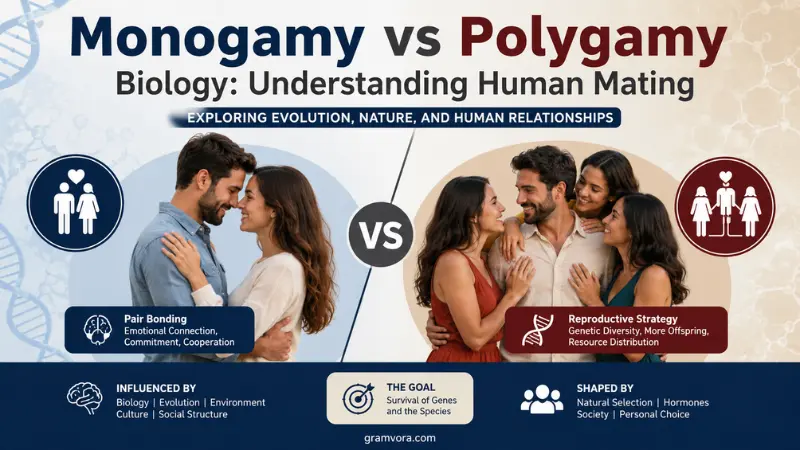
Monogamy and polygamy are both standard terms, but biology uses them in a more specific way than everyday relationship talk sometimes does.
Monogamy generally means having one mate at a time. Polygamy generally means having more than one mate at a time.
For humans, however, biology does not give us a simple answer such as “humans are completely monogamous” or “humans are naturally polygamous.” Human pair-bonding, marriage, sexual behavior, and family life can take different forms.
Quick Answer
In biological usage, monogamy means one mate, while polygamy means multiple mates.
The important point is that human biology is more complicated than this basic definition. Humans can form long-term pair bonds, but pair-bonding does not automatically mean lifelong sexual exclusivity.
Likewise, the existence of polygamous relationships does not mean that every person or every society practices polygamy.
So, if you are comparing the two terms in biology, use monogamy for a one-mate system and polygamy for a multiple-mate system.
Why People Confuse Them
The confusion comes partly from the different ways these words are used.
In everyday English, monogamy often refers to marriage or an exclusive romantic relationship. Polygamy commonly refers to marriage involving more than one spouse.
Biologists can use the same words when discussing animals and mating systems. In that setting, the focus is on mating patterns rather than simply on legal marriage.
Human relationships make the distinction even harder because a person can have a long-term social partner without being sexually exclusive throughout the entire relationship.
That is why a biological discussion needs more precision than a simple “one partner versus many partners” explanation.
Key Differences At A Glance
| Feature | Monogamy | Polygamy |
|---|---|---|
| Basic meaning | One mate at a time | More than one mate |
| Common human use | One spouse or exclusive partner | More than one spouse at the same time |
| Biological use | One-mate mating system | Multiple-mate mating system |
| Human application | Can involve long-term pair-bonding | Can involve culturally recognized multiple spouses |
| Does it prove lifelong exclusivity? | No | No |
The key difference is the number of mates involved at a given time.
Human biology adds another layer because social bonds and sexual behavior do not always follow exactly the same pattern.
Meaning and Usage Difference
Monogamy is the one-mate term. In biological discussions, it describes a mating arrangement in which one individual mates with one mate at a time.
Polygamy is the multiple-mate term. In biological usage, it describes mating with more than one individual.
For humans, the word polygamy is also strongly associated with marriage. This creates an important distinction between ordinary social language and biological language.
A biological discussion may ask what mating system is characteristic of a population. A social discussion may ask whether a person has more than one spouse.
Another useful point is that biology recognizes different forms of monogamy. A pair may live together and form a strong social bond without maintaining complete sexual exclusivity.
This means that calling humans “monogamous” does not necessarily mean that every human relationship is lifelong and sexually exclusive.
Tone, Context, and Formality
Both words are neutral, established nouns, but their context matters.
Monogamy is common in conversations about marriage, dating, relationships, psychology, anthropology, and biology.
Polygamy is also used in relationship, marriage, anthropology, and biological discussions. In human contexts, it usually refers to multiple spouses rather than simply having several romantic interests.
For precise biological writing, it is often helpful to specify exactly what is being measured. A researcher may be discussing social pair-bonding, sexual behavior, or reproductive patterns rather than treating all of these as the same thing.
That precision prevents a common mistake: assuming that living as a pair automatically proves complete sexual exclusivity.
Which One Should You Use?
Use monogamy when you mean a one-mate arrangement.
- “The study examined monogamy in human populations.”
- “Monogamy involves one mate at a time in its biological sense.”
Use polygamy when you mean a multiple-mate arrangement.
- “The researchers compared monogamy with polygamy.”
- “Polygamy describes a mating system involving multiple mates.”
When discussing human marriage specifically, be careful not to treat every form of multiple-partner behavior as polygamy. The term has a specific relationship to having multiple spouses.
When One Choice Sounds Wrong
Calling a one-mate system polygamy changes the meaning because polygamy specifically involves multiple mates.
Likewise, calling a multiple-mate system monogamy creates the opposite problem.
Another mistake is using monogamy to mean “one partner for life” in every biological discussion. The term can describe one mate at a time without requiring that the same mate remain the partner for an entire lifetime.
For example, someone may experience more than one exclusive relationship during life. That pattern can still be described as serial monogamy.
Common Mistakes (and Quick Fixes)
Mistake: “Polygamy means having several romantic partners.”
Better: “Polygamy traditionally refers to having more than one spouse at the same time, while biological usage can refer more broadly to multiple mates.”
Mistake: “Monogamy always means one partner for life.”
Better: “Monogamy can mean one mate at a time, including arrangements that do not last for life.”
Mistake: “Humans are either biologically monogamous or biologically polygamous.”
Better: “Human mating patterns show variation, and researchers debate how best to characterize our species.”
Mistake: Treating social pair-bonding as proof of complete sexual exclusivity.
Better: Separate the social relationship from the sexual or reproductive pattern being discussed.
Everyday Examples
Here are practical examples of how the terms work:
- “Their marriage is monogamous because they have one spouse at a time.”
- “The researcher studied whether a population showed predominantly monogamous or polygamous mating patterns.”
- “A long-term pair bond does not necessarily prove complete sexual monogamy.”
- “The anthropologist compared different human societies with different marriage systems.”
- “The biological discussion focused on mating patterns rather than legal definitions of marriage.”
These examples show why context matters. The words themselves are straightforward; the difficult part is deciding exactly which aspect of human relationships is being described.
Dictionary-Style Word Details
Verb
Monogamy: Not commonly used as a verb in standard US English. The related adjective is monogamous, as in “They have a monogamous relationship.”
Polygamy: Not commonly used as a verb in standard US English. The related adjective is polygamous, as in “The society has a polygamous marriage system.”
Neither monogamy nor polygamy should normally be used as an action verb.
Noun
Monogamy: A noun referring to the condition or practice of having one spouse or mate at a time.
Polygamy: A noun referring to the condition or practice of having more than one spouse or, in biological usage, more than one mate.
Both are generally treated as uncountable nouns when describing the general practice or condition.
Synonyms
Monogamy: There is no perfect everyday synonym. “One-mate mating” can serve as a plain biological description, but it is not a full replacement in every context.
Polygamy: “Multiple-mate mating” can be a plain biological description, but it is not an exact replacement in every human-marriage context.
The closest alternatives depend on whether the discussion concerns marriage, sexual behavior, or biological mating systems.
Example Sentences
Monogamy:
- “The article examines monogamy in human populations.”
- “They chose monogamy for their relationship.”
Polygamy:
- “The study compared polygamy with monogamous marriage.”
- “Polygamy can describe a marriage system involving more than one spouse.”
Word History
Monogamy comes through Latin and Greek roots associated with being married to one person.
Polygamy also comes through Latin and Greek, with roots referring to having many marriages.
The shared -gamy element relates to marriage, while the prefixes distinguish one from many.
Phrases Containing
Monogamy:
- social monogamy
- serial monogamy
- monogamous relationship
- monogamous marriage
Polygamy:
- polygamous marriage
- polygamous relationship
- polygamous mating
- practice of polygamy
In biological writing, these phrases can be more precise than using either word alone.
FAQs
1. What is the biological difference between monogamy and polygamy?
Monogamy generally refers to a mating system involving one mate at a time, while polygamy refers to a mating system involving multiple mates. In humans, the terms can have more specific meanings depending on whether the discussion concerns marriage, sexual behavior, or reproduction.
2. Are humans biologically monogamous or polygamous?
Human biology does not fit neatly into only one category. Humans form strong pair bonds, but human mating and relationship patterns also show considerable variation across individuals and societies.
3. Is monogamy natural for humans?
Humans have biological and social traits associated with pair-bonding, but that does not establish that every human is naturally or exclusively monogamous. Human mating behavior is complex and variable.
4. Does biology prove that humans are meant to be monogamous?
No. Biology can provide evidence about human mating behavior and pair-bonding, but it does not establish a single relationship arrangement that every human is biologically required to follow.
5. What does polygamy mean in human biology?
In a broad biological sense, polygamy refers to mating with multiple partners. In everyday discussions about humans, however, polygamy most often refers to having multiple spouses at the same time.
6. What does monogamy mean in biology?
In biology, monogamy generally describes a mating arrangement involving one mate at a time. The term does not necessarily mean that the same pair remains together for life or that sexual exclusivity is absolute.
7. Does monogamy mean one partner for life?
Not necessarily. Monogamy can mean having one partner at a time. A person can have several consecutive monogamous relationships without having multiple partners simultaneously.
8. Is polygamy the opposite of monogamy?
Yes, in the basic sense that monogamy involves one mate while polygamy involves multiple mates. However, human mating systems are more complex than this simple opposition suggests.
9. Why do humans form pair bonds if polygamy also occurs?
Pair-bonding can support cooperation, parental investment, and raising children, but these factors do not eliminate variation in human mating behavior. Human relationships can reflect both biological and social influences.
10. Are monogamy and polygamy biological terms?
Yes. Both terms can be used in biology to describe mating systems. They are also commonly used in discussions of human marriage and relationships.
Conclusion
The basic distinction is simple: monogamy refers to one mate at a time, while polygamy refers to multiple mates.
The biology of human relationships, however, cannot be reduced to those two labels. Humans form pair bonds, marry in different ways, and show variation in sexual and reproductive behavior.
For clear writing, use monogamy for a one-mate system and polygamy for a multiple-mate system. When discussing human biology, also be clear about whether you mean social bonding, sexual exclusivity, marriage, or mating behavior.


