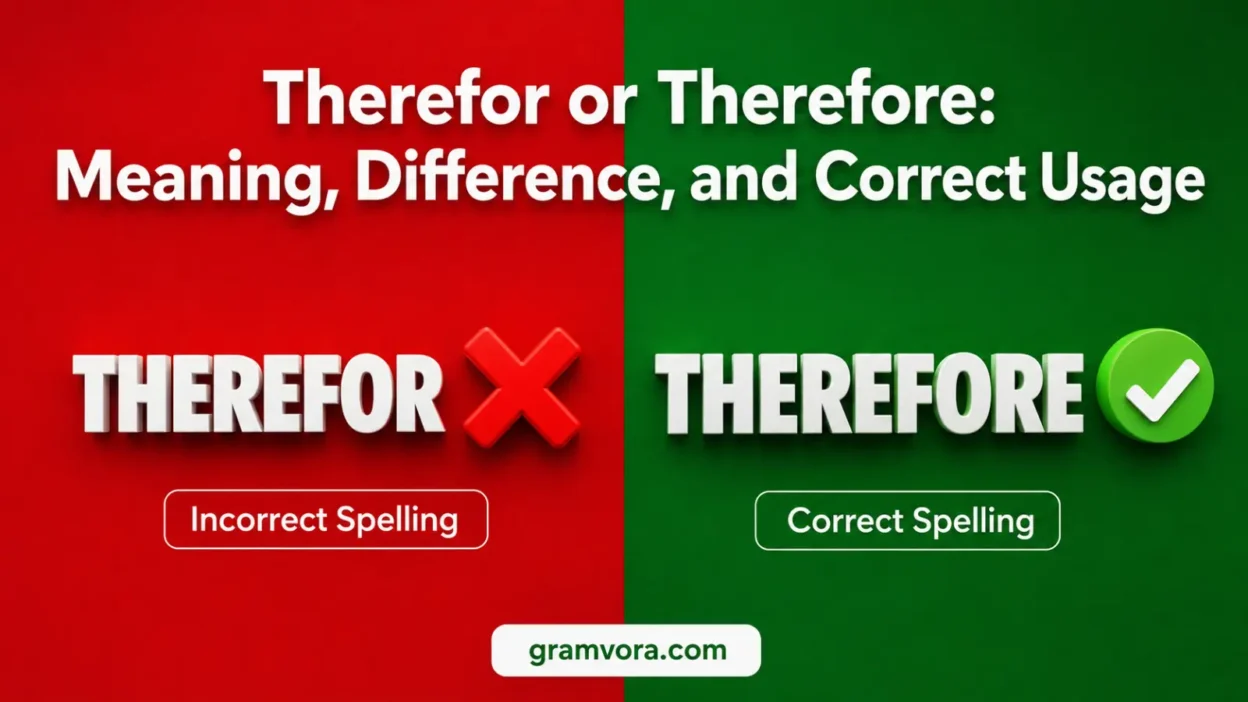
Therefor and therefore are both real English words, but they are not alternate spellings. They have different meanings and perform different jobs in a sentence.
Therefore is the word most readers need. It introduces a result, consequence, or logical conclusion. Therefor means “for that” or “for it” and now appears mainly in legal or highly formal writing.
Quick Answer
Use therefore when you mean “for that reason,” “as a result,” or “consequently.”
Use therefor when you literally mean “for that,” “for it,” or “in return for that,” usually in a legal or contract-style sentence.
The roads were icy; therefore, school opened late.
The buyer accepted the equipment and issued payment therefor.
In ordinary US English, therefore is almost always the natural choice.
Why People Confuse Them
The words differ by only one final letter. They also contain the same familiar parts, there and for, so therefor can look like a shortened spelling of therefore.
Their pronunciation adds to the confusion. Therefore is normally stressed at the beginning: THERE-fore. Therefor is normally stressed at the end: there-FOR. In fast speech, that difference may be hard to notice.
Frequency also matters. People see therefore often in reports, essays, news, and workplace writing. They may encounter therefor only in a contract, court filing, or older document. As a result, some writers assume the shorter word must be an error.
Key Differences At A Glance
| Context | Best Choice | Why |
|---|---|---|
| Showing a result or consequence | therefore | It means “for that reason” or “as a result.” |
| Drawing a logical conclusion | therefore | It connects evidence with a conclusion. |
| Writing a normal email, essay, or report | therefore | It is standard and widely understood. |
| Referring to payment for something already named | therefor | It can mean “for it” or “in return for that.” |
| Drafting traditional legal or contract language | therefor, when intended | It may point back to a specific item, duty, or payment. |
| Rewriting for plain language | for that or for it | These phrases are usually clearer than therefor. |
| Feature | therefor | therefore |
| Core meaning | for that; for it; in return for that | for that reason; as a result |
| Grammar | adverb | adverb, often used as a conjunctive adverb |
| Usual tone | legal, formal, or old-fashioned | neutral to formal |
| Main function | refers back to a thing already mentioned | introduces a result or conclusion |
| Typical position | often near the end of a clause | beginning or middle of a clause |
Meaning and Usage Difference
Therefore shows that one fact, action, or condition leads to another.
The store was closed; therefore, we came back the next day.
Here, the second action happened because the store was closed. Therefore connects the reason with its result.
Therefor points back to a thing or matter already mentioned. It does not introduce a conclusion.
The contractor completed the repairs and received payment therefor.
Here, therefor means “for the repairs” or “for them.” The payment is connected to the repairs as an exchange, not as a logical conclusion.
Both words are adverbs, but only therefore commonly works as a conjunctive adverb. It can link the meaning of two independent clauses. Therefor does not serve that connecting role.
Punctuation depends on the sentence structure. When therefore joins two independent clauses, the standard pattern is a semicolon before it and a comma after it:
The application was incomplete; therefore, the office returned it.
When therefore begins a new sentence, place a comma after it:
The application was incomplete. Therefore, the office returned it.
When it appears inside a compound predicate, a comma is usually unnecessary:
The application was incomplete and therefore returned.
Therefor does not require special punctuation. It follows the normal punctuation of the sentence.
Tone, Context, and Formality
Therefore fits school papers, professional reports, explanations, formal emails, and careful everyday writing. It can sound more formal than so, but it is not limited to academic or legal contexts.
In casual conversation, many speakers prefer so:
The bus was late, so I missed the meeting.
In a report, therefore may sound more precise:
The bus arrived late; therefore, the employee missed the meeting.
Therefor has a much narrower range. It often sounds stiff or dated outside contracts, statutes, court documents, and other formal records. A sentence such as “I returned the shoes and got a refund therefor” is grammatical, but most US readers would find “got a refund for them” more natural.
Legal writing does not automatically require therefor. Even in formal documents, a plain phrase may be clearer when it avoids uncertainty.
Which One Should You Use?
First, replace the word with a short test phrase.
When “as a result” fits, use therefore:
The deadline passed; as a result, the offer expired.
The deadline passed; therefore, the offer expired.
When “for it” or “for that” fits, therefor may be grammatically possible:
The seller transferred the property and received payment for it.
The seller transferred the property and received payment therefor.
Then consider the audience. For general readers, use the plain phrase instead of therefor unless the formal wording serves a clear purpose. Therefore needs no such warning because it remains normal in modern US writing.
When One Choice Sounds Wrong
Therefor sounds wrong when the sentence needs a result connector.
Incorrect: The roads flooded; therefor, the game was canceled.
Correct: The roads flooded; therefore, the game was canceled.
The cancellation resulted from the flooding, so therefore is required.
Therefore sounds wrong when the sentence means “for the thing just mentioned.”
Incorrect: The agreement listed the service and the fee therefore.
Correct but formal: The agreement listed the service and the fee therefor.
Clearer: The agreement listed the service and its fee.
The fee is for the service. It is not a conclusion caused by the service.
Therefor may also sound unnatural even when its meaning is technically correct. In ordinary writing, “for it,” “for that,” “for them,” or a repeated noun often reads better.
Common Mistakes (and Quick Fixes)
Mistake: Treating therefor as a misspelling in every case.
Quick fix: Check the meaning. It is a real adverb, but its use is specialized.
Mistake: Using therefor to mean “consequently.”
Quick fix: Substitute “as a result.” When that phrase works, choose therefore.
Mistake: Joining two full sentences with only a comma.
Incorrect: The office was closed, therefore we left.
Quick fix: Use a semicolon, a period, or a coordinating conjunction.
Correct: The office was closed; therefore, we left.
Mistake: Adding commas around every use of therefore.
Quick fix: Look at its job in the sentence. No comma is usually needed in “The item was damaged and therefore discounted.”
Mistake: Forcing therefor into everyday prose.
Quick fix: Replace it with a clearer phrase: “The customer received compensation for the delay.”
Everyday Examples
School: Jordan missed two labs; therefore, he had to complete a make-up assignment.
Work: The client changed the deadline. Therefore, the team revised its schedule.
Travel: Our flight was canceled, and we were therefore moved to a morning departure.
Shopping: The laptop arrived damaged; therefore, the store approved a return.
Contract-style wording: The supplier delivered the materials and submitted an invoice therefor.
Plain rewrite: The supplier delivered the materials and submitted an invoice for them.
Legal-style wording: The tenant reported the damage and requested compensation therefor.
Plain rewrite: The tenant reported the damage and requested compensation for it.
Dictionary-Style Word Details
Verb
Therefor: Not used as a verb in standard US English. It functions as an adverb.
Therefore: Not used as a verb in standard US English. It functions as an adverb.
Noun
Therefor: Not commonly used as a noun in modern standard US English.
Therefore: Treat it as an adverb in current ordinary writing. Rare historical or specialized noun uses do not affect the normal therefor or therefore choice.
Synonyms
Therefor: Exact one-word synonyms are limited. Closest plain alternatives include “for that,” “for it,” “for them,” and “in return for that.”
Therefore: Meaning-matched alternatives include “consequently,” “thus,” “hence,” “accordingly,” “as a result,” and, in a more conversational tone, “so.”
Neither word has one simple antonym that works in every sentence.
Example Sentences
Therefor: The board approved the project and set aside funds therefor.
Therefor: The buyer received the goods and paid the agreed price therefor.
Therefore: The board rejected the first proposal; therefore, the staff prepared a new one.
Therefore: The package was mislabeled and therefore sent to the wrong address.
Word History
Both words are old compounds formed from there and for, and both have been recorded since Middle English. Modern usage has separated their functions clearly.
Therefore developed as the common word for a consequence or conclusion. Therefor kept the more literal meaning “for that” and became concentrated in formal and legal phrasing.
Phrases Containing
Therefor: “payment therefor,” “compensation therefor,” “funds therefor,” and “reasons therefor.” These patterns mean payment, compensation, funds, or reasons for the thing already mentioned.
Therefore: “and therefore,” “therefore, we,” “therefore necessary,” and “therefore unable.” These patterns introduce or mark a result.
FAQs
Is therefor a real word?
Yes, therefor is a real English word. It means “for that,” “for it,” or “in return for that.” However, it is uncommon in everyday US English and appears mainly in legal, contractual, or highly formal writing.
What is the difference between therefor and therefore?
Therefor refers to something already mentioned and means “for that” or “for it.” Therefore introduces a result or conclusion and means “for that reason” or “as a result.”
Which is correct: therefor or therefore?
Both words are correct, but they are used differently. Use therefore when showing a consequence or conclusion. Use therefor when referring to payment, compensation, funds, or another thing provided for something previously mentioned.
Can I use therefor instead of therefore?
No. The two words are not interchangeable. Therefore connects a reason with a result, while therefor points back to a specific thing. Using one in place of the other can change the sentence’s meaning.
How do you use therefore in a sentence?
Use therefore to introduce a result or logical conclusion. For example: “The roads were icy; therefore, the school opened late.” It can also appear without commas in a phrase such as “The item was damaged and therefore discounted.”
How do you use therefor in a sentence?
You might write: “The contractor completed the repairs and received payment therefor.” In this sentence, therefor means “for the repairs.” In everyday writing, “received payment for them” would usually sound clearer.
Does therefore need a comma?
A comma often follows therefore when it begins a sentence or follows a semicolon: “The office was closed; therefore, we left.” A comma is usually unnecessary when it appears within a compound predicate: “The form was incomplete and therefore rejected.”
Is therefor commonly used in American English?
No. Therefor is rare in modern everyday American English. It is still found in contracts, laws, court documents, and other formal writing. Most general readers will find “for it” or “for that” easier to understand.
Conclusion
The difference between therefor and therefore is meaning, not optional spelling.
Use therefore for a result, consequence, or conclusion. Use therefor only when it means “for that,” “for it,” or “in return for that,” usually in formal or legal wording.
For most modern US writing, therefore is the correct and natural choice. When therefor is technically possible, a plain phrase often communicates the idea more clearly.